 Back
BackChapter 1: Chemistry in Our Lives – Foundations for GOB Chemistry
Study Guide - Smart Notes
 Tailored notes based on your materials, expanded with key definitions, examples, and context.
Chapter 1: Chemistry in Our Lives
Introduction to Chemistry
Chemistry is the study of the composition, structure, properties, and reactions of matter. It is a central science that connects physical sciences with life sciences and is essential for understanding the world around us, including biological and environmental processes.
Matter refers to all substances that make up our world, including solids, liquids, and gases.
Chemicals are substances with a definite composition and properties, found both in nature and as products made by chemists.
Examples: Water, oxygen, carbon dioxide, and even products like toothpaste are all matter and contain chemicals.
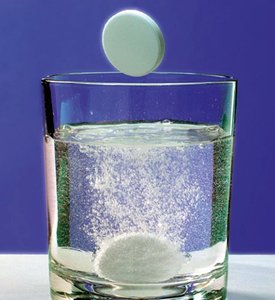
Everyday Chemistry Applications
Forensic scientists use chemistry to analyze bodily fluids and tissue samples in crime laboratories.
Hemoglobin, a chemical in blood, transports oxygen and carbon dioxide in the body.
Toothpaste contains several chemicals, each with a specific function (see table below).
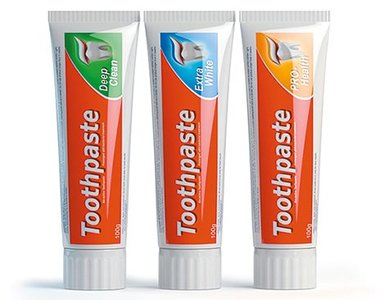
Chemicals Commonly Used in Toothpaste
Chemical | Function |
|---|---|
Calcium carbonate | Abrasive to remove plaque |
Sorbitol | Prevents loss of water and hardening |
Sodium lauryl sulfate | Loosens plaque |
Titanium dioxide | Makes toothpaste white and opaque |
Sodium fluorophosphate | Strengthens tooth enamel, prevents cavities |
Methyl salicylate | Provides wintergreen flavor |
Scientific Method
Thinking Like a Scientist
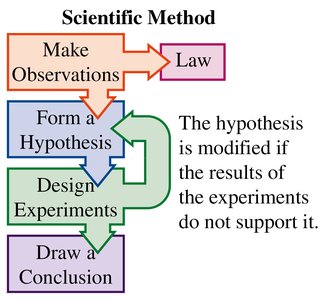
The scientific method is a systematic approach used by scientists to explore observations, develop hypotheses, and test them through experiments. This process leads to conclusions and the development of theories or laws.
Observation: Gathering information about nature.
Hypothesis: A possible explanation for an observation.
Experiment: Testing the hypothesis through controlled investigation.
Conclusion/Theory: Analyzing results to determine if the hypothesis is supported.
Example: Everyday Scientific Thinking
Observation: Sneezing and itchy eyes after visiting a friend with a cat.
Hypothesis: You may be allergic to cats.
Experiment: Symptoms disappear after leaving; reappear when visiting another friend with a cat.
Conclusion: Supported hypothesis – you are allergic to cats.

Studying and Learning Chemistry
Effective Study Strategies
Success in chemistry requires active learning and effective study habits. Connecting new information to prior knowledge, self-testing, and regular review are essential.
Ask yourself questions as you read.
Self-test with practice problems.
Study regularly, not just before exams.
Relate new concepts to what you already know.
Work in study groups for collaborative learning.

Textbook Features for Learning
Looking Ahead: Outlines chapter topics.
Key Math Skills: Reviews essential math concepts.
Core Chemistry Skills: Highlights important chemistry skills.
Engage Questions: Prompts self-testing during reading.
Practice Problems: Immediate application of new ideas.
End-of-Chapter Summaries: Concept maps, reviews, and key terms.


Making a Study Plan
Read the chapter before class.
Attend lectures and review learning goals.
Keep a problem notebook and work through sample problems.
Organize or join a study group.
See your professor during office hours for clarification.
Review key math and chemistry skills regularly.
Key Math Skills for Chemistry
Identifying Place Values
Understanding place values is essential for interpreting measurements and performing calculations in chemistry.
Each digit in a number has a specific place value (e.g., tens, ones, tenths, hundredths).
Example: In 15.24 g, 1 = tens, 5 = ones, 2 = tenths, 4 = hundredths.
Using Positive and Negative Numbers
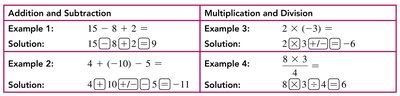
Calculations in chemistry often involve both positive and negative numbers. The rules for arithmetic operations are:
Multiplication/Division: Same signs yield positive results; different signs yield negative results.
Addition: Add values; the sign follows the larger absolute value.
Subtraction: Change the sign of the number being subtracted and add.
Calculating Percentages
Percentages are used to express the proportion of a part relative to the whole. The formula is:
Example: If a bullet contains 13.9 g lead, 0.3 g tin, and 0.9 g antimony (total 15.1 g):
Lead:
Tin:
Antimony:
Solving Equations
Solving equations is a fundamental skill in chemistry for manipulating formulas and solving for unknowns.
Isolate the variable of interest by performing algebraic operations on both sides of the equation.
Example: Solve for :
Interpreting Graphs
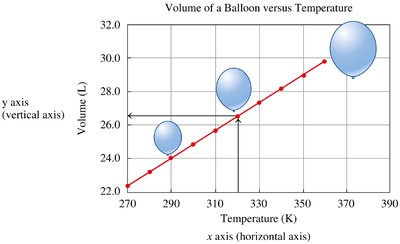
Graphs visually represent relationships between variables. Understanding axes, labels, and trends is crucial for data interpretation.
The x-axis (horizontal) typically represents the independent variable.
The y-axis (vertical) represents the dependent variable.
Example: The volume of a balloon increases as temperature increases (direct relationship).
Writing Numbers in Scientific Notation
Scientific Notation
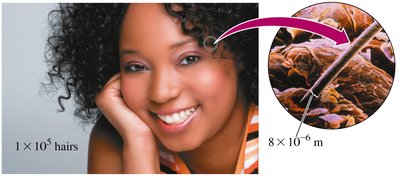
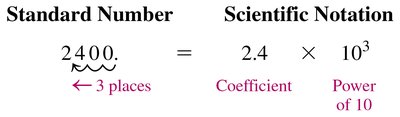
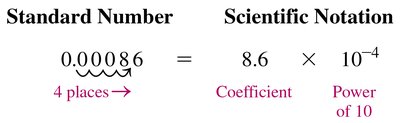
Scientific notation is used to express very large or very small numbers in a compact form. It consists of a coefficient (between 1 and 10) multiplied by a power of 10.
Example: 0.000008 m = m
Example: 64,000 =

Converting Numbers to Scientific Notation
Move the decimal point to create a coefficient between 1 and 10.
Count the number of places moved; this becomes the exponent of 10.
If the decimal is moved to the left, the exponent is positive; if to the right, negative.
Powers of 10 Table
Standard Number | Scientific Notation |
|---|---|
10,000 | |
1,000 | |
100 | |
10 | |
1 | |
0.1 | |
0.01 | |
0.001 | |
0.0001 |
Scientific Notation and Calculators
Many calculators use the EE or EXP key to enter numbers in scientific notation.
Calculator displays may show numbers as 7.52E04 for .

Concept Map: Chemistry in Our Lives
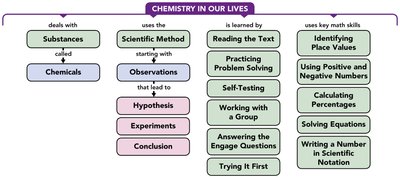
Additional info: This chapter provides foundational concepts and skills essential for success in General, Organic, and Biological Chemistry, including the scientific method, study strategies, and key mathematical operations.
