Back
Chapter 1: Chemistry in Our Lives – Study Notes
Study Guide - Smart Notes
 Tailored notes based on your materials, expanded with key definitions, examples, and context.
Chemistry in Our Lives
Introduction to Chemistry
Chemistry is the scientific study of the composition, structure, properties, and reactions of matter. It is a central science that explains the substances and changes we observe in the world around us. Chemistry is involved in everything from the air we breathe to the medicines we take and the food we eat.
Composition: What substances are made of (elements, compounds, mixtures).
Structure: How atoms and molecules are arranged in a substance.
Properties: The characteristics and behaviors of substances (e.g., melting point, density, reactivity).
Reactions: How substances interact and change into new substances.
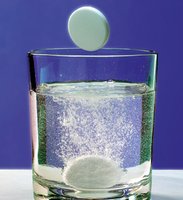
Example: An antacid tablet reacts with water, producing bubbles as a result of a chemical reaction.
Matter and Chemicals
Matter refers to anything that has mass and occupies space. Everything around us, including ourselves, is made of matter. Chemicals are substances with a definite composition and properties, whether they are naturally occurring or synthesized by chemists.
Examples of matter: water, air, antacid tablets, oxygen, carbon dioxide, and living organisms.
Examples of chemicals: toothpaste (a mixture of chemicals), table salt (sodium chloride), and sugar (sucrose).
Learning Check: Which of the following contain chemicals? Answer: Fruit, milk, and breakfast cereal all contain chemicals. Sunlight is not matter and does not contain chemicals.
The Scientific Method
Thinking Like a Scientist
The scientific method is a systematic approach used by scientists to explore observations, answer questions, and solve problems. It involves making observations, forming hypotheses, conducting experiments, and drawing conclusions.

Steps of the Scientific Method
Observation: Gathering information about the world using the senses or instruments.
Hypothesis: Proposing a possible explanation for the observation.
Experiment: Testing the hypothesis through controlled investigation.
Conclusion (Theory): Analyzing results to determine if the hypothesis is supported or needs to be revised.
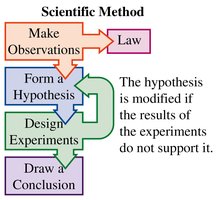
Example: If you sneeze and itch after visiting a friend with a cat, you might hypothesize you are allergic to cats. Testing this by visiting other friends with cats and observing the same reaction supports your hypothesis.

Application of the Scientific Method
Observation: You ran for 25 minutes on a treadmill (recorded by your trainer).
Hypothesis: Your doctor thinks your weight loss is due to increased exercise.
Experiment: Testing the effect of exercise on weight loss.
Conclusion: Scientific studies show that exercising lowers blood pressure.
Scientific Notation
Writing Numbers in Scientific Notation
Scientific notation is a method for expressing very large or very small numbers in a compact form. It is commonly used in chemistry to handle measurements that vary greatly in magnitude.
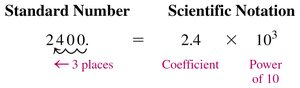
A number in scientific notation is written as: where a is the coefficient (at least 1 but less than 10) and n is an integer (the power of 10).
To convert a standard number to scientific notation, move the decimal point to create a coefficient between 1 and 10, and count the number of places moved to determine the exponent.
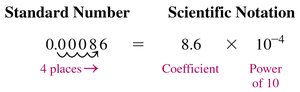
Example: The width of a human hair is m; the number of hairs on a human scalp is .

Using Scientific Notation with Calculators
Many scientific calculators use the EE or EXP key to enter numbers in scientific notation. The display typically shows a number between 1 and 10, followed by the exponent.



Practice: Writing Numbers in Scientific Notation
64,000 =
0.021 =
Concept Map: Chemistry in Our Lives
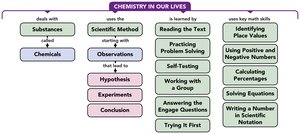
The concept map below summarizes the main ideas of this chapter, including the role of chemicals, the scientific method, and key math skills used in chemistry.