 Back
Chapter 1: Chemistry in Our Lives – Matter, Measurement, and Mathematical Operations
Study Guide - Smart Notes
 Tailored notes based on your materials, expanded with key definitions, examples, and context.
Chemistry: An Introduction
What Is Chemistry?
Chemistry is the scientific study of matter, focusing on its composition, structure, properties, and the reactions it undergoes. Understanding chemistry is essential for interpreting the physical world and the changes substances experience.
Composition: What substances are made of (elements, compounds).
Structure: How atoms and molecules are arranged.
Properties: Characteristics such as color, density, melting point, and reactivity.
Reactions: How substances interact and transform into new substances.
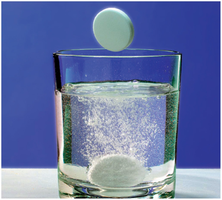
Example: An antacid tablet reacts with water, producing bubbles as a result of a chemical reaction.
The Scientific Method
Thinking Like a Scientist
The scientific method is a systematic approach used by scientists to investigate phenomena, acquire new knowledge, or correct and integrate previous knowledge. It involves making observations, forming hypotheses, conducting experiments, and drawing conclusions.
Observation: Gathering information about the natural world.
Hypothesis: A proposed explanation based on observations.
Experiment: Testing the hypothesis through controlled procedures.
Conclusion: Analyzing results to confirm or refute the hypothesis.
Law/Theory: If repeated experiments support the hypothesis, it may become a scientific law or theory.
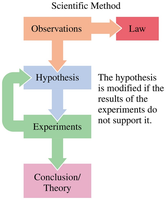
Additional info: The scientific method is iterative; hypotheses may be revised based on experimental results.
Key Math Skills for Chemistry
Place Values
Understanding place values is fundamental for accurate measurement and calculation in chemistry. Each digit in a number represents a specific value depending on its position relative to the decimal point.
Whole numbers: Each digit has a place value (ones, tens, hundreds, etc.).
Decimals: Digits to the right of the decimal point represent tenths, hundredths, thousandths, etc.
Example: In 15.24 grams, 1 is in the tens place, 5 in the ones, 2 in the tenths, and 4 in the hundredths.

Positive and Negative Numbers in Calculations
Positive and negative numbers are used in chemistry to represent quantities such as temperature changes, energy, and charge. Understanding their arithmetic rules is essential for accurate calculations.
Positive numbers: Greater than zero, often written without a sign.
Negative numbers: Less than zero, written with a minus sign.
Multiplication/Division: Same signs yield positive results; different signs yield negative results.
Addition: Add numbers with the same sign; subtract the smaller from the larger when signs differ, and keep the sign of the larger number.
Subtraction: Change the sign of the number being subtracted and add.
Example: 12 + (−15) = −3

Calculating Percentages
Percentages are used in chemistry to express concentrations, yields, and composition. The percentage is calculated by dividing the part by the whole and multiplying by 100%.
Formula:
Example: An aspirin tablet contains 325 mg of aspirin in a total mass of 545 mg. The percentage of aspirin is .

Interpreting Graphs
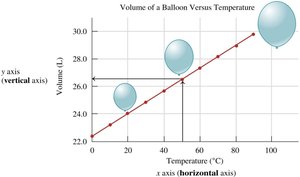
Graphs are visual tools for representing relationships between variables in chemistry, such as temperature and volume. Understanding axes, data points, and trends is crucial for interpreting experimental results.
Axes: The vertical (y) axis typically represents the dependent variable; the horizontal (x) axis represents the independent variable.
Direct relationship: As one variable increases, the other also increases.
Example: The volume of a balloon increases as temperature rises, showing a direct relationship.
Scientific Notation
Writing Numbers in Scientific Notation
Scientific notation is used to express very large or very small numbers in a compact form, which is essential for handling measurements in chemistry.
Format: , where is the coefficient (1 ≤ $a$ < 10) and is the exponent.
Example: The width of a human hair is 0.000008 meters, written as meters.
Example: The number of hairs on a human scalp is 100,000, written as hairs.

Steps for Writing Scientific Notation
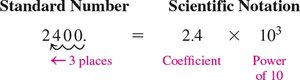
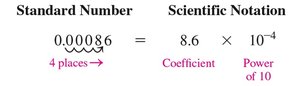
To convert a standard number to scientific notation, move the decimal point to create a coefficient between 1 and 10, and count the number of places moved to determine the exponent.
Step 1: Move the decimal point to obtain a coefficient between 1 and 10.
Step 2: Express the number of places moved as a power of 10.
Step 3: Write the product of the coefficient and the power of 10.
Example: 64,000 becomes ; 0.021 becomes .
Using Scientific Notation on Calculators
Scientific calculators allow entry and display of numbers in scientific notation using keys such as EE or EXP. Understanding calculator notation is important for accurate computation.
Entry: Use EE or EXP followed by the exponent.
Display: Numbers are shown as a coefficient followed by E and the exponent.
Example: 4 × 10⁶ is entered as 4 EE 6; 2.5 × 10⁻⁴ as 2.5 EE −4.


Additional info: Scientific notation is essential for expressing measurements in chemistry, such as Avogadro's number or atomic masses.
