 Back
Chapter 1: Chemistry in Our Lives – Structured Study Notes
Study Guide - Smart Notes
 Tailored notes based on your materials, expanded with key definitions, examples, and context.
Chemistry: The Study of Change
Introduction to Chemistry
Chemistry is the science that explores matter and the changes it undergoes. It is fundamental to understanding the world around us, from the composition of everyday materials to the processes that sustain life. Chemistry impacts various fields, including health, energy, technology, and agriculture.
Matter: Anything that occupies space and has mass.
Substance: A form of matter with a definite composition and distinct properties.
Chemistry in the 21st Century
Chemistry plays a crucial role in modern advancements and societal challenges:
Health and Medicine: Sanitation systems, surgery with anesthesia, vaccines, antibiotics, and gene therapy.
Energy and Environment: Fossil fuels, solar energy, nuclear energy.
Materials and Technology: Polymers, ceramics, liquid crystals, superconductors, molecular computing.
Food and Agriculture: Genetically modified crops, natural pesticides, specialized fertilizers.
The Scientific Method
Steps of the Scientific Method
The scientific method is a systematic approach to research, used to investigate phenomena, acquire new knowledge, or correct and integrate previous knowledge.
Hypothesis: A tentative explanation for a set of observations.
Qualitative Observations: General observations about the system.
Quantitative Observations: Numerical measurements of the system.
Law: A concise statement describing a consistent relationship between phenomena.
Theory: A unifying principle that explains a body of facts and laws.

Defining Chemistry and Matter
Key Definitions
Chemistry is the study of matter and the changes it undergoes. Matter is anything that occupies space and has mass. Substances are forms of matter with definite composition and distinct properties.
Mass: Measure of the quantity of matter; SI unit is kilogram (kg).
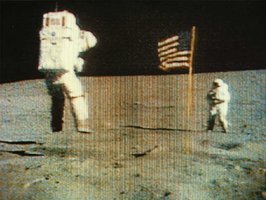
Weight: Force that gravity exerts on an object; varies with location.
Extensive vs. Intensive Properties
Properties of matter are classified as extensive or intensive:
Extensive Properties: Depend on the amount of matter (e.g., mass, length, volume).
Intensive Properties: Do not depend on the amount of matter (e.g., density, temperature, color).

States of Matter
Three Common States
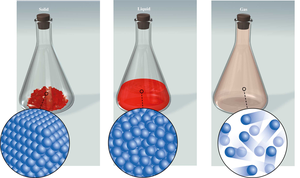
Matter exists in three common states: solid, liquid, and gas. Each state has distinct characteristics regarding shape, volume, and particle arrangement.
Solid: Definite shape and volume; particles are closely packed.
Liquid: Definite volume but no definite shape; particles are less tightly packed.
Gas: Neither definite shape nor volume; particles are far apart and move freely.
Effect of Boiling Water on Ice
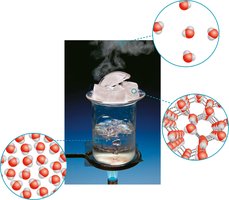
Boiling water can cause a block of ice to melt, demonstrating a physical change from solid to liquid.
Types of Changes
Physical vs. Chemical Changes
Changes in matter are classified as physical or chemical:
Physical Change: Does not alter the composition or identity of a substance (e.g., ice melting).
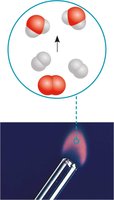
Chemical Change: Alters the composition or identity of the substance(s) involved (e.g., hydrogen burning in air to form water).
Classification of Matter
Mixtures and Substances
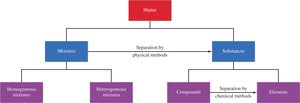
Matter can be classified as mixtures or pure substances. Mixtures can be separated by physical means, while pure substances can only be separated by chemical means.
Mixture: Combination of two or more substances retaining their distinct identities.
Homogeneous Mixture: Uniform composition throughout.
Heterogeneous Mixture: Non-uniform composition.
Separation of Mixtures
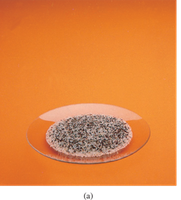
Physical means such as filtration, distillation, or magnetism can separate mixtures into their pure components.
 fo
Elements and Compounds
Elements
An element is a substance that cannot be separated into simpler substances by chemical means. There are 118 known elements, with 82 occurring naturally and 36 created by scientists.
Compounds
A compound is a substance composed of atoms of two or more elements chemically united in fixed proportions. Compounds can only be separated into their pure components by chemical means.
Measurement in Chemistry
International System of Units (SI)
The SI system is used for scientific measurements. Key base units include meter (length), kilogram (mass), second (time), ampere (electric current), kelvin (temperature), mole (amount of substance), and candela (luminous intensity).
Prefixes Used with SI Units
Prefixes are used to denote multiples or fractions of SI units.
Prefix | Symbol | Meaning | Example |
|---|---|---|---|
peta- | P | 1,000,000,000,000,000, or | 1 petameter (Pm) = m |
tera- | T | 1,000,000,000,000, or | 1 terameter (Tm) = m |
giga- | G | 1,000,000,000, or | 1 gigameter (Gm) = m |
mega- | M | 1,000,000, or | 1 megameter (Mm) = m |
kilo- | K | 1,000, or | 1 kilometer (km) = m |
deci- | d | 1/10, or | 1 decimeter (dm) = 0.1 m |
centi- | c | 1/100, or | 1 centimeter (cm) = 0.01 m |
milli- | m | 1/1,000, or | 1 millimeter (mm) = 0.001 m |
micro- | μ | 1/1,000,000, or | 1 micrometer (μm) = m |
nano- | n | 1/1,000,000,000, or | 1 nanometer (nm) = m |
pico- | p | 1/1,000,000,000,000, or | 1 picometer (pm) = m |
femto- | f | 1/1,000,000,000,000,000, or | 1 femtometer (fm) = m |
atto- | a | 1/1,000,000,000,000,000,000, or | 1 attometer (am) = m |
Accuracy and Precision
Definitions
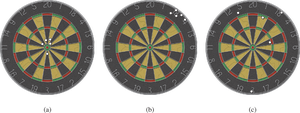
Accuracy refers to how close a measurement is to the true value, while precision refers to how close a set of measurements are to each other.
Scientific Notation and Significant Figures
Scientific Notation
Scientific notation is used to express very large or very small numbers. It is written as , where is a number between 1 and 10, and is an integer.
Significant Figures
Significant figures indicate the precision of a measurement. Rules for determining significant figures include:
All nonzero digits are significant.
Zeros between nonzero digits are significant.
Leading zeros are not significant.
Trailing zeros in a number greater than 1 are significant if to the right of the decimal point.
Trailing zeros in a number less than 1 are significant only if at the end and in the middle of the number.
Dimensional Analysis
Method of Solving Problems
Dimensional analysis is a technique for converting units using conversion factors. Units are carried through calculations, and if all units cancel except for the desired unit, the problem is solved correctly.
Temperature Scales
Comparison of Temperature Scales
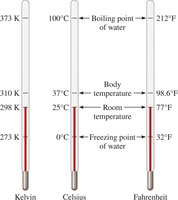
Three common temperature scales are Kelvin, Celsius, and Fahrenheit. The relationships are:
Density and Volume
Definitions and Calculations
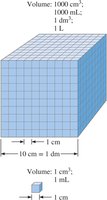
Density is defined as mass per unit volume. The SI unit for density is kg/m3, but g/mL or g/cm3 are commonly used in chemistry.
Formula:
Summary
This chapter introduces the foundational concepts of chemistry, including the scientific method, classification of matter, measurement, and calculations. Understanding these basics is essential for further study in GOB Chemistry.
