 Back
Chapter 1: Matter and Measurements – GOB Chemistry Study Notes
Study Guide - Smart Notes
 Tailored notes based on your materials, expanded with key definitions, examples, and context.
Chapter 1: Matter and Measurements
Chemistry: The Central Science
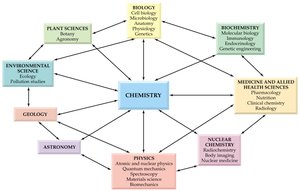
Chemistry is the study of the nature, properties, and transformations of matter. It connects to many scientific and health-related disciplines, making it a central science in understanding the physical world and biological systems.
Matter: Anything that has mass and occupies space.
Applications: Chemistry is foundational to biology, physics, medicine, environmental science, and more.
States of Matter
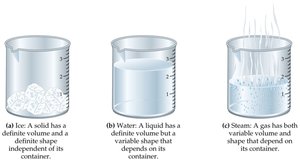
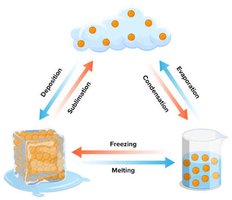
Matter exists in three primary states: solid, liquid, and gas. The state depends on temperature and energy changes.
Solid: Definite shape and volume.
Liquid: Definite volume, variable shape.
Gas: Variable shape and volume.
Physical Change: Changes in state are physical changes; the chemical identity remains the same.
Classification of Matter
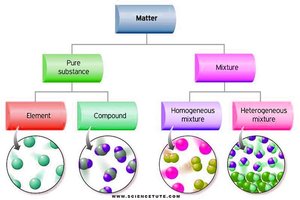
Matter can be classified based on its composition and uniformity. The main categories are pure substances and mixtures.
Pure Substance: Has a constant composition; can be an element or a compound.
Mixture: Contains two or more substances; can be homogeneous (uniform) or heterogeneous (non-uniform).
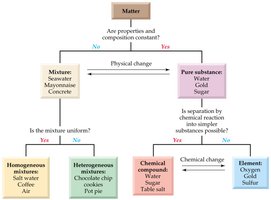
Classification Examples
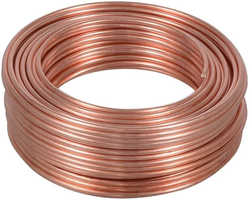
Element: Pure copper wire is an element; it cannot be broken down chemically.
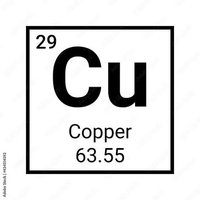
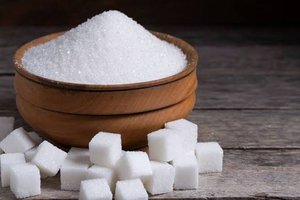
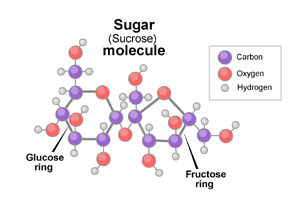
Compound: Pure table sugar (sucrose) is a compound; it can be broken down chemically.
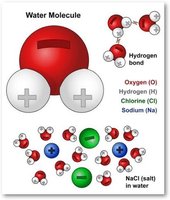
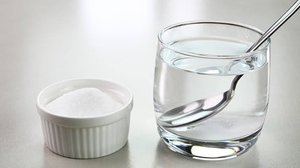
Homogeneous Mixture: Salt completely dissolved in water forms a homogeneous mixture.
Physical vs Chemical Changes
Changes in matter are classified as physical or chemical based on whether the substance's identity changes.
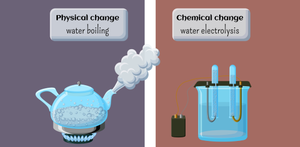
Physical Change: Alters form, size, or state without changing chemical composition (e.g., melting ice, boiling water).
Chemical Change: Produces new substances with different chemical identities (e.g., burning paper, rusting iron).
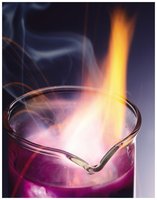
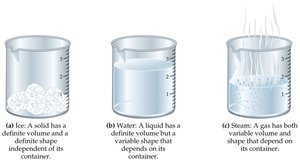
States of Matter (Revisited)
Solids, liquids, and gases differ in their properties and behavior.
Solid: Definite shape and volume.
Liquid: Definite volume, takes shape of container.
Gas: No definite shape or volume.
Chemical Elements and Symbols
Elements are represented by unique symbols, usually one or two letters. These symbols are used in chemical formulas and equations.
Element Symbol: First letter capitalized, second letter lowercase (e.g., C for carbon, Cl for chlorine).
Common Elements: H, C, N, O, Na, Mg, Al, K, Ca, Fe, Cl, Cu, Zn, Ag, Sn, Au.

Elements of Life and Composition
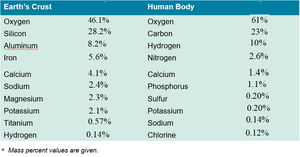
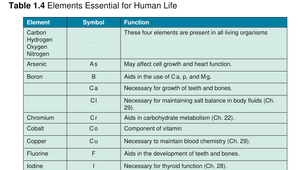
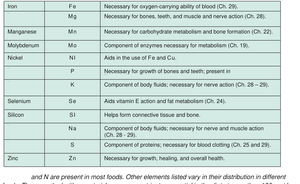
Elements are distributed differently in the Earth's crust and the human body. Some are essential for life.
Earth's Crust | Human Body |
|---|---|
Oxygen 46.1% | Oxygen 61% |
Silicon 28.2% | Carbon 23% |
Aluminum 8.2% | Hydrogen 10% |
Iron 5.6% | Nitrogen 2.6% |
Calcium 4.1% | Calcium 1.4% |
Sodium 2.1% | Phosphorus 1.1% |
Magnesium 2.3% | Sulfur 0.20% |
Potassium 2.1% | Potassium 0.20% |
Titanium 0.57% | Sodium 0.14% |
Hydrogen 0.14% | Chlorine 0.12% |
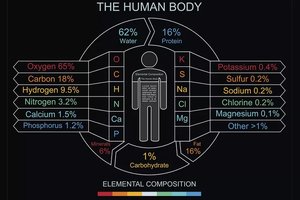
Essential Elements in the Human Body
Some elements are required for life, either as macronutrients (needed in larger amounts) or micronutrients (needed in smaller amounts).
Macronutrients: C, H, O, N
Micronutrients: Fe, I, Ca, Na, K, etc.
Chemical Formulas and Subscripts
Chemical formulas use element symbols and subscripts to indicate the types and numbers of atoms in a compound.
Subscript: Indicates the number of atoms of the element immediately before it.
Example: H2O has 2 hydrogen atoms and 1 oxygen atom.
Counting Atoms in Formulas
H2SO4: 2 H, 1 S, 4 O (7 atoms total)
C6H12O6: 6 C, 12 H, 6 O (24 atoms total)
Ca3N2: 3 Ca, 2 N (5 atoms total)
Chemical Reactions and Equations
Chemical reactions transform reactants into products, often producing new substances with different properties.
Reactant: Starting substance
Product: Substance formed
Equation: Reactants → Products
Example Reaction
Decomposition of Water:
Scientific Notation
Scientific notation is used to express very large or very small numbers efficiently, making calculations easier and clarifying significant figures.
Format: Coefficient × 10Exponent
Example: 6.02 × 10²³
Conversion: Move the decimal point to create a coefficient between 1 and 10; exponent shows the number of places moved.
Measurements and Dimensional Analysis
Measurements require both a number and a unit. Dimensional analysis uses conversion factors to change units and solve problems.
Mass: kg, g, mg, µg
Length: km, m, cm, mm
Volume: L, mL, µL, cm3
Metric Prefixes: kilo (k), milli (m), micro (µ)
Unit Conversion Example
Convert 2.35 L to mL:
Significant Figures
Significant figures reflect the precision of a measurement. The rules for counting significant figures depend on the presence of zeros and decimal points.
Nonzero digits and interior zeros: Always count.
Leading zeros: Do not count.
Trailing zeros: Count if after a decimal point.
Exact numbers: Have unlimited significant figures.
Examples
94.072 g: 5 significant figures
0.0834 cm: 3 significant figures
138.200 m: 6 significant figures
23,000 kg: Ambiguous; use scientific notation to clarify
Calculations with Significant Figures
The operation determines how the final answer is rounded.
Multiplication/Division: Round to the same number of significant figures as the factor with the fewest.
Addition/Subtraction: Round to the least precise decimal place.
Example
5.19 cm × 95.01 cm × 0.10 cm = 49 cm3 (2 significant figures)
Temperature, Heat, and Energy
Temperature measures the average kinetic energy of particles; heat is energy transferred due to temperature differences. Three scales are used: Celsius, Fahrenheit, and Kelvin.
Conversion Equations:
Specific Heat Equation:
Example
How much heat warms 50.0 g of water from 20.0 °C to 30.0 °C?
Density
Density relates the mass of a substance to the volume it occupies. It predicts whether objects will float or sink in a liquid.
Equation:
Units: g/cm3 (solids), g/mL (liquids), g/L (gases)
Floating: An object floats if its density is less than the liquid's density.
Example
Find the density of a liquid with mass 45.0 g and volume 18.0 mL:
Scientific Method
The scientific method uses evidence and logical reasoning to explain observations, such as why some canned drinks float.
