 Back
Chapter 1: Matter, Energy, and Measurement – GOB Chemistry Study Notes
Study Guide - Smart Notes
 Tailored notes based on your materials, expanded with key definitions, examples, and context.
Matter, Energy, and Measurement
Introduction to Chemistry
Chemistry is the scientific study of matter, its properties, and the changes it undergoes. It is foundational to many science-related fields, including medicine, energy, technology, and biochemistry. Understanding chemistry enables us to comprehend the composition and behavior of the world around us.

Definition and Classification of Matter
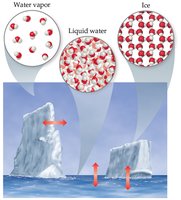
Matter is anything that has mass and occupies space. Matter can be classified by its state (solid, liquid, gas) and by its composition (element, compound, mixture).
Solid: Definite shape and volume.
Liquid: Definite volume, takes the shape of its container.
Gas: No definite shape or volume; expands to fill its container.
Classification by Composition
Matter can be further classified as substances (elements and compounds) or mixtures (homogeneous and heterogeneous).
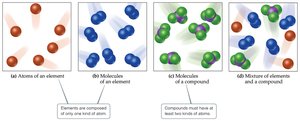
Element: A pure substance that cannot be broken down into simpler substances by chemical means. Each element is made of one kind of atom.
Compound: A pure substance composed of two or more elements chemically combined in fixed proportions. Compounds can be decomposed into simpler substances.
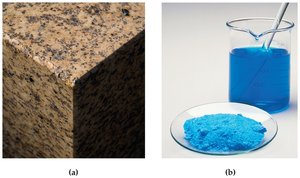
Mixture: A physical combination of two or more substances. Mixtures can be homogeneous (uniform composition, also called solutions) or heterogeneous (variable composition).
Atoms, Molecules, and Elements
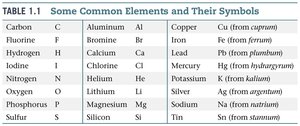
Atoms are the fundamental building blocks of matter. Elements consist of only one type of atom, while compounds contain molecules formed from two or more different atoms bonded together. Chemists use symbols to represent elements, often derived from their English or Latin names.
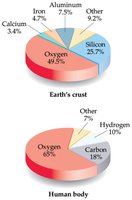
Composition of the Earth and Human Body
There are 118 named elements, but only a few make up the majority of the Earth's crust and the human body. Oxygen is the most abundant element in both.
The Law of Constant Composition
Compounds always have the same relative number of atoms of each element, regardless of the sample. This is known as the Law of Constant Composition (Law of Definite Proportions).
Representing Elements and Compounds
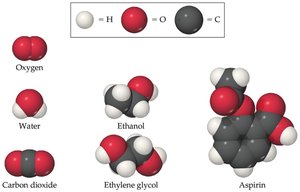
Elements are represented by symbols (e.g., H for hydrogen, O for oxygen). Compounds are represented by chemical formulas (e.g., H2O for water). Models and diagrams help visualize the arrangement of atoms in molecules.

Physical and Chemical Properties
Physical properties can be observed without changing the identity of a substance (e.g., color, density, melting point). Chemical properties describe a substance's ability to undergo chemical changes (e.g., flammability, reactivity).
Numbers and Measurement in Chemistry
Chemistry relies heavily on quantitative measurements. Key concepts include units of measurement, uncertainty, significant figures, and dimensional analysis.
SI Units and Metric System
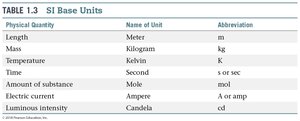
The International System of Units (SI) is the standard for scientific measurements. The metric system uses base units such as meter (m) for length, kilogram (kg) for mass, second (s) for time, kelvin (K) for temperature, and mole (mol) for amount of substance.
Metric System Prefixes
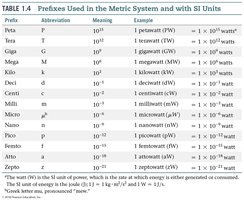
Prefixes are used to express multiples or fractions of base units (e.g., kilo-, centi-, milli-).
Volume
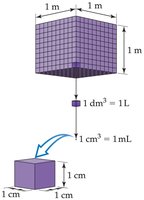
Volume is a derived unit (length3). Common units include liter (L) and milliliter (mL). 1 L = 1 dm3; 1 mL = 1 cm3.
Temperature Scales
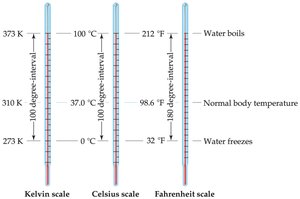
Temperature is measured in Celsius (°C), Kelvin (K), and Fahrenheit (°F). The Kelvin scale is the SI unit and starts at absolute zero. Conversion formulas:
Energy
The SI unit of energy is the joule (J). Kinetic energy is calculated as:
1 J = 1 kg·m2/s2
1 cal = 4.184 J (calorie, not to be confused with the nutritional Calorie, which is 1 kcal)
Density
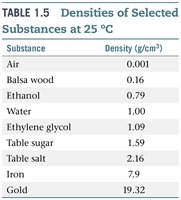
Density is a physical property defined as mass per unit volume:
Common units: g/mL or g/cm3
Uncertainty, Accuracy, and Precision
All measurements have some degree of uncertainty. Accuracy refers to how close a measurement is to the true value, while precision refers to how close repeated measurements are to each other.

Significant Figures
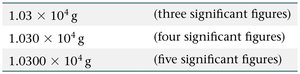
Significant figures reflect the precision of a measured or calculated quantity. Rules for determining significant figures:
All nonzero digits are significant.
Zeros between nonzero digits are significant.
Leading zeros are not significant.
Trailing zeros are significant if there is a decimal point.
Significant Figures in Calculations
Addition/Subtraction: Round to the least significant decimal place.
Multiplication/Division: Round to the same number of significant figures as the measurement with the fewest significant figures.
Dimensional Analysis
Dimensional analysis is a method for converting between units using conversion factors. Conversion factors are treated as exact numbers, allowing for precise calculations. The process involves setting up ratios so that units cancel appropriately, leading to the desired unit.

Tables
Common Elements and Their Symbols
Element | Symbol |
|---|---|
Carbon | C |
Fluorine | F |
Hydrogen | H |
Iodine | I |
Nitrogen | N |
Oxygen | O |
Phosphorus | P |
Sulfur | S |
Aluminum | Al |
Bromine | Br |
Calcium | Ca |
Chlorine | Cl |
Helium | He |
Lithium | Li |
Magnesium | Mg |
Silicon | Si |
Copper | Cu |
Iron | Fe |
Lead | Pb |
Mercury | Hg |
Potassium | K |
Silver | Ag |
Sodium | Na |
Tin | Sn |
SI Base Units
Physical Quantity | Name of Unit | Abbreviation |
|---|---|---|
Length | Meter | m |
Mass | Kilogram | kg |
Temperature | Kelvin | K |
Time | Second | s or sec |
Amount of substance | Mole | mol |
Electric current | Ampere | A or amp |
Luminous intensity | Candela | cd |
Metric System Prefixes
Prefix | Abbreviation | Meaning | Example |
|---|---|---|---|
Peta | P | 1015 | 1 petawatt (PW) = 1 × 10¹⁵ watts |
Tera | T | 1012 | 1 terawatt (TW) = 1 × 10¹² watts |
Giga | G | 109 | 1 gigawatt (GW) = 1 × 10⁹ watts |
Mega | M | 106 | 1 megawatt (MW) = 1 × 10⁶ watts |
Kilo | k | 103 | 1 kilowatt (kW) = 1 × 10³ watts |
Deci | d | 10-1 | 1 deciwatt (dW) = 1 × 10⁻¹ watts |
Centi | c | 10-2 | 1 centiwatt (cW) = 1 × 10⁻² watts |
Milli | m | 10-3 | 1 milliwatt (mW) = 1 × 10⁻³ watts |
Micro | μ | 10-6 | 1 microwatt (μW) = 1 × 10⁻⁶ watts |
Nano | n | 10-9 | 1 nanowatt (nW) = 1 × 10⁻⁹ watts |
Pico | p | 10-12 | 1 picowatt (pW) = 1 × 10-12 watts |
Femto | f | 10-15 | 1 femtowatt (fW) = 1 × 10-15 watts |
Atto | a | 10-18 | 1 attowatt (aW) = 1 × 10-18 watts |
Zepto | z | 10-21 | 1 zeptowatt (zW) = 1 × 10-21 watts |
Densities of Selected Substances at 25°C
Substance | Density (g/cm3) |
|---|---|
Air | 0.001 |
Balsa wood | 0.16 |
Ethanol | 0.79 |
Water | 1.00 |
Ethylene glycol | 1.09 |
Table sugar | 1.59 |
Table salt | 2.16 |
Iron | 7.9 |
Gold | 19.32 |
Summary
This chapter introduces the foundational concepts of chemistry, including the classification of matter, the importance of measurement and units, and the handling of uncertainty in scientific data. Mastery of these topics is essential for success in GOB Chemistry and for understanding more advanced chemical principles.
