 Back
Chapter 1: Matter, Energy, and Measurement – GOB Chemistry Study Notes
Study Guide - Smart Notes
 Tailored notes based on your materials, expanded with key definitions, examples, and context.
Introduction to Matter, Energy, and Measurement
Overview
This chapter introduces fundamental concepts in chemistry, including the nature of matter and energy, and the importance of measurement in scientific study. Understanding these basics is essential for all subsequent topics in General, Organic, and Biological (GOB) Chemistry.
Units of Measurement
SI Units and Metric System
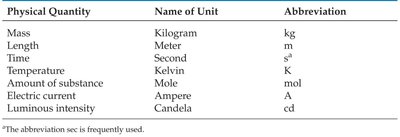
The metric system is the standard for scientific measurement worldwide. The Système International d’Unités (SI) defines seven base units, each corresponding to a fundamental physical quantity.
Base Units: Each physical quantity has a unique base unit.
Derived Units: Other units are derived from these base units.
Physical Quantity | Name of Unit | Abbreviation |
|---|---|---|
Mass | Kilogram | kg |
Length | Meter | m |
Time | Second | s |
Temperature | Kelvin | K |
Amount of substance | Mole | mol |
Electric current | Ampere | A |
Luminous intensity | Candela | cd |
Metric Prefixes
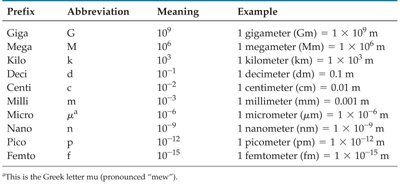
Prefixes are used to express multiples or fractions of base units, making measurements more practical for different scales.
Prefix | Abbreviation | Meaning | Example |
|---|---|---|---|
Giga | G | 109 | 1 gigameter (Gm) = 1 × 10⁹ m |
Mega | M | 106 | 1 megameter (Mm) = 1 × 10⁶ m |
Kilo | k | 103 | 1 kilometer (km) = 1 × 10³ m |
Deci | d | 10-1 | 1 decimeter (dm) = 0.1 m |
Centi | c | 10-2 | 1 centimeter (cm) = 0.01 m |
Milli | m | 10-3 | 1 millimeter (mm) = 0.001 m |
Micro | μ | 10-6 | 1 micrometer (μm) = 1 × 10⁻⁶ m |
Nano | n | 10-9 | 1 nanometer (nm) = 1 × 10⁻⁹ m |
Pico | p | 10-12 | 1 picometer (pm) = 1 × 10-12 m |
Femto | f | 10-15 | 1 femtometer (fm) = 1 × 10-15 m |
Temperature
Temperature Scales
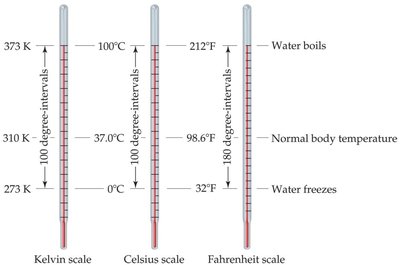
Temperature is a measure of the average kinetic energy of particles. The Celsius and Kelvin scales are most commonly used in scientific contexts.
Celsius (°C): Water freezes at 0°C and boils at 100°C.
Kelvin (K): The SI unit; absolute zero is 0 K. Water freezes at 273 K and boils at 373 K.
Fahrenheit (°F): Used mainly in the United States; water freezes at 32°F and boils at 212°F.
Conversion Formulas:
Volume
Metric Units of Volume
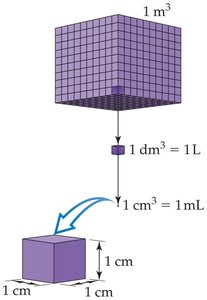
Volume is commonly measured in liters (L) and milliliters (mL). The relationships between units are based on the dimensions of cubes.
1 L = 1 dm3
1 mL = 1 cm3 = 1 cc
Measuring Volume
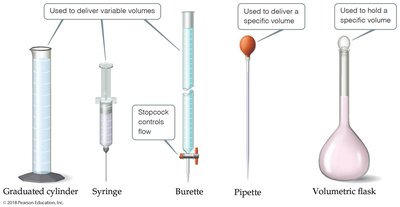
Different laboratory instruments are used to measure volume, each suited for specific tasks.
Graduated cylinder: Used for variable volumes.
Syringe: Delivers variable volumes.
Burette: Used for titrations; delivers variable volumes with a stopcock.
Pipette: Delivers a specific volume.
Volumetric flask: Holds a specific volume.
Density
Definition and Calculation
Density is a physical property defined as mass per unit volume. It is commonly expressed in grams per milliliter (g/mL) or grams per cubic centimeter (g/cm3).
Formula:
To solve for mass:
To solve for volume:
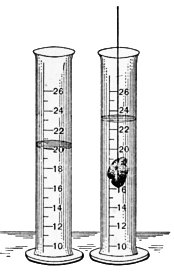
Volume by Displacement
Volume can be measured by displacement, especially for irregularly shaped objects. The object is submerged in a liquid, and the change in liquid level indicates the volume.
Uncertainty in Measurement
Exact vs. Inexact Numbers
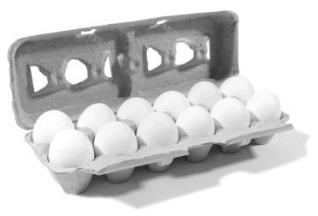
Exact numbers are defined values (e.g., 12 eggs in a dozen), while inexact numbers are measured and have associated uncertainty.
Exact numbers: No uncertainty.
Inexact numbers: Some uncertainty due to measurement.
Reporting Uncertainty
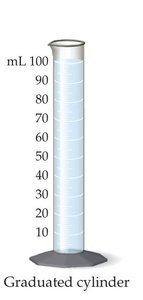
All measurements have uncertainty, typically in the last digit reported. For example, 27 °C ± 1 °C.
Accuracy and Precision
Definitions
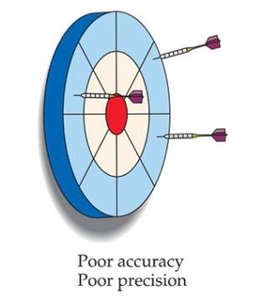
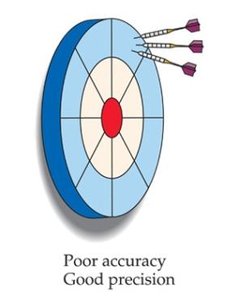
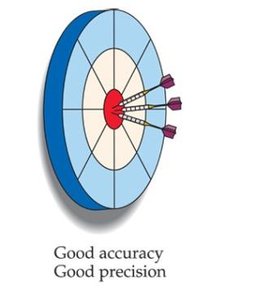
Accuracy: How close a measurement is to the true value.
Precision: How close repeated measurements are to each other.
Visual Representation
Significant Figures
Rules for Determining Significant Figures
All nonzero digits are significant.
Zeroes between significant digits are significant.
Zeroes at the beginning are not significant.
Zeroes at the end are significant if a decimal point is present.
Examples:
3.25 (3 s.f.)
0.0057 (2 s.f.)
8000. (4 s.f.)
Significant Figures in Calculations
Addition/Subtraction: Answer should have the same number of decimal places as the measurement with the fewest decimal places.
Multiplication/Division: Answer should have the same number of significant figures as the measurement with the fewest significant figures.
Example:
(1 decimal place)
(1 significant figure)
Scientific Notation
Usage and Conversion
Scientific notation is used to express very large or very small numbers. The significant digits are written as a number between 1 and 10, followed by a power of ten.
Large numbers: Positive exponent (e.g., )
Small numbers: Negative exponent (e.g., )
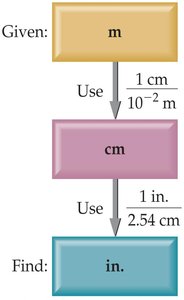
Dimensional Analysis
Unit Conversion
Dimensional analysis uses conversion factors to change units. Each conversion factor is based on an equivalence statement.
Example:
Conversion factor: or
Health & Medicine Applications
Dosage Calculations
Dosage is often calculated using conversion factors from medication labels. For example, 325 mg per tablet of aspirin.

Example: If a tablet contains 325 mg, then is a conversion factor.
Liquid medications: for acetaminophen.
Toxicology
LD50 and Risk Assessment
The LD50 (lethal dose for 50% of test animals) is a standard measure of toxicity. Dosage is typically measured in mg/kg or μg/kg of body mass.
Example: LD50 of caffeine is 192 mg/kg.
Calculation: For a 59 kg person, the lethal dose is .
If each cup of coffee contains 100 mg, then cups.

Additional info: These notes expand on brief points from the original materials, providing definitions, formulas, and examples for clarity and completeness.
