 Back
Chapter 1: Measurement and the Properties of Matter – GOB Chemistry Study Notes
Study Guide - Smart Notes
 Tailored notes based on your materials, expanded with key definitions, examples, and context.
Measurement and the Properties of Matter
Chemistry: The Central Science
Chemistry is known as the central science because it connects and overlaps with many other scientific disciplines, including biology, physics, geology, and medicine. It is the study of the nature, properties, and transformations of matter.
Chemistry: The study of matter and the changes it undergoes.
Matter: Anything that has mass and occupies space.
Property: A characteristic used to describe or identify matter, which can be physical or chemical.
Transformation: A change in the properties of matter, which can be physical or chemical.
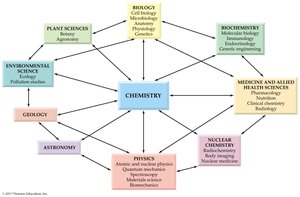
Physical and Chemical Properties and Changes
Substances possess both physical and chemical properties. Understanding these properties helps in identifying and classifying matter.
Physical Properties: Can be observed without changing the substance's chemical identity (e.g., density, color, melting point).
Chemical Properties: Observed when a substance undergoes a chemical change, resulting in a new substance (e.g., flammability, reactivity).
Physical Change: Does not alter the chemical makeup (e.g., melting ice, dissolving sugar in water).
Chemical Change: Alters the chemical makeup, forming new substances (e.g., burning, rusting).
Physical changes do not affect chemical reactivity.
Chemical changes often involve energy changes (heat, light, etc.).

Example: Mixing vinegar (acetic acid) and baking soda (sodium bicarbonate) produces carbon dioxide gas, a chemical change evidenced by bubbling.
States of Matter
Matter exists in three common states: solid, liquid, and gas. The state depends on temperature and pressure.
Solid (s): Definite shape and volume; rigid and dense (e.g., ice).
Liquid (ℓ): Definite volume, indefinite shape; takes the shape of its container (e.g., water).
Gas (g): No definite shape or volume; expands to fill its container (e.g., steam).
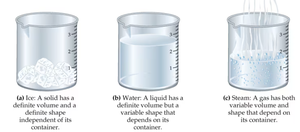
State changes (e.g., melting, boiling) are physical changes.
Classification of Matter
Matter can be classified as pure substances or mixtures.
Pure Substance: Uniform composition; can be an element or a compound.
Mixture: Combination of two or more substances; each retains its identity and properties.
Elements and Compounds
Element: Contains only one type of atom; cannot be broken down chemically (e.g., O2, Na).
Compound: Contains two or more elements chemically combined in fixed ratios (e.g., H2O, NaCl).
Compounds can be separated into elements by chemical changes, not physical means.
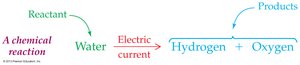
Chemical Elements and Symbols
Each element is represented by a unique symbol, usually one or two letters (e.g., H for hydrogen, Ca for calcium). Some symbols are derived from Latin names (e.g., Na for sodium).
1-letter symbols are capitalized; 2-letter symbols have only the first letter capitalized.
Chemical Formulas
Chemical formulas use elemental symbols and subscripts to indicate the number of atoms of each element in a compound.
Example: H2O (2 hydrogen, 1 oxygen), C6H12O6 (glucose).
Physical Quantities: Units and Scientific Notation
Physical quantities are described by a number and a unit. The SI (International System) is the standard for scientific measurements.
Mass: kilogram (kg), gram (g)
Length: meter (m)
Volume: cubic meter (m3), liter (L), milliliter (mL)
Scientific notation expresses very large or small numbers as a value between 1 and 10 multiplied by a power of 10.
Example:

Example:

To convert from scientific notation to standard notation, move the decimal point according to the exponent.


Measuring Mass, Length, and Volume
Volume is the amount of space occupied by an object. In chemistry, liters (L) and milliliters (mL) are commonly used.
1 L = 1 dm3 = 1000 mL
1 mL = 1 cm3
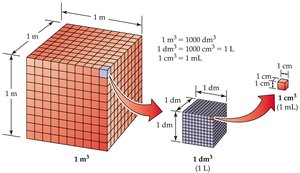
Measurement and Significant Figures
Significant figures reflect the precision of a measurement. The last digit is always estimated.
All nonzero digits are significant.
Zeros between nonzero digits are significant.
Leading zeros are not significant.
Trailing zeros after a decimal point are significant.
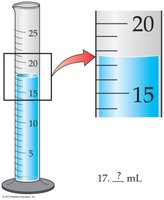
When reading a graduated cylinder, estimate one digit beyond the smallest marked division.
Rounding Off Numbers and Calculations with Significant Figures
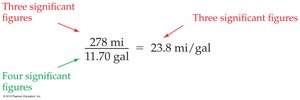
For multiplication/division: The result should have the same number of significant figures as the value with the fewest significant figures.
For addition/subtraction: The result should have the same number of decimal places as the value with the fewest decimal places.

Problem Solving: Unit Conversions
The factor-label method (dimensional analysis) is used to convert between units using conversion factors. Set up the calculation so that units cancel appropriately.
Example: To convert 150.0 lbs to kg, use the conversion factor .
Temperature, Heat, and Energy
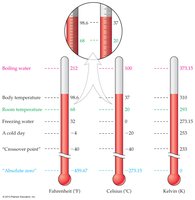
Temperature can be measured in degrees Celsius (°C), Fahrenheit (°F), or Kelvin (K). The Kelvin scale is the SI unit for temperature.
0 K is absolute zero, the lowest possible temperature.
Conversion formulas:
Energy and Specific Heat
Energy is the capacity to do work or supply heat. The SI unit is the joule (J); the calorie (cal) is also used in medicine and nutrition.
1 cal = amount of heat to raise 1 g of water by 1°C
1 Calorie (nutritional) = 1000 cal = 1 kcal
Specific heat is the amount of heat needed to raise the temperature of 1 g of a substance by 1°C.
Equation:
q = heat (cal or J)
m = mass (g)
s = specific heat (cal/g·°C or J/g·°C)
ΔT = temperature change (°C)
Density and Specific Gravity
Density relates the mass of an object to its volume.
Equation:
For solids: g/cm3
For liquids: g/mL
Density can be used as a conversion factor between mass and volume.
Specific gravity is the ratio of the density of a substance to the density of water at the same temperature (unitless).

Summary Table: Classification of Matter
Type | Description | Examples |
|---|---|---|
Element | One type of atom; cannot be broken down chemically | O2, Na, Cu |
Compound | Two or more elements chemically combined in fixed ratios | H2O, NaCl, C6H12O6 |
Mixture | Physical blend of two or more substances; each retains its identity | Air, salt water, sugar + baking soda |
Key Equations
Density:
Specific Heat:
Kelvin to Celsius:
Celsius to Fahrenheit:
Specific Gravity:
Additional info: This guide covers all foundational concepts from Chapter 1 of a GOB Chemistry course, including matter, measurement, units, significant figures, and basic calculations. It is suitable for exam preparation and as a reference for laboratory work.
