 Back
BackChapter 1: Science and Measurements – Study Notes
Study Guide - Smart Notes
 Tailored notes based on your materials, expanded with key definitions, examples, and context.
Science and Measurements
Why Learn Chemistry or Science?
Chemistry and science have profoundly impacted society by improving health, agriculture, and technology. Scientific discoveries have led to advances such as enhanced food supply, medical imaging, and therapeutic drugs.
Enhanced agriculture: Improved crop yields and food security.
Medical advances: Development of medical scanners (e.g., CT, MRI) and drugs (e.g., antibiotics, anti-cancer drugs).


What is Science?
Science is a systematic method for gaining knowledge and understanding of reality. It produces generalizations with predictive value, allowing us to anticipate natural phenomena.
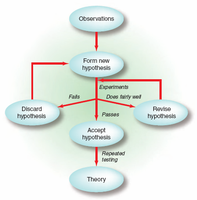
Scientific Method: A logical approach to solving problems and answering questions through observation, hypothesis, experimentation, and theory development.
Scientific Theory: A well-tested explanation (model) for a broad set of observations. Theories are supported by repeated experiments and observations.
Scientific Law: A concise statement that summarizes the results of many observations and experiments. Laws describe what happens but do not explain why.
Matter and Energy
What is Matter?
Matter is anything that has mass and occupies space. It can be described by its physical and chemical properties.
Physical properties: Characteristics observed without changing the substance (e.g., color, melting point).
Chemical properties: Describe how a substance changes into a new substance during a chemical reaction.
States of Matter
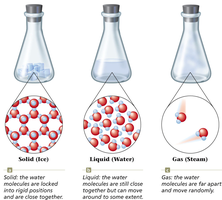
Matter exists in three main physical states: solid, liquid, and gas. Each state has distinct particle arrangements and properties.
Solid: Particles are tightly packed in fixed positions.
Liquid: Particles are close but can move past each other.
Gas: Particles are far apart and move freely.
Energy
Energy is the ability to do work. It exists in two main forms:
Potential energy: Stored energy due to position or composition.
Kinetic energy: Energy of motion.
Examples:
A mountain climber sitting at the top of a peak: Potential energy
A mountain climber rappelling down a cliff: Kinetic energy
A hamburger on a plate: Potential energy
A nurse inflating a blood pressure cuff: Kinetic energy
Measurements in Science
Measurements and SI Units
Measurements consist of a number and a unit. The International System of Units (SI) is the standard system used in science.
Meter (m): Length
Gram (g): Mass
Second (s): Time
Kelvin (K): Temperature
Liter (L): Volume
Scientific Notation
Scientific notation expresses very large or very small numbers in the form , where and is an integer.
Example:
Coefficient: A single digit or a number with a decimal after the first digit.
Base: Always
Exponent: Positive or negative integer indicating the number of decimal places moved.
Significant Figures
Significant figures (sig figs) indicate the precision of a measurement. Rules for counting significant figures:
All non-zero digits are significant.
Zeros between non-zero digits are significant.
Leading zeros are not significant.
Trailing zeros are significant only if there is a decimal point.
Examples:
1.102 (4 sig figs)
0.0001102 (4 sig figs)
1.102000 (7 sig figs)
10500 (3 sig figs)
Accuracy vs. Precision
Accuracy is how close a measurement is to the true value. Precision is how close repeated measurements are to each other.
Rounding and Calculations with Significant Figures
Addition/Subtraction: The result has the same number of decimal places as the least precise measurement.
Multiplication/Division: The result has the same number of significant figures as the measurement with the fewest significant figures.
All operations combined: Track significant figures and decimal places at each step; do not round until the final answer.
Unit Conversions and Metric Prefixes
Unit Conversions
To convert between units, use equivalence statements (conversion factors). Multiply by the conversion factor so that units cancel appropriately.
Example:
Example:
Example:
Metric Prefixes
Metric prefixes indicate multiples or fractions of base units. Common prefixes include kilo- (k, ), centi- (c, ), milli- (m, ), micro- (μ, ), and nano- (n, ).
Prefix | Symbol | Factor |
|---|---|---|
kilo- | k | |
centi- | c | |
milli- | m | |
micro- | μ | |
nano- | n |
Example: Convert 9758 mg to grams:
Temperature Unit Conversions
Temperature Scales
Three common temperature units are Celsius (°C), Kelvin (K), and Fahrenheit (°F). Conversion formulas:
Keep the precision of the original measurement when converting temperatures.
