 Back
BackChapter 1 Study Guide – Chemistry Basics: Matter and Measurement
Study Guide - Smart Notes
 Tailored notes based on your materials, expanded with key definitions, examples, and context.
Q1. Classify each of the following substances as a mixture or a pure substance:
a. cake batter
b. the helium gas inside a balloon
Background
Topic: Classifying Matter
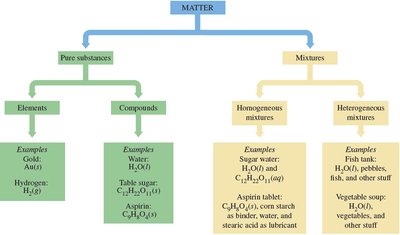
This question tests your understanding of the basic forms of matter and how to distinguish between mixtures and pure substances. Pure substances have a uniform and definite composition, while mixtures contain two or more substances physically combined.
Key Terms:
Pure Substance: Matter made up of only one type of substance (element or compound).
Mixture: Combination of two or more substances that can be separated physically.
Step-by-Step Guidance
Consider whether each substance is made up of only one type of material or contains multiple components.
Recall that pure substances can be elements (like helium) or compounds (like water), while mixtures can be homogeneous (uniform throughout) or heterogeneous (not uniform).
Think about cake batter: Does it have a uniform composition or is it made from several ingredients?
Think about helium gas: Is it a single element or a combination of substances?
Try solving on your own before revealing the answer!
Final Answer:
a. Cake batter is a mixture because it contains several ingredients combined together.
b. Helium gas inside a balloon is a pure substance because it consists of only helium atoms.
Mixtures can be separated into their components, while pure substances cannot be separated by physical means.
Q2. Classify each of the following mixtures as homogeneous or heterogeneous. Briefly justify your answer:
a. olive oil
b. rocky road ice cream
Background
Topic: Types of Mixtures
This question tests your ability to distinguish between homogeneous mixtures (uniform composition) and heterogeneous mixtures (non-uniform composition).
Key Terms:
Homogeneous Mixture: Composition is the same throughout (e.g., olive oil).
Heterogeneous Mixture: Composition varies throughout (e.g., rocky road ice cream).

Step-by-Step Guidance
Examine whether the mixture looks the same throughout or if you can see different parts or phases.
Recall that olive oil is typically uniform in appearance and composition.
Consider rocky road ice cream: Does it contain visible chunks or different ingredients?
Justify your classification based on the definition of homogeneous and heterogeneous mixtures.
Try solving on your own before revealing the answer!
Final Answer:
a. Olive oil is a homogeneous mixture because its composition is uniform throughout.
b. Rocky road ice cream is a heterogeneous mixture because it contains visible chunks of nuts, marshmallows, and chocolate.
Homogeneous mixtures appear consistent, while heterogeneous mixtures have distinct parts.
Q3. Use the periodic table to answer the following questions:
a. What is the elemental symbol for oxygen?
b. To what group does oxygen belong?
c. What period is oxygen in?
Background
Topic: Elements and the Periodic Table
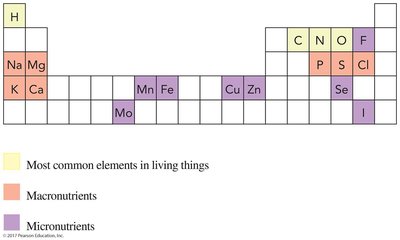
This question tests your ability to use the periodic table to identify element symbols, groups (vertical columns), and periods (horizontal rows).
Key Terms:
Elemental Symbol: One or two letters representing an element.
Group: Vertical column in the periodic table.
Period: Horizontal row in the periodic table.
Step-by-Step Guidance
Locate oxygen on the periodic table and note its symbol.
Identify the group number (column) for oxygen.
Identify the period number (row) for oxygen.
Recall that groups are numbered from 1 to 18 and periods from 1 to 7.
Try solving on your own before revealing the answer!
Final Answer:
a. The elemental symbol for oxygen is O.
b. Oxygen belongs to group 16 (or VIA).
c. Oxygen is in period 2.
These answers are found by locating oxygen on the periodic table and reading its group and period numbers.
Q4. Determine whether each of the following is a physical change or a chemical reaction:
a. a plant using carbon dioxide and water to make sugar
b. water vapor condensing on a cool evening to form dew on the grass
Background
Topic: Physical vs. Chemical Changes
This question tests your ability to distinguish between physical changes (changes in state or form, no new substance formed) and chemical reactions (new substances formed).
Key Terms:
Physical Change: Change in state or appearance, no change in chemical identity.
Chemical Reaction: Change in chemical identity, new substances formed.

Step-by-Step Guidance
For each scenario, ask whether the substance's chemical identity changes or stays the same.
Recall that photosynthesis (plant making sugar) involves new substances being formed.
Condensation (water vapor to dew) involves a change in state but not in chemical identity.
Use the definitions to classify each change.
Try solving on your own before revealing the answer!
Final Answer:
a. The plant making sugar is a chemical reaction because new substances (sugar) are formed.
b. Water vapor condensing is a physical change because the chemical identity (H2O) remains the same.
Physical changes do not alter the chemical identity, while chemical reactions produce new substances.
Q5. Using the appropriate conversion factor, convert each of the following quantities to the indicated unit:
a. 10,000 cg = ________ g
b. 5 g/mL = ________ mg/dL
Background
Topic: Unit Conversions
This question tests your ability to use conversion factors to change between metric units and other units commonly used in chemistry and health sciences.
Key Terms and Formulas:
Conversion Factor: A ratio used to convert from one unit to another.
Metric Prefixes: centi (c) = 0.01, milli (m) = 0.001, deci (d) = 0.1, etc.
Key Formulas:
Step-by-Step Guidance
For part a, set up the conversion using the relationship between centigrams and grams.
For part b, convert grams to milligrams and milliliters to deciliters using the appropriate conversion factors.
Write the conversion as a multiplication of the original value by the conversion factor.
Check that the units cancel appropriately, leaving the desired unit.
Try solving on your own before revealing the answer!
Final Answer:
a. 10,000 cg = 100 g
b. 5 g/mL = 500,000 mg/dL
These conversions use the relationships between metric units and apply dimensional analysis.
