 Back
BackChapter 11: Introduction to Organic Chemistry – Hydrocarbons and Nomenclature
Study Guide - Smart Notes
 Tailored notes based on your materials, expanded with key definitions, examples, and context.
Introduction to Organic Chemistry
Organic chemistry is the study of compounds primarily composed of carbon and hydrogen, often containing other elements such as oxygen, nitrogen, sulfur, and halogens. This chapter introduces the classification, structure, and nomenclature of hydrocarbons, including alkanes, alkenes, alkynes, and aromatic compounds.
Alkanes
Structure and Properties
Alkanes are saturated hydrocarbons containing only single bonds between carbon atoms. Their general formula is $C_nH_{2n+2}$ for acyclic (open-chain) alkanes.
Structure: Each carbon forms four single covalent bonds (tetrahedral geometry).
Properties: Nonpolar, low reactivity, insoluble in water, less dense than water.
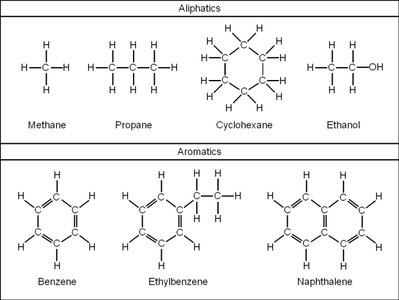
Examples: Methane (CH4), Ethane (C2H6), Propane (C3H8).
Alkanes with Substituents (Branched Alkanes)
Branched alkanes contain alkyl or halogen substituents attached to the main carbon chain. The IUPAC system is used to systematically name these compounds.
Longest Chain: Identify the longest continuous carbon chain as the parent hydrocarbon.
Numbering: Number the chain from the end nearest a substituent.
Substituents: Name and locate each substituent; list them in alphabetical order.
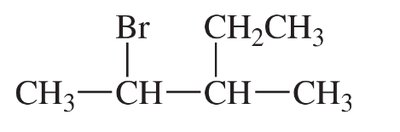
Example: The compound below is named 2-bromo-3-ethylpentane:
Longest chain: 5 carbons (pentane)
Substituents: bromo at C2, ethyl at C3
Alkenes and Alkynes
Structure and Nomenclature
Alkenes contain at least one carbon-carbon double bond ($C=C$), while alkynes contain at least one carbon-carbon triple bond ($C\equiv C$). Their general formulas are $C_nH_{2n}$ for alkenes and $C_nH_{2n-2}$ for alkynes.
Longest Chain: Must include the double or triple bond.
Numbering: Number the chain from the end nearest the multiple bond.
Substituents: Name and locate each substituent; double/triple bond position is indicated by the lowest possible number.
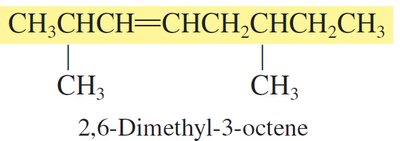
Example: 2,6-dimethyl-3-octene:
Longest chain: 8 carbons (octene)
Double bond starts at C3
Methyl groups at C2 and C6
Guide to Naming Alkenes and Alkynes
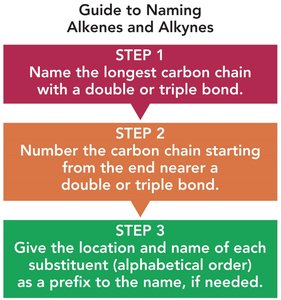
Step 1: Name the longest carbon chain with the double or triple bond.
Step 2: Number the chain from the end nearer the multiple bond.
Step 3: Give the location and name of each substituent in alphabetical order as a prefix.
Haloalkenes and Haloalkynes
When halogen substituents are present, the double or triple bond takes precedence in numbering. Halogens are named as prefixes (e.g., bromo-, chloro-).
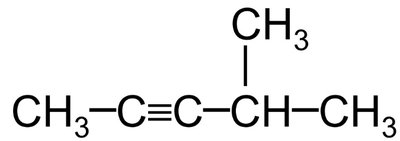
Example: 4-bromo-2-pentyne:
Longest chain: 5 carbons (pentyne)
Triple bond starts at C2
Bromo group at C4
Cycloalkanes
Structure and Nomenclature
Cycloalkanes are saturated hydrocarbons with carbon atoms arranged in a ring. They have two fewer hydrogen atoms than their open-chain counterparts.
Naming: Prefix 'cyclo-' to the name of the corresponding alkane.
Substituents: List substituents in alphabetical order; use the lowest possible numbers for multiple substituents.
Examples:
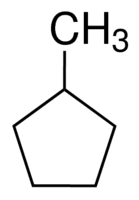
Methylcyclopentane: a methyl group attached to cyclopentane.
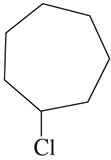
Chlorocycloheptane: a chloro group attached to cycloheptane.
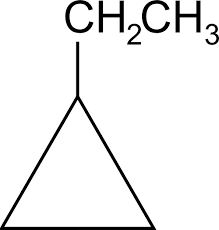
Ethylcyclopropane: an ethyl group attached to cyclopropane.
Geometric (Cis-Trans) Isomers
Definition and Requirements
Geometric isomers (cis-trans isomers) are a type of stereoisomerism found in alkenes. They have the same structural formula but differ in the spatial arrangement of groups around the double bond.
Cis Isomer: Similar groups are on the same side of the double bond.
Trans Isomer: Similar groups are on opposite sides of the double bond.
Requirement: Each carbon of the double bond must have two different groups attached for cis-trans isomerism to be possible.
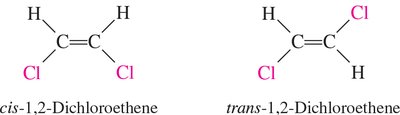
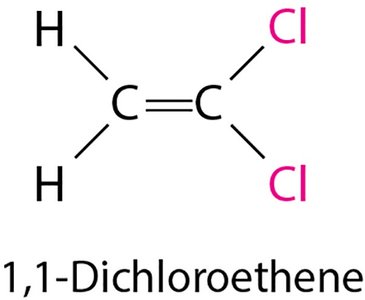
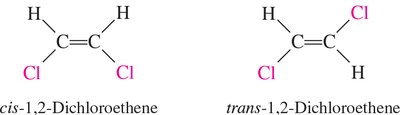
Example: 1,2-Dichloroethene
Cis-1,2-dichloroethene: Both Cl atoms on the same side.
Trans-1,2-dichloroethene: Cl atoms on opposite sides.
1,1-Dichloroethene: No cis-trans isomerism possible (both Cl on the same carbon).
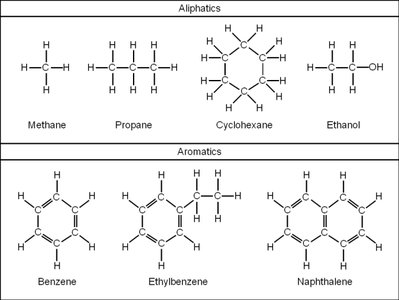
Aromatic Compounds
Structure and Examples
Aromatic compounds contain a benzene ring, a planar ring of six carbon atoms with alternating double bonds (delocalized electrons). They are a distinct class of hydrocarbons with unique stability and reactivity.
Examples: Benzene, ethylbenzene, naphthalene.
Summary Table: Types of Hydrocarbons
Type | General Formula | Bonding | Example |
|---|---|---|---|
Alkane | $C_nH_{2n+2}$ | Single bonds | Methane (CH4) |
Alkene | $C_nH_{2n}$ | At least one double bond | Ethene (C2H4) |
Alkyne | $C_nH_{2n-2}$ | At least one triple bond | Ethyne (C2H2) |
Aromatic | Varies | Alternating double bonds (benzene ring) | Benzene (C6H6) |
