 Back
BackChapter 11: Solutions – Structure, Properties, and Biological Relevance
Study Guide - Smart Notes
 Tailored notes based on your materials, expanded with key definitions, examples, and context.
Solutions
Introduction to Solutions
Solutions are homogeneous mixtures composed of two or more substances. They are fundamental in chemistry and biology, as they allow for the transport and interaction of molecules in living systems and industrial processes.
Solute: The substance present in the lesser amount, which is dissolved.
Solvent: The substance present in the greater amount, which does the dissolving.
Common examples include saltwater (NaCl in water) and air (a mixture of gases).
Types of Solutions
Solutions can exist in different phases depending on the physical state of the solute and solvent.
Solution Phase | Solute Phase | Solvent Phase | Example |
|---|---|---|---|
Gaseous solution | Gas | Gas | Air (mainly O2 and N2) |
Liquid solution | Gas | Liquid | Club soda (CO2 in water) |
Liquid solution | Liquid | Liquid | Vodka (ethanol in water) |
Liquid solution | Solid | Liquid | Seawater (salt in water) |
Solid solution | Solid | Solid | Brass (copper and zinc) |
Intermolecular Forces and Solution Formation
Properties of Liquids and Intermolecular Forces
Liquids have molecules that are much closer together than gases, allowing for significant intermolecular interactions. These forces influence properties such as boiling point, viscosity, and the ability to dissolve substances.
Intermolecular forces include hydrogen bonding, dipole-dipole interactions, and London dispersion forces.
Water is a prime example, with strong hydrogen bonds between molecules.
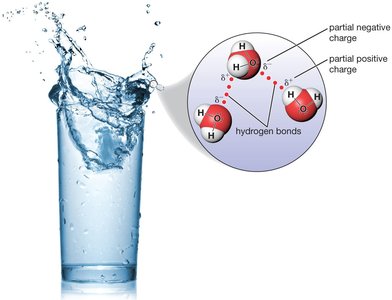
Role of Intermolecular Forces in Dissolving Substances
Intermolecular forces determine how well a solvent can dissolve a solute. Water, a polar solvent, dissolves many ionic and polar substances due to ion-dipole interactions.
When ionic compounds like NaCl dissolve, water molecules surround the ions, stabilizing them in solution.
Ion-dipole interactions are key to this process.
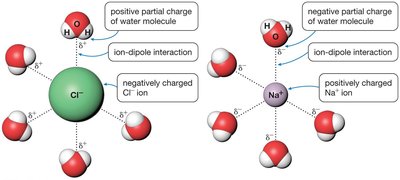
Solubility and the "Like Dissolves Like" Principle
Polarity and Solubility
The solubility of a substance depends on the polarity of both the solute and the solvent. The phrase "like dissolves like" means that polar solvents dissolve polar or ionic solutes, while nonpolar solvents dissolve nonpolar solutes.
Polar solvents: Water, acetone, methanol
Nonpolar solvents: Carbon tetrachloride, toluene, hexane
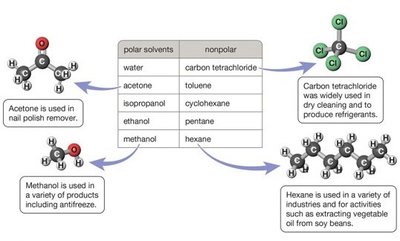
Concentration of Solutions
Defining Concentration
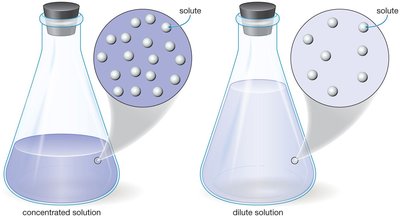
Concentration expresses the amount of solute dissolved in a given amount of solution. It is crucial in laboratory and medical settings for preparing and administering solutions.
Common units: percent concentration, molarity (M), and others.
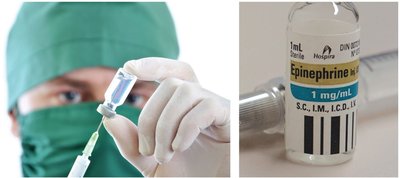
Percent Concentration
Percent concentration is often used in everyday and laboratory contexts.
Mass/volume percent (m/v%):
Volume/volume percent (v/v%):
Molarity
Molarity (M) is the number of moles of solute per liter of solution. It is the most common unit for expressing concentration in chemistry.
Example: A 0.5 M NaCl solution contains 0.5 moles of NaCl per liter.
Dilution of Solutions
To prepare solutions of lower concentration from a stock solution, dilution is performed by adding more solvent. The amount of solute remains constant during dilution.
The dilution equation: or more generally
Where and are the initial molarity and volume, and and are the final molarity and volume.
Osmosis and Biological Relevance
Osmosis and Cell Membranes
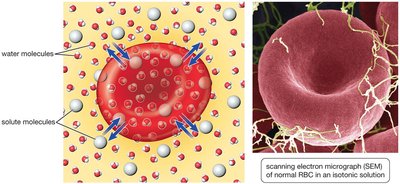
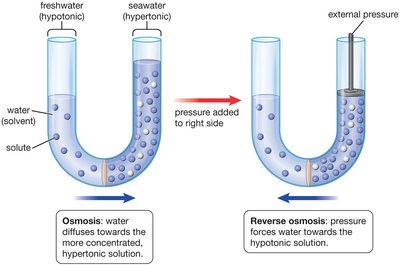
Osmosis is the movement of solvent molecules (usually water) across a semipermeable membrane from a region of lower solute concentration to higher solute concentration. This process is vital for maintaining cellular function.
Semipermeable membrane: Allows passage of solvent but not solute particles.
Diffusion: Movement from high to low concentration.
Osmosis: Special case of diffusion involving water across membranes.
Osmotic Pressure and Tonicity
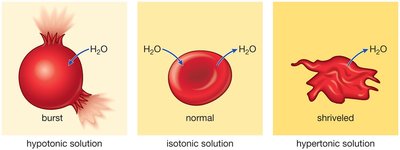
Osmotic pressure is the pressure required to stop osmosis. The tonicity of a solution describes its relative solute concentration compared to another solution (often the cell interior).
Isotonic: Equal solute concentration inside and outside the cell; water moves equally in both directions.
Hypotonic: Lower solute concentration outside the cell; water enters the cell, which may burst.
Hypertonic: Higher solute concentration outside the cell; water leaves the cell, causing it to shrivel.
Reverse Osmosis
Reverse osmosis is a process where external pressure forces water through a semipermeable membrane from a more concentrated (hypertonic) solution to a less concentrated (hypotonic) solution. It is widely used for water purification.
Dialysis
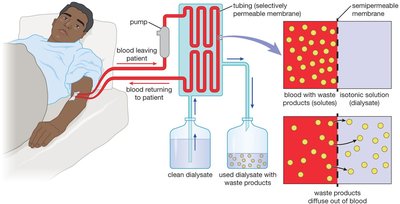
Dialysis is a medical process that uses a semipermeable membrane to separate waste products from the blood when the kidneys are not functioning properly. It allows small solute molecules and ions to pass through, but retains larger particles and cells.
Summary Table: Solution Properties and Processes
Process | Description | Biological/Practical Example |
|---|---|---|
Osmosis | Water moves from low to high solute concentration across a membrane | Water balance in red blood cells |
Reverse Osmosis | External pressure forces water from high to low solute concentration | Desalination of seawater |
Dialysis | Separation of small solutes from larger particles using a membrane | Kidney dialysis for renal failure |
Practice Scenarios: Osmosis vs. Reverse Osmosis
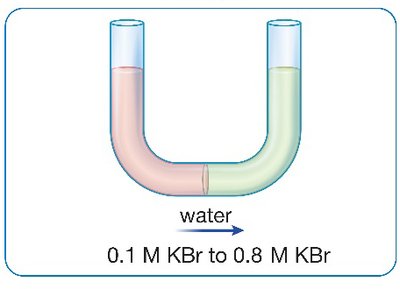
Osmosis: Water moves from 0.1 M KBr to 0.8 M KBr (water moves toward higher solute concentration).
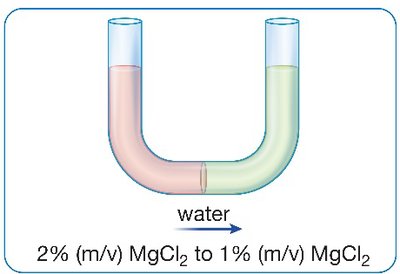
Reverse Osmosis: Water moves from 2% (m/v) MgCl2 to 1% (m/v) MgCl2 (requires external pressure).
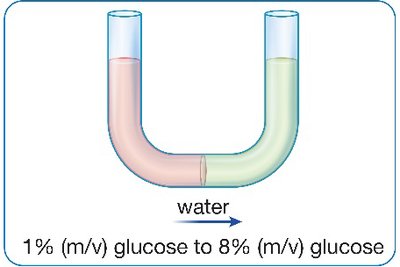
Osmosis: Water moves from 1% (m/v) glucose to 8% (m/v) glucose (water moves toward higher solute concentration).
Additional info: Understanding solution properties and processes is essential for fields such as medicine, environmental science, and biochemistry, where the movement of water and solutes across membranes underpins many physiological and technological applications.
