 Back
BackChapter 12: Acids and Bases – Study Notes
Study Guide - Smart Notes
 Tailored notes based on your materials, expanded with key definitions, examples, and context.
Acids and Bases
Definitions and Properties
Acids and bases are fundamental classes of compounds in chemistry, each with distinct properties and behaviors in aqueous solutions. Understanding their definitions, strengths, and reactions is essential for studying chemical and biological systems.
Acids: Substances that produce hydrogen ions (H+) when dissolved in water. The hydrogen ion is essentially a proton, and in aqueous solution, it is often represented as the hydronium ion (H3O+).
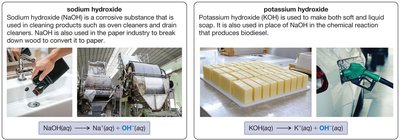
Bases: Compounds that produce hydroxide ions (OH−) when dissolved in water. Most common bases are metal hydroxides from Group 1A and 2A elements.
Brønsted-Lowry Definition: An acid is a proton donor, and a base is a proton acceptor. This definition broadens the concept to include more substances.
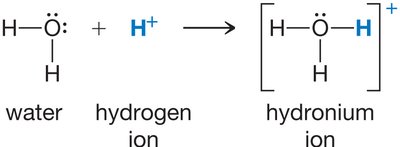
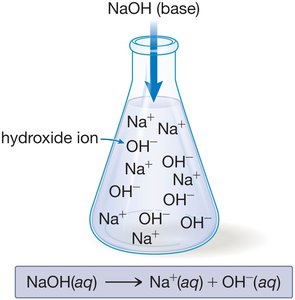
Brønsted-Lowry Acid-Base Reactions
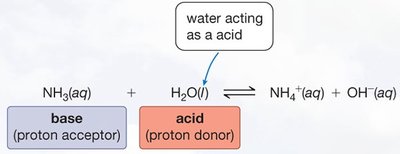
Brønsted-Lowry theory focuses on the transfer of protons (H+) between reactants. Water can act as either an acid or a base depending on the reaction partner.
Example: NH3 (ammonia) acts as a base by accepting a proton from water, which acts as an acid.
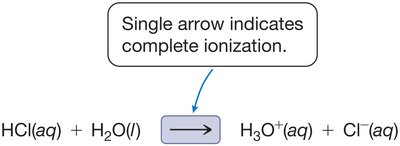
Example: HCl (hydrochloric acid) donates a proton to water, which acts as a base.
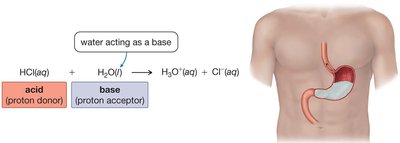
Conjugate Acid-Base Pairs
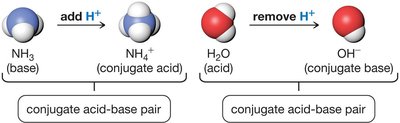
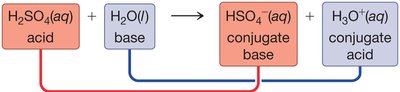
When an acid donates a proton, it forms its conjugate base; when a base accepts a proton, it forms its conjugate acid. The only difference between a conjugate acid and base is one proton.
Conjugate acid-base pair: Two species that differ by one proton.
Example: NH3 (base) and NH4+ (conjugate acid); H2O (acid) and OH− (conjugate base).
Acid and Base Strength
Strong and Weak Acids
Acids and bases are classified as strong or weak based on their degree of ionization in water.
Strong acids: Completely ionize in water (single arrow in equations). Examples include HCl, HNO3, H2SO4.
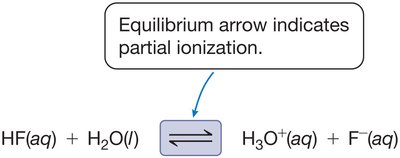
Weak acids: Only partially ionize in water (equilibrium arrow in equations). Examples include acetic acid (CH3COOH), hydrofluoric acid (HF).
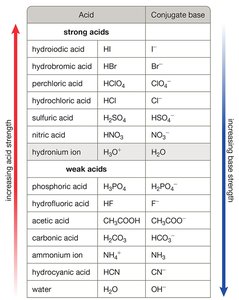
The stronger the acid, the weaker its conjugate base, and vice versa.
Strong and Weak Bases
Strong bases, such as NaOH and KOH, dissociate completely in water, while weak bases, such as ammonia (NH3), only partially react with water.
Strong bases: LiOH, NaOH, KOH, Ca(OH)2, Sr(OH)2, Ba(OH)2
Weak bases: NH3, CH3NH2
Polyprotic Acids
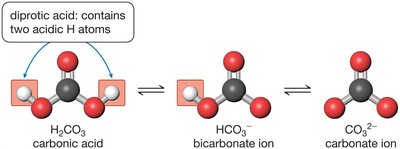
Some acids can donate more than one proton per molecule. Diprotic acids have two acidic hydrogens, while triprotic acids have three.
Example: Sulfuric acid (H2SO4) is diprotic; phosphoric acid (H3PO4) is triprotic.
Carbonic acid (H2CO3) is a weak diprotic acid.
Acid Dissociation Constants (Ka)
Equilibrium and Ka Expression
Weak acids establish an equilibrium in water. The acid dissociation constant (Ka) quantifies the extent of ionization:
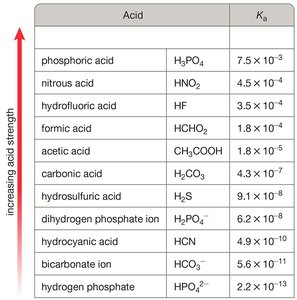
Larger Ka values indicate stronger acids.
Water Ionization and pH
Water as an Acid and a Base
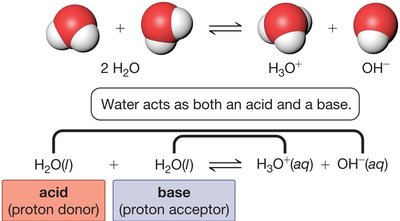
Water can act as both an acid and a base (amphoteric). In pure water, two molecules react to form hydronium and hydroxide ions:
The water dissociation constant: at 25°C
Acidic, Basic, and Neutral Solutions
The relative concentrations of hydronium and hydroxide ions determine whether a solution is acidic, basic, or neutral:
Neutral: M
Acidic:
Basic:
pH Scale
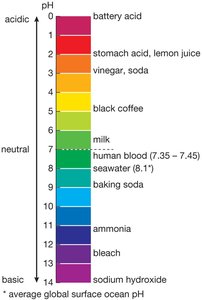
The pH scale quantifies the acidity or basicity of a solution:
Acidic: pH < 7; Neutral: pH = 7; Basic: pH > 7
Acid-Base Reactions and Neutralization
Neutralization Reactions
When an acid reacts with a base, a neutralization reaction occurs, producing water and a salt:
General equation: Acid + Base → Water + Salt
Example:

Diprotic Acid Neutralization
Diprotic acids require two moles of base for complete neutralization:
Example:
Titration
Titration is a laboratory technique used to determine the concentration of an acid or base by neutralizing it with a solution of known concentration.
Key calculation: (for monoprotic acids and bases)
Buffers
Buffer Solutions and Their Role
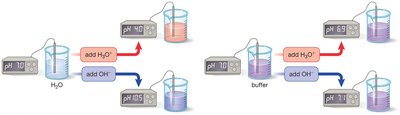
Buffers are solutions that resist drastic changes in pH when small amounts of acid or base are added. They are essential in biological systems to maintain stable pH conditions.
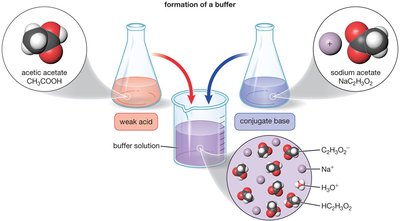
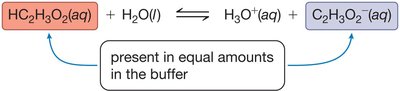
Composed of a weak acid and its conjugate base (or a weak base and its conjugate acid).
Example: Acetic acid (CH3COOH) and sodium acetate (NaCH3COO).

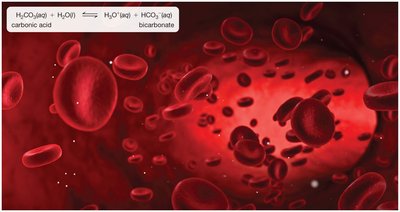
Biological Buffers: The Carbonic Acid/Bicarbonate System
The carbonic acid/bicarbonate buffer system is crucial for maintaining blood pH between 7.35 and 7.45. Disruption of this balance can lead to serious health conditions such as respiratory acidosis.
Summary Table: Strong and Weak Acids and Bases
Acid | Conjugate Base |
|---|---|
Hydroiodic acid (HI) | I− |
Hydrobromic acid (HBr) | Br− |
Perchloric acid (HClO4) | ClO4− |
Hydrochloric acid (HCl) | Cl− |
Sulfuric acid (H2SO4) | HSO4− |
Nitric acid (HNO3) | NO3− |
Hydronium ion (H3O+) | H2O |
Phosphoric acid (H3PO4) | H2PO4− |
Hydrofluoric acid (HF) | F− |
Acetic acid (CH3COOH) | CH3COO− |
Carbonic acid (H2CO3) | HCO3− |
Ammonium ion (NH4+) | NH3 |
Hydrocyanic acid (HCN) | CN− |
Water (H2O) | OH− |
Additional info: This table summarizes the relative strengths of common acids and their conjugate bases, which is essential for predicting the direction of acid-base reactions and understanding buffer systems.
