 Back
BackChapter 15: Amines – Structure, Properties, and Biological Importance
Study Guide - Smart Notes
 Tailored notes based on your materials, expanded with key definitions, examples, and context.
Chapter 15: Amines
15.1 Structure and Classification of Amines
Amines are organic compounds derived from ammonia (NH3) in which one or more hydrogen atoms are replaced by organic groups. The nitrogen atom in amines has five valence electrons, forms three covalent bonds, and retains one lone pair, resulting in a trigonal pyramidal geometry.
Primary (1°) amine: Nitrogen is bonded to one organic group and two hydrogens (RNH2).
Secondary (2°) amine: Nitrogen is bonded to two organic groups and one hydrogen (R2NH).
Tertiary (3°) amine: Nitrogen is bonded to three organic groups (R3N).
Quaternary ammonium ion: Nitrogen is bonded to four organic groups and carries a positive charge (R4N+).
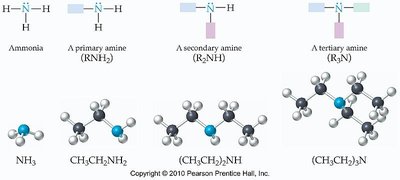
Example: Ethylamine (CH3CH2NH2) is a primary amine; diethylamine ((CH3CH2)2NH) is a secondary amine; triethylamine ((CH3CH2)3N) is a tertiary amine.
15.2 Nomenclature of Amines
The naming of amines depends on their structure and the groups attached to the nitrogen atom.
Primary alkyl amines: Name the alkyl group attached to nitrogen and add the suffix "-amine" (e.g., methylamine).
Secondary and tertiary amines (identical groups): Use prefixes di- or tri- (e.g., dimethylamine, trimethylamine).
Secondary and tertiary amines (different groups): Name as N-substituted derivatives of the largest primary amine (e.g., N-methylethylamine).
Aromatic amines: The simplest is aniline (C6H5NH2).
Amino group as a substituent: Use the prefix "amino-" (e.g., 2-aminopropane).
15.3 Heterocyclic Nitrogen Compounds
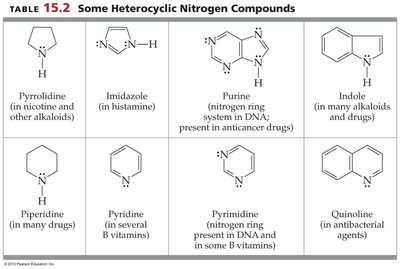
Heterocycles are ring structures containing atoms other than carbon, commonly nitrogen. These structures are prevalent in natural products, drugs, and vitamins.
Compound | Structure | Occurrence/Use |
|---|---|---|
Pyrrolidine | Five-membered ring with one N | Nicotine, alkaloids |
Imidazole | Five-membered ring with two N | Histamine |
Purine | Fused rings with four N | DNA, anticancer drugs |
Indole | Benzene fused to pyrrole | Alkaloids, drugs |
Piperidine | Six-membered ring with one N | Drugs |
Pyridine | Six-membered ring with one N | B vitamins |
Pyrimidine | Six-membered ring with two N | DNA, B vitamins |
Quinoline | Benzene fused to pyridine | Antibacterial agents |
15.4 Physical Properties of Amines
The physical properties of amines are influenced by their ability to form hydrogen bonds and their molecular structure.
Hydrogen bonding: Primary and secondary amines can hydrogen bond with themselves; tertiary amines cannot.
Boiling points: 1° and 2° amines have higher boiling points than alkanes of similar size, but lower than alcohols. 3° amines have lower boiling points than 1° and 2° amines.
Water solubility: All amines (including 3°) can hydrogen bond with water, making them water-soluble to varying degrees.
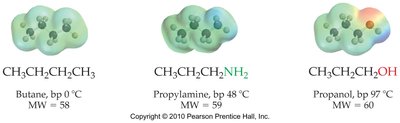
Example: Propylamine (BP = 48°C) has a higher boiling point than butane (BP = 0°C) but lower than propanol (BP = 97°C).
15.5 Basicity of Amines
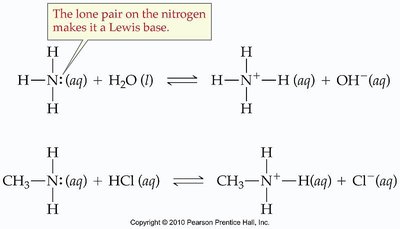
Amines act as Lewis bases due to the lone pair of electrons on nitrogen, which can accept a proton (H+).
Reaction with acids: Amines react with acids to form ammonium ions.
Conjugate acid-base pairs: Neutral amines are the base form; ammonium ions are the acid form. They differ by one proton.
pH dependence: The form (charged or neutral) depends on the pH relative to the amine's pKa.
Example: At low pH (acidic), the ammonium ion form is favored; at high pH (basic), the neutral amine form is favored.
15.6 Amines and Ammonium Ions in Biological Systems
In the human body, physiological pH is around 7.4. Most amines exist as charged ammonium ions under these conditions, which affects their solubility and transport in biological systems.
Solubility switch: Charged ammonium ions are more soluble in water (polar environments), while neutral amines are more soluble in nonpolar environments (e.g., cell membranes).
Drug absorption: Many drugs are designed to switch between charged and neutral forms to optimize absorption and transport.
Example: Amphetamine is ionized in the acidic stomach but neutral in the more basic small intestine, allowing absorption into cells.
15.7 Naming Ammonium Ions and Amine Salts
Ammonium ions are named by replacing the "-amine" ending with "-ammonium." Amine salts are ionic compounds formed from the reaction of amines with acids, resulting in an ammonium cation and an anion.
Ammonium salts: Odorless, white, crystalline, and highly water-soluble.
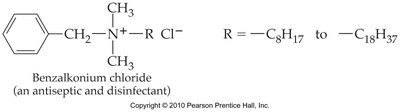
Quaternary ammonium salts: Cannot revert to neutral amines; often used as disinfectants and antiseptics.
Naming convention: Name the cation (ammonium ion) first, followed by the anion (e.g., diphenhydrammonium chloride).

15.8 Amines in Plants: Alkaloids
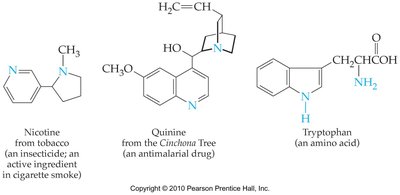
Alkaloids are naturally occurring nitrogen-containing compounds found in plants. They are usually basic, bitter, and often toxic. Many alkaloids are heterocyclic amines and have significant physiological effects.
Examples: Caffeine, nicotine (stimulants); quinine (antimalarial); morphine, codeine (analgesics).
Biological activity: Alkaloids can act as stimulants, pain relievers, sleep inducers, or cause euphoria.
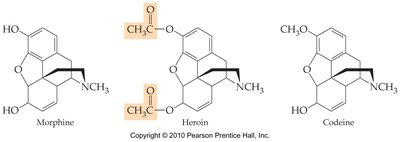
Additional info: The structural diversity of alkaloids underlies their wide range of pharmacological activities.
