 Back
Chapter 16: Amines – Structure, Classification, Properties, and Nomenclature
Study Guide - Smart Notes
 Tailored notes based on your materials, expanded with key definitions, examples, and context.
Chapter 16: Amines
16.1 Classifying Amines
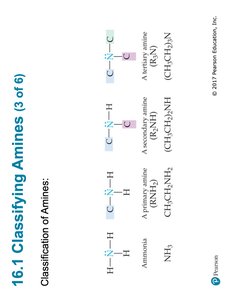
Amines are organic compounds containing one or more organic groups bonded to a nitrogen atom. They are derivatives of ammonia (NH3) and are classified based on the number of organic groups directly attached to the nitrogen atom.
Primary amine (1o): One organic group attached to nitrogen. General formula: RNH2.
Secondary amine (2o): Two organic groups attached to nitrogen. General formula: R2NH.
Tertiary amine (3o): Three organic groups attached to nitrogen. General formula: R3N.
Learning Objective: Identify and classify an amine as primary, secondary, or tertiary.
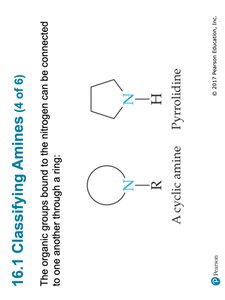
The organic groups bound to the nitrogen can be connected to one another through a ring, forming cyclic amines.
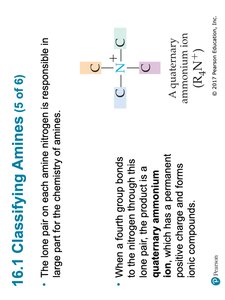
The lone pair on each amine nitrogen is responsible for much of the chemistry of amines. When a fourth group bonds to the nitrogen through its lone pair, the product is a quaternary ammonium ion (R4N+), which has a permanent positive charge and forms ionic compounds.
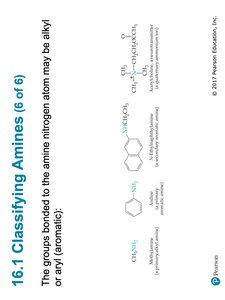
The groups bonded to the amine nitrogen atom may be alkyl or aryl (aromatic).
16.2 Naming and Drawing Amines
Amines are named according to their classification. The naming conventions depend on whether the amine is primary, secondary, or tertiary, and whether it is alkyl or aryl.
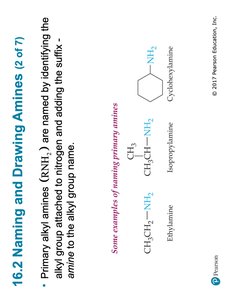
Primary alkyl amines (RNH2): Named by identifying the alkyl group attached to nitrogen and adding the suffix -amine to the alkyl group name.
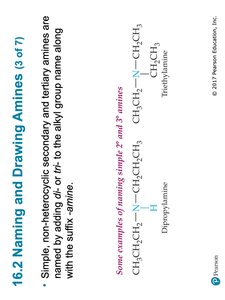
Secondary and tertiary amines: Named by adding di- or tri- to the alkyl group name along with the suffix -amine.
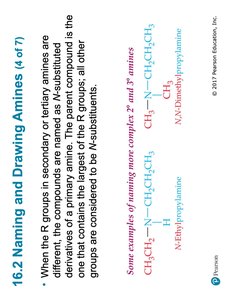
For more complex secondary or tertiary amines, the parent compound is the largest group attached to nitrogen; other groups are considered N-substituents and are named as prefixes.
The -NH2 functional group is called an amino group. When this group is a substituent, amino- is used as a prefix in the compound name.
Aromatic amines are primarily known by their common names. The simplest aromatic amine is aniline.
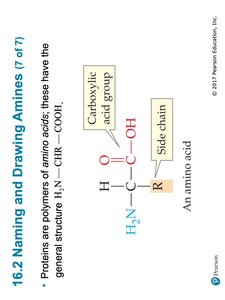
Proteins are polymers of amino acids, which have the general structure H2N–CHR–COOH.
Worked Examples: Classifying and Naming Amines
Example 1: Write the structure of N,N-diethylbutylamine and identify its classification.
Analysis: The suffix -amine indicates an amine. The N,N- prefix shows two ethyl groups are attached to nitrogen, and butyl is the parent compound.
Solution: The structure shows three alkyl groups bonded to N, so it is a tertiary amine.
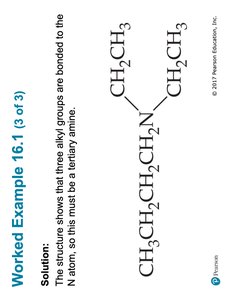
Example 2: Name the compound NH–CH3 attached to a cyclohexane ring.
Analysis: Two groups (cyclohexyl and methyl) are attached to nitrogen. The largest group is cyclohexyl, so the compound is named as N-methylcyclohexylamine.
Solution: It is a secondary amine.
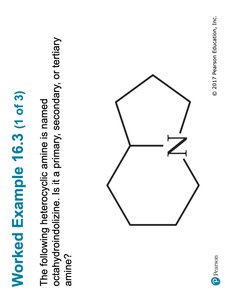
Example 3: Classify octahydroindolizine.
Analysis: The nitrogen is part of a ring and is attached to three individual carbon groups.
Solution: It is a tertiary amine.
16.3 Properties of Amines
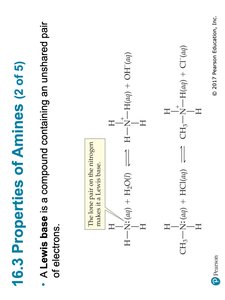
The lone electron pair on the nitrogen in amines causes them to act as weak Brønsted-Lowry bases or Lewis bases. Amines exhibit properties such as hydrogen bonding, solubility, boiling point, and basicity.
Lewis base: A compound containing an unshared pair of electrons.

Primary and secondary amines can hydrogen bond with one another.
Primary and secondary amines have higher boiling points than alkanes of similar size due to hydrogen bonding. Oxygen can form more hydrogen bonds per molecule than nitrogen, so alcohols have even higher boiling points than amines.
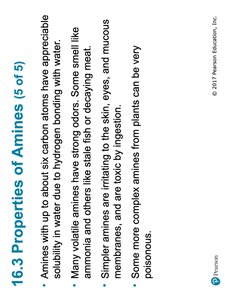
Amines with up to about six carbon atoms have appreciable solubility in water due to hydrogen bonding.
Many volatile amines have strong odors; some smell like ammonia, others like stale fish or decaying meat.
Simpler amines are irritating to the skin, eyes, and mucous membranes, and are toxic by ingestion. Some more complex amines from plants can be very poisonous.
16.4 Heterocyclic Nitrogen Compounds
A heterocycle is a ring that contains nitrogen or some other atom in addition to carbon. In many nitrogen-containing compounds, the nitrogen atom is in a ring with carbon atoms. Heterocyclic nitrogen compounds may be nonaromatic or aromatic.
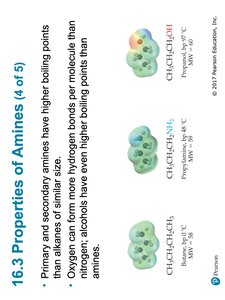
Table 16.1: Some Heterocyclic Nitrogen Compounds
Compound | Structure | Type |
|---|---|---|
Pyrrolidine | Five-membered ring with N | Saturated cyclic amine |
Pyrrole | Five-membered ring with N and double bonds | Aromatic |
Pyridine | Six-membered ring with N and double bonds | Aromatic |
Quinoline | Fused rings with N | Aromatic |
Imidazole | Five-membered ring with two N atoms | Aromatic |
Piperidine | Six-membered ring with N | Saturated cyclic amine |
Pyrimidine | Six-membered ring with two N atoms | Aromatic |
Purine | Fused rings with four N atoms | Aromatic |
16.5 Basicity of Amines
Aqueous solutions of amines are weakly basic because of the formation of OH- and R3NH+ ions in water. Amines act as bases in water, accepting protons and forming ammonium ions.
Learning Objective: Identify and draw the products formed when an amine reacts with acid.
Additional info: Further sections likely cover amine salts, alkaloids, and their biological significance, but are not included in the provided materials.
