 Back
BackChapter 2 Study Guidance: Chemistry and Measurements (GOB Chemistry)
Study Guide - Smart Notes
 Tailored notes based on your materials, expanded with key definitions, examples, and context.
Q1. State the name and type of measurement indicated by the units in each situation:
a. Deshawn has a temperature of ___
b. A physician orders 1.5 g of cefuroxime for injection.
c. A physician orders 1 L of a sodium chloride solution to be given intravenously.
d. A medication is to be given to a patient every 4 h.
e. Deshawn has a pulse of 76 beats per minute.
Background
Topic: Units of Measurement
This question tests your ability to identify the physical quantity (such as mass, volume, time, etc.) associated with a given unit and to distinguish between different types of measurements in chemistry and medicine.
Key Terms:
Unit: A standard quantity used to specify measurements (e.g., gram, liter, hour).
Type of Measurement: The physical property being measured (e.g., mass, volume, time, temperature).
Step-by-Step Guidance
For each situation, identify the unit used (e.g., °C, g, L, h, beats/min).
Determine what physical property the unit measures (e.g., temperature, mass, volume, time, rate).
State the name of the unit and the type of measurement for each situation.
Consider whether the measurement is related to a medical or chemical context.
Try solving on your own before revealing the answer!
Final Answer:
a. Degree Celsius (°C) is a unit of temperature.
b. Gram (g) is a unit of mass.
c. Liter (L) is a unit of volume.
d. Hour (h) is a unit of time.
e. Minute (min) is a unit of time (beats per minute is a rate).
Each unit corresponds to a specific physical property commonly measured in chemistry and medicine.
Q2. How many significant figures are in each of the following measured numbers?
a. The width of an average sciatic nerve is 0.00243 m
b. A child has a mass of 10.600 kg
c. A dialysis solution contains ___ of water (written in scientific notation)
Background
Topic: Significant Figures
This question tests your understanding of how to count significant figures in measured numbers, including rules for zeros and scientific notation.
Key Terms and Rules:
Significant Figures (SFs): Digits in a measurement that are known with certainty plus one digit that is estimated.
Rules for SFs:
Nonzero digits are always significant.
Zeros between nonzero digits are significant.
Leading zeros are not significant.
Trailing zeros in a decimal number are significant.
All digits in the coefficient of scientific notation are significant.
Step-by-Step Guidance
For each number, identify all nonzero digits and zeros.
Apply the rules for significant figures to each number.
Count the number of significant figures for each measured value.
For scientific notation, focus on the digits in the coefficient.
Try solving on your own before revealing the answer!
Final Answer:
a. 0.00243 m has three significant figures.
b. 10.600 kg has five significant figures.
c. The number in scientific notation has four significant figures (all digits in the coefficient).
Apply the rules for zeros and scientific notation to determine the correct number of significant figures.
Q3. Identify each of the following numbers as measured or exact, and give the number of significant figures in each measured number:
a. 0.170 L
b. 3 bags
c. ___
d. 1 m = 100 cm
Background
Topic: Measured vs. Exact Numbers and Significant Figures
This question tests your ability to distinguish between measured and exact numbers, and to count significant figures in measured values.
Key Terms:
Measured Number: Obtained by measurement; has limited precision.
Exact Number: Obtained by counting or definition; has infinite precision.
Significant Figures: Applies only to measured numbers.
Step-by-Step Guidance
For each number, decide if it is measured (from a measurement) or exact (from counting or definition).
If measured, count the significant figures using the rules from the previous question.
If exact, note that significant figures do not apply.
For definitions (e.g., 1 m = 100 cm), recognize these as exact numbers.
Try solving on your own before revealing the answer!
Final Answer:
a. 0.170 L is measured; three significant figures.
b. 3 bags is exact (counted); significant figures do not apply.
c. (If measured, count SFs; if exact, state so.)
d. 1 m = 100 cm is exact (definition); significant figures do not apply.
Measured numbers have limited precision and significant figures; exact numbers are counted or defined and have infinite precision.
Q4. Round off each of the following numbers to three significant figures:
a. 35.7823 m
b. 0.0026217 L
c. ___
Background
Topic: Rounding Off Significant Figures
This question tests your ability to round numbers to a specified number of significant figures, following proper rounding rules.
Key Terms and Rules:
Rounding Off: Adjusting a number to keep only the desired number of significant figures.
Rules:
Identify digits to be dropped.
If the first digit dropped is 5 or greater, increase the last retained digit by 1.
If the first digit dropped is less than 5, keep the last retained digit unchanged.
Step-by-Step Guidance
Identify the first three significant figures in each number.
Determine which digits will be dropped.
Apply the rounding rule based on the value of the first dropped digit.
Replace dropped digits with zeros if necessary (for large numbers).
Try solving on your own before revealing the answer!
Final Answer:
a. 35.8 m
b. 0.00262 L
c. (Apply rounding rules to the third example.)
Rounding ensures the answer reflects the correct precision for significant figures.
Q5. Perform the following calculations with measured numbers, and give the answers with the correct number of significant figures (multiplication/division):
a. ___
b. ___
c. ___
Background
Topic: Significant Figures in Multiplication and Division
This question tests your ability to apply the rules for significant figures when performing multiplication and division with measured numbers.
Key Rule:
The answer should have the same number of significant figures as the measurement with the fewest significant figures.
Step-by-Step Guidance
Determine the number of significant figures in each measured number.
Perform the calculation (multiplication or division) as indicated.
Round the answer to match the number of significant figures in the measurement with the fewest SFs.
Try solving on your own before revealing the answer!
Final Answer:
a. 21
b. 5.88
c. 5.00
The answer reflects the correct number of significant figures based on the calculation.
Q6. Perform the following calculations with measured numbers, and give each answer with the correct number of decimal places (addition/subtraction):
a. 104 + 7.8 + 40
b. ___
Background
Topic: Decimal Places in Addition and Subtraction
This question tests your ability to apply the rules for decimal places when performing addition and subtraction with measured numbers.
Key Rule:
The answer should have the same number of decimal places as the measurement with the fewest decimal places.
Step-by-Step Guidance
Determine the number of decimal places in each measured number.
Perform the addition or subtraction as indicated.
Round the answer to match the number of decimal places in the measurement with the fewest decimal places.
Try solving on your own before revealing the answer!
Final Answer:
a. 150 (rounded off to the tens place)
b. 138.43 (rounded off to the hundredths place)
The answer reflects the correct number of decimal places based on the calculation.
Q7. Complete each of the following equalities involving millimeters:
a. 1 m = ___ mm
b. 1 cm = ___ mm
Background
Topic: Metric Prefixes and Equalities
This question tests your understanding of metric prefixes and how to convert between units using equalities.
Key Terms:
Metric Prefix: A prefix that denotes a power of ten (e.g., milli-, centi-, kilo-).
Equality: A statement that two quantities are equal (e.g., 1 m = 1000 mm).
Step-by-Step Guidance
Recall the meaning of the metric prefixes (e.g., milli- means 1/1000).
Write the equality for meters to millimeters and centimeters to millimeters.
Fill in the blanks with the correct conversion factors.
Try solving on your own before revealing the answer!
Final Answer:
a. 1 m = 1000 mm
b. 1 cm = 10 mm
Metric equalities are based on the powers of ten associated with each prefix.
Q8. Write the equality and two conversion factors, and identify each number as exact or give the number of significant figures for each:
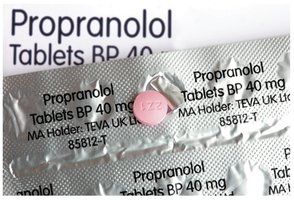
a. The medication contains 40. mg of propranolol in 1 tablet.
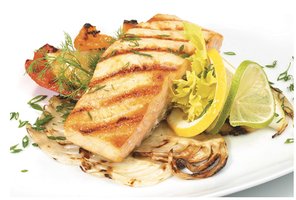
b. Salmon contains 1.9% omega-3 fatty acids by mass.
Background
Topic: Equalities and Conversion Factors
This question tests your ability to write equalities and conversion factors from a statement, and to identify whether numbers are exact or measured (with SFs).
Key Terms:
Equality: A statement that two quantities are equal (e.g., 40 mg = 1 tablet).
Conversion Factor: A ratio used to convert from one unit to another.
Exact Number: Obtained by counting or definition.
Measured Number: Obtained by measurement; has SFs.
Step-by-Step Guidance
Identify the equality in each statement (e.g., 40 mg = 1 tablet).
Write two conversion factors based on the equality (e.g., and ).
Determine if each number is exact or measured, and state the number of SFs for measured numbers.
Try solving on your own before revealing the answer!
Final Answer:
a. Equality: 40 mg = 1 tablet; Conversion factors: and ; 40 mg is measured (two SFs), 1 tablet is exact.
b. Equality: 1.9 g omega-3 per 100 g salmon; Conversion factors: and ; 1.9 is measured (two SFs), 100 is exact (definition).
Conversion factors are derived from equalities, and SFs are determined by measurement or definition.
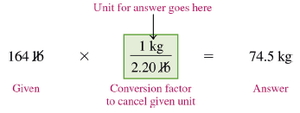
Q9. If Deshawn weighs 164 lb, what is his body mass in kilograms?
Background
Topic: Unit Conversion Using Conversion Factors
This question tests your ability to convert between units (pounds to kilograms) using conversion factors and to apply significant figures.
Key Formula:
Conversion factor:
Step-by-Step Guidance
State the given quantity (164 lb) and the needed unit (kg).
Write the conversion factor that relates pounds to kilograms.
Set up the calculation so that pounds cancel and kilograms remain.
Multiply the given value by the conversion factor, keeping track of significant figures.

Try solving on your own before revealing the answer!
Final Answer: 74.5 kg
The answer is rounded to three significant figures, matching the precision of the given value.
Q10. If tablets in stock contain 75 mcg of Synthroid, how many tablets are required to provide a prescribed dose of 0.150 mg?
Background
Topic: Using Two Conversion Factors
This question tests your ability to use multiple conversion factors to solve a dosage problem, including metric conversions and clinical factors.
Key Formulas:
Metric conversion:
Clinical conversion:
Step-by-Step Guidance
State the given quantity (0.150 mg) and the needed unit (number of tablets).
Write a plan to convert milligrams to micrograms, then to tablets.
Set up the calculation so that milligrams and micrograms cancel, leaving tablets.
Multiply the given value by both conversion factors, keeping track of significant figures.

Try solving on your own before revealing the answer!
Final Answer: 2 tablets
More than one tablet is needed because each tablet contains less than the prescribed dose.
Q11. If a person weighs 155 lb and has 16% body fat by mass, what is the mass, in kilograms, of body fat?
Background
Topic: Using Percent as a Conversion Factor
This question tests your ability to use percent as a conversion factor and to convert between units (pounds to kilograms).
Key Formula:
Percent conversion:
Unit conversion:
Step-by-Step Guidance
State the given quantity (155 lb) and the needed unit (kg of body fat).
Write a plan to convert pounds to kilograms, then apply the percent factor to find mass of fat.
Set up the calculation so that pounds cancel, kilograms remain, and percent is applied.
Multiply the given value by the conversion factors, keeping track of significant figures.
Try solving on your own before revealing the answer!
Final Answer: 11 kg
The mass of body fat is less than the total body mass, as expected.
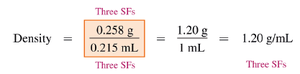
Q12. If a 0.258-g sample of HDL has a volume of 0.215 mL, what is the density, in grams per milliliter, of the HDL sample?
Background
Topic: Calculating Density
This question tests your ability to calculate density from mass and volume measurements.
Key Formula:
Density:
Step-by-Step Guidance
State the given mass (0.258 g) and volume (0.215 mL).
Write the density expression.
Ensure mass is in grams and volume is in milliliters.
Substitute the values into the density formula, keeping track of significant figures.
Try solving on your own before revealing the answer!
Final Answer: 1.20 g/mL
The density is greater than 1, which makes sense since the mass is greater than the volume.
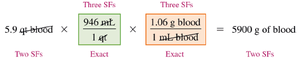
Q13. If Deshawn has a blood volume of 5.9 qt and the density of blood is 1.06 g/mL, what is the mass, in grams, of Deshawn’s blood?
Background
Topic: Problem Solving Using Density
This question tests your ability to use density and unit conversions to calculate mass from volume.
Key Formulas:
Volume conversion:
Density:
Step-by-Step Guidance
State the given volume (5.9 qt) and needed unit (grams).
Write a plan to convert quarts to milliliters, then use density to find mass.
Set up the calculation so that quarts and milliliters cancel, leaving grams.
Multiply the given value by the conversion factors, keeping track of significant figures.
Try solving on your own before revealing the answer!
Final Answer: 5900 g
The calculation uses density and volume conversion to find the mass of blood.
