 Back
Chapter 3 Study Guide: Compounds, Electron Arrangements, and the Mole
Study Guide - Smart Notes
 Tailored notes based on your materials, expanded with key definitions, examples, and context.
Compounds and Electron Arrangements
Electron Arrangements and Energy Levels
Atoms are composed of electrons, protons, and neutrons. Electrons occupy specific energy levels around the nucleus, and their arrangement determines the chemical properties of the atom.
Electrons are negatively charged particles in constant motion, possessing energy.
Lower energy levels are more stable than higher energy levels.
Electrons can only occupy certain energy levels (quantized), not energies in between.
The maximum number of electrons in a given energy level is calculated by the formula , where n is the energy level.
Atoms rearrange their electrons to increase stability.
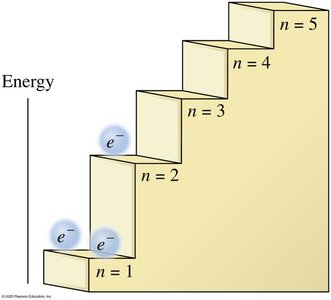
Energy Level Diagram
Each step represents a principal energy level (n=1, n=2, etc.).
Electrons fill lower energy levels first.
Valence Shells and Valence Electrons
The highest energy level containing electrons is called the valence shell. Electrons in this shell are known as valence electrons and are responsible for chemical bonding.
Valence electrons are farthest from the nucleus.
They participate in the formation of compounds.
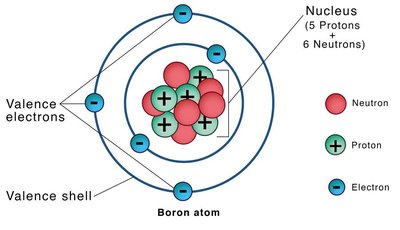
Valence Electrons and the Periodic Table
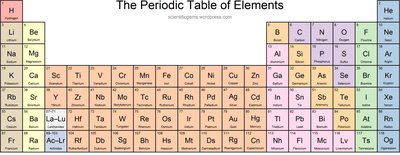
The periodic table helps determine the number of valence electrons for main-group elements (Groups 1A–8A).
The group (column) number indicates the number of valence electrons.
The period (row) indicates the outermost energy level containing electrons.
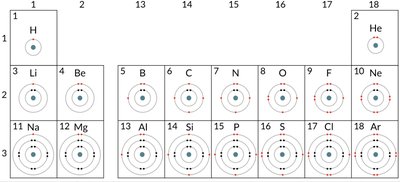
The Octet Rule
Atoms are most stable when they have eight valence electrons, known as the octet rule. Noble gases naturally have a full valence shell and are chemically inert.
Atoms achieve an octet by:
Losing electrons to form cations (positive ions)
Gaining electrons to form anions (negative ions)
Sharing electrons to form covalent bonds
Periodic Trends
Atomic Radius
The atomic radius is the distance from the nucleus to the outermost electron shell. It varies across the periodic table due to changes in energy levels and nuclear charge.
Down a group: atoms gain energy levels, increasing atomic radius.
Across a period (left to right): atoms have more protons, pulling electrons closer and decreasing atomic radius.
Larger atoms lose electrons more easily.
Electronegativity
Electronegativity is the ability of an atom to attract shared electrons in a chemical bond.
Across a period (right): increases due to more protons.
Up a group: increases as valence electrons are closer to the nucleus.
Ionization Energy
Ionization energy is the energy required to remove an electron from an atom.
Across a period (right): increases due to stronger nuclear attraction.
Up a group: increases as electrons are closer to the nucleus.
Low ionization energy means easier formation of positive ions.
Chemical Bonds and Compounds
Types of Chemical Bonds
Chemical bonds are attractions between charged particles (electrons and protons) in atoms. They are classified as:
Ionic bonds: Transfer of electrons between metals and nonmetals.
Covalent bonds: Sharing of electrons between nonmetals.
Metallic bonds: Delocalized electrons among metal atoms.
Ionic Bonds
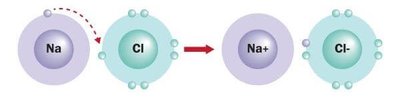
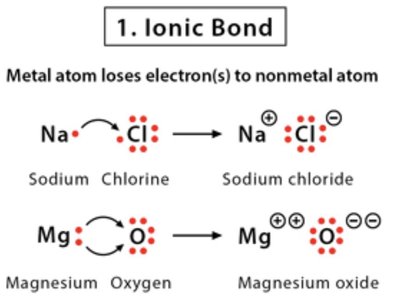
Ionic bonds occur when a metal atom transfers electrons to a nonmetal atom, forming oppositely charged ions that attract each other.
Metal becomes a cation (positive ion).
Nonmetal becomes an anion (negative ion).
Example: Sodium (Na) transfers an electron to chlorine (Cl), forming Na+ and Cl-.
Common Ionic Charges by Group
Group | Valence Electrons | Most Likely Charge | Example |
|---|---|---|---|
1A | 1 | +1 | Na |
2A | 2 | +2 | Mg |
3A | 3 | +3 | Al |
5A | 5 | -3 | N |
6A | 6 | -2 | O |
7A | 7 | -1 | Cl |
8A | 8 | 0 | - |
Covalent Bonds
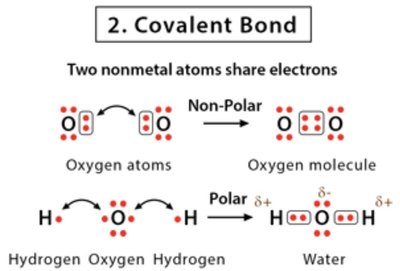
Covalent bonds form between nonmetal atoms by sharing electrons, allowing each atom to achieve a full valence shell (octet).
Atoms share electrons to achieve stability.
Example: Water (H2O) forms by sharing electrons between hydrogen and oxygen.
Molecular Shapes
Three-Dimensional Arrangement of Atoms
The shape of a molecule is determined by the arrangement of bonds around the central atom. Atoms arrange themselves so that bonds are as far apart as possible.
Linear: Atoms arranged in a straight line (e.g., CO2).
Bent: Atoms form an angle (e.g., H2O).
Tetrahedral: Four bonds arranged symmetrically (e.g., CH4).
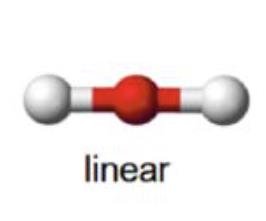
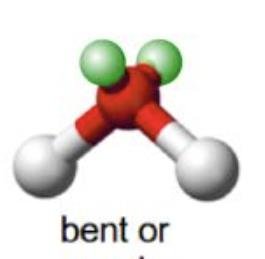
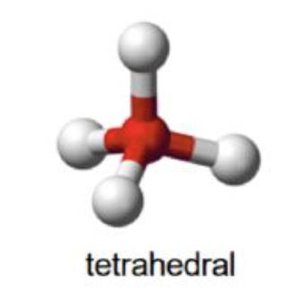
Molecular Weight and the Mole
Molecular Weight
The molecular weight of a compound is the sum of the atomic masses of its constituent atoms.
Formula:
Example: CO2 has 1 carbon (12.01 g/mol) and 2 oxygen (16.00 g/mol each), so its molecular weight is 44.01 g/mol.
The Mole and Avogadro's Number
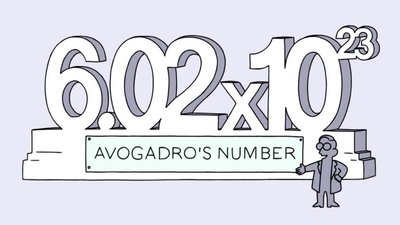
A mole is a counting unit in chemistry, representing 6.022 × 10²³ particles (Avogadro's number).
1 mole of any substance contains 6.022 × 10²³ representative particles (atoms, molecules, or formula units).
Used to relate mass, number of particles, and volume in chemical calculations.
Mole Conversions
Converting between moles and number of particles uses Avogadro's number as a conversion factor.
1 mol atoms = 6.022 × 10²³ atoms
Example: To find the number of atoms in 2.45 mol of copper, multiply 2.45 by 6.022 × 1023.
Representative Particles Table
Substance | Representative Particle |
|---|---|
He | atoms |
Cu | atoms |
Fe | atoms |
O2 | molecules |
H2O | molecules |
CO2 | molecules |
NaCl | formula units |
Calculating Moles and Mass
To calculate the mass of a substance from moles, use the molecular weight as a conversion factor.
Formula:
Example: 1 mol of glucose (C6H12O6) has a molecular weight of 180.16 g/mol.
To find the number of moles in 100 g of glucose:
Summary Table: Key Concepts
Concept | Definition | Example |
|---|---|---|
Valence Electrons | Electrons in the outermost shell | Group 1A has 1 valence electron |
Octet Rule | Atoms are stable with 8 valence electrons | Noble gases |
Ionic Bond | Transfer of electrons between metal and nonmetal | NaCl |
Covalent Bond | Sharing of electrons between nonmetals | H2O |
Mole | 6.022 × 10²³ particles | 1 mol of O2 = 6.022 × 10²³ molecules |
Additional info: Academic context was added to clarify periodic trends, molecular shapes, and mole calculations for completeness.
