 Back
Chapter 4: Introduction to Organic Compounds - GOB Chemistry Study Guide
Study Guide - Smart Notes
 Tailored notes based on your materials, expanded with key definitions, examples, and context.
Chapter 4: Introduction to Organic Compounds
4.1 Representing the Structures of Organic Compounds
Organic compounds can be represented in several ways to convey their structure and connectivity. Understanding these representations is essential for interpreting and drawing organic molecules.
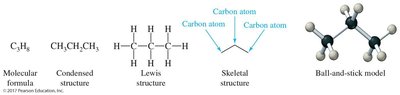
Molecular Formula: Shows the number and type of atoms present (e.g., C3H8).
Condensed Structure: Groups atoms to show connectivity without displaying all bonds (e.g., CH3CH2CH3).
Lewis Structure: Displays all atoms and bonds, including lone pairs.
Skeletal Structure: Simplifies the molecule by omitting hydrogen atoms bonded to carbon; lines represent bonds, and vertices represent carbon atoms.
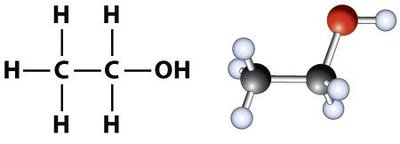
Ball-and-Stick Model: 3D representation showing spatial arrangement of atoms.
Example: Propane can be represented in all these forms.

4.2 Alkanes: The Simplest Organic Compounds
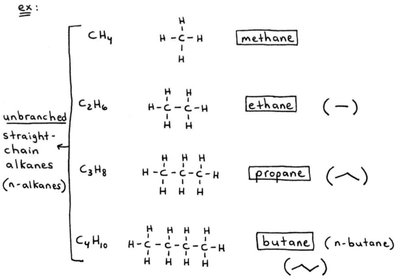
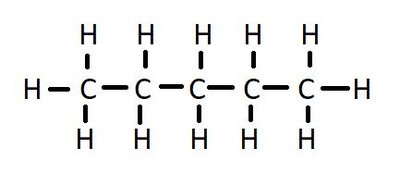
Alkanes are the simplest family of organic compounds, consisting only of carbon and hydrogen atoms connected by single bonds. They are referred to as saturated hydrocarbons.
General Formula: for straight-chain alkanes.
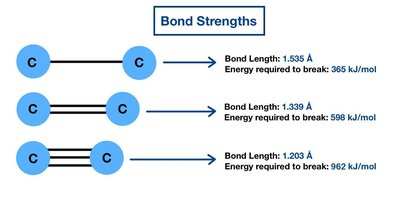
Saturated Hydrocarbons: All carbon-carbon bonds are single bonds.
Nonpolar Nature: Alkanes are nonpolar due to similar electronegativities of C and H.
Examples: Methane (CH4), Ethane (C2H6), Propane (C3H8), Butane (C4H10).


4.2 Cycloalkanes
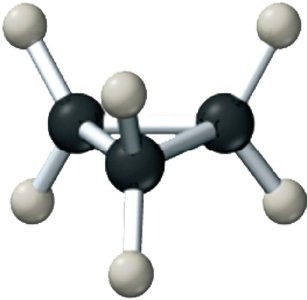
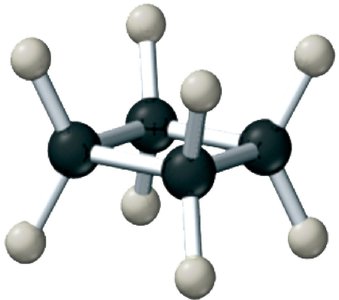
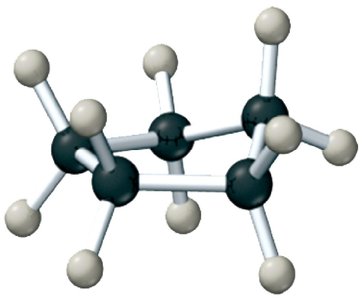
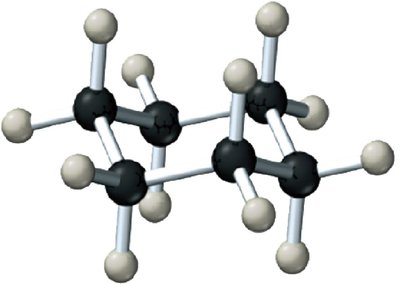
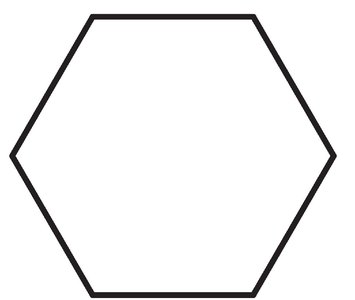
Cycloalkanes are ring-shaped alkanes. Their general formula is . Common cycloalkanes include cyclopropane, cyclobutane, cyclopentane, and cyclohexane.
Cyclopropane: C3H6 (triangle ring)
Cyclobutane: C4H8 (square ring)
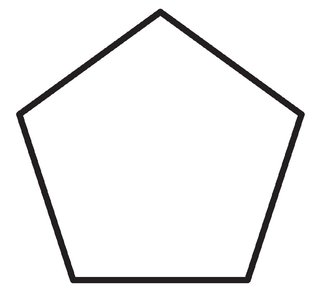
Cyclopentane: C5H10 (pentagon ring)
Cyclohexane: C6H12 (hexagon ring)

4.3 Families of Organic Compounds—Functional Groups
Functional groups are specific groups of atoms within molecules that are responsible for the characteristic chemical reactions of those molecules. Recognizing functional groups is key to understanding organic chemistry.
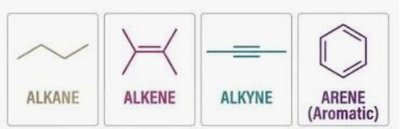
Common Functional Groups: Alkane, Alkene, Alkyne, Aromatic (arene), Alcohol, Ether, Amine, Thiol, Sulfide, Disulfide.
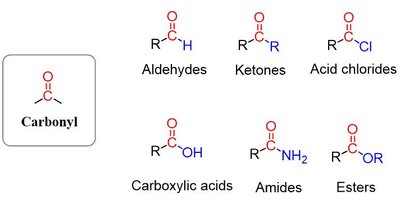
Carbonyl-containing Groups: Aldehydes, Ketones, Carboxylic acids, Esters, Amides.
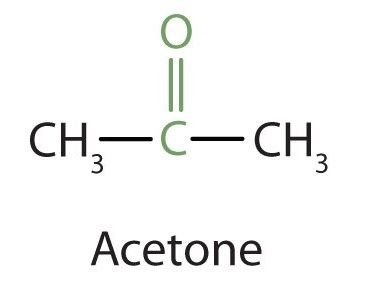
Example: Acetone is a ketone with the structure CH3COCH3.


4.3 Unsaturated Hydrocarbons—Aromatics
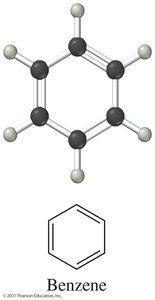
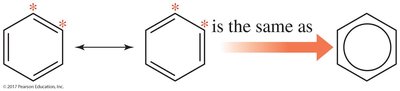
Aromatic compounds, such as benzene, contain rings with alternating double bonds. All carbon-carbon bonds in benzene are the same length due to resonance.
Benzene: C6H6, ring structure with delocalized electrons.
Resonance: Benzene's structure is often represented with a circle inside a hexagon.

4.4 Nomenclature of Simple Alkanes
The International Union of Pure and Applied Chemistry (IUPAC) system provides rules for naming organic compounds. The name consists of three parts: substituents, parent name, and suffix.
Parent Name: Based on the longest continuous carbon chain.
Substituents: Groups attached to the main chain, named and numbered for their position.
Suffix: Indicates the family (e.g., -ane for alkanes).
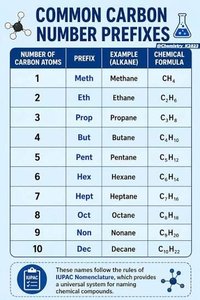
Common Prefixes: Meth-, Eth-, Prop-, But-, Pent-, Hex-, Hept-, Oct-, Non-, Dec-.




4.5 Isomerism in Organic Compounds
Isomerism refers to compounds with the same molecular formula but different structures or spatial arrangements. There are several types of isomers in organic chemistry.
Structural Isomers: Same formula, different connectivity.
Conformational Isomers: Same connectivity, different spatial arrangement due to rotation about single bonds.
Cis-Trans Stereoisomers: Restricted rotation in rings or double bonds leads to distinct spatial arrangements (cis: same side, trans: opposite sides).
Chiral Molecules and Enantiomers: Nonsuperimposable mirror images; contain a chiral center (carbon bonded to four different groups).


4.5 Unsaturated Fatty Acids and Cis Alkenes
Unsaturated fatty acids contain cis alkenes, which are important in biological systems. Essential fatty acids must be obtained from the diet.
Omega Designation: Indicates the position of the double bond relative to the terminal carbon.
Example: Linoleic and α-linolenic acids are essential fatty acids.
4.5 Stereoisomers—Chiral Molecules and Enantiomers
Chiral molecules have nonsuperimposable mirror images called enantiomers. Most enantiomers contain a chiral center, a tetrahedral carbon bonded to four different groups.
Identifying Chiral Centers: Locate tetrahedral carbons and check if all four groups are different.
Example: Limonene enantiomers have different smells (orange vs. turpentine).
4.5 Functional Groups & Naming Alkenes, Alkynes, and Carbonyl Compounds
Naming rules for alkenes, alkynes, and carbonyl compounds require identifying the longest chain containing the functional group and assigning the lowest possible numbers to the functional group carbons.
Alkenes: Use -ene suffix; indicate location of double bond.
Alkynes: Use -yne suffix; indicate location of triple bond.
Carbonyl Compounds: Use suffixes such as -al (aldehyde), -one (ketone), -oic acid (carboxylic acid), -oate (ester); carbonyl carbon gets lowest number.
Summary Table: Types of Isomerism
Type | Description | Example |
|---|---|---|
Structural Isomer | Same formula, different connectivity | Butane vs. 2-methylpropane |
Conformational Isomer | Same connectivity, different spatial arrangement | Staggered vs. eclipsed ethane |
Cis-Trans Isomer | Same formula, different spatial arrangement (restricted rotation) | Cis-2-butene vs. trans-2-butene |
Enantiomer | Nonsuperimposable mirror images | Limonene enantiomers |
Key Equations and Formulas
Alkane General Formula:
Cycloalkane General Formula:
Practice Question Example
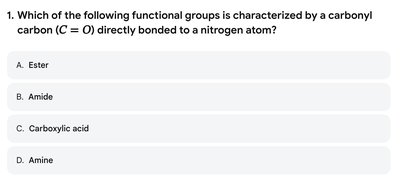
Which of the following functional groups is characterized by a carbonyl carbon (C = O) directly bonded to a nitrogen atom?
A. Ester
B. Amide (Correct)
C. Carboxylic acid
D. Amine
Additional info:
Expanded explanations and examples were added for clarity and completeness.
Tables and images were recreated and selected strictly for direct relevance to the adjacent content.
