 Back
Chapter 4: Molecular Compounds – Study Notes for GOB Chemistry
Study Guide - Smart Notes
 Tailored notes based on your materials, expanded with key definitions, examples, and context.
Chapter 4: Molecular Compounds
4.1 Covalent Bonds
Covalent bonds are fundamental to molecular compounds, formed by the sharing of electrons between atoms. This section introduces the nature of covalent bonds and distinguishes them from ionic bonds.
Covalent bond: A chemical bond formed when two atoms share one or more pairs of electrons.
Molecule: A group of atoms held together by covalent bonds.
Octet Rule: Main group elements tend to react to achieve eight valence electrons (or two for hydrogen), resulting in a noble gas electron configuration.
Formation of Covalent Bonds: Nonmetals achieve an octet by sharing electrons in covalent bonds.
Example: Hydrogen atoms (each with one electron) combine to form a hydrogen molecule (H2) by sharing their electrons, resulting in a stable configuration similar to helium.
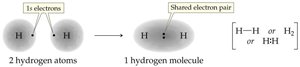
Bond Length: The optimum distance between nuclei in a covalent bond, balancing attractive and repulsive forces.
Diatomic Elements: Seven elements exist naturally as diatomic molecules: nitrogen (N2), oxygen (O2), hydrogen (H2), fluorine (F2), chlorine (Cl2), bromine (Br2), and iodine (I2).
4.2 Covalent Bonds and the Periodic Table
Molecular compounds consist of molecules, not ions. The number of covalent bonds an atom forms is predictable based on its position in the periodic table.
Molecular Compound: A compound made up of molecules held together by covalent bonds.
Bonding Patterns: Main group elements form covalent bonds to achieve octet configurations.
Exceptions to the Octet Rule: Boron forms only three covalent bonds (six electrons). Elements in the third row and below can have expanded octets due to vacant d orbitals.
Example: Iodine and chlorine form one covalent bond each in ICl, achieving octets.
4.3 Multiple Covalent Bonds
Some molecules require sharing more than one pair of electrons between atoms to satisfy the octet rule, resulting in double or triple bonds.
Single Bond: One pair of shared electrons, represented by a single line (e.g., H–H).
Double Bond: Two pairs of shared electrons, represented by a double line (e.g., O=O).
Triple Bond: Three pairs of shared electrons, represented by a triple line (e.g., N≡N).
Common Elements: Carbon, nitrogen, and oxygen frequently form multiple bonds.
Example: Oxygen molecule (O2) forms a double bond to achieve octets.
4.4 Coordinate Covalent Bonds
A coordinate covalent bond occurs when both electrons in the shared pair are donated by the same atom. Once formed, it is indistinguishable from other covalent bonds.
Coordinate Covalent Bond: Both electrons in the bond originate from one atom.
Unusual Bonding Patterns: Nitrogen may have four covalent bonds, oxygen may have three.
Example: Boron can achieve an octet by forming a coordinate covalent bond with a filled valence orbital from another atom.
4.5 Characteristics of Molecular Compounds
Molecular compounds differ from ionic compounds in structure, composition, and properties.
Ionic Compounds: High melting and boiling points due to strong electrostatic attraction between ions.
Molecular Compounds: Lower melting and boiling points; molecules are neutral and lack strong electrostatic attraction.
Property | Ionic Compounds | Molecular Compounds |
|---|---|---|
Melting/Boiling Point | High | Low |
Structure | Crystal lattice | Discrete molecules |
Electrical Conductivity | Conducts when molten or dissolved | Does not conduct |
Bonding | Electrostatic attraction | Covalent bonds |
4.6 Molecular Formulas and Lewis Structures
Molecular formulas specify the types and numbers of atoms in a molecule. Lewis structures show both the connections among atoms and the locations of lone-pair valence electrons.
Molecular Formula: Indicates the exact number and type of atoms in a molecule (e.g., H2O).
Structural Formula: Shows connections among atoms using lines for covalent bonds.
Lewis Structure: Shows both bonds and lone pairs of electrons.
4.7 Drawing Lewis Structures
Lewis structures are drawn using a systematic method based on the molecular formula and the octet rule.
Step 1: Find the total number of valence electrons for all atoms.
Step 2: Draw lines between connected atoms to represent bonding pairs.
Step 3: Add lone pairs so each atom (except H) has an octet.
Step 4: Place remaining electrons as lone pairs on the central atom.
Step 5: If the central atom lacks an octet, form multiple bonds using lone pairs from neighboring atoms.
Example: Hydrogen cyanide (HCN) has a triple bond between C and N to satisfy the octet rule.
4.8 The Shapes of Molecules
The shape of a molecule is determined by the Valence-Shell Electron-Pair Repulsion (VSEPR) model, which considers the number of electron charge clouds around the central atom.
VSEPR Model: Electron charge clouds orient as far apart as possible.
Bond Angle: The angle formed by three adjacent atoms.
Linear: Two charge clouds, bond angle of 180°.
Trigonal Planar: Three charge clouds, bond angle of 120°.
Tetrahedral: Four charge clouds, bond angle of 109.5°.
Bent: Lone pairs reduce bond angles.
Example: Hydronium ion (H3O+) is pyramidal due to three bonds and one lone pair on oxygen.
4.9 Polar Covalent Bonds and Electronegativity
Bond polarity arises when electrons are shared unequally between atoms due to differences in electronegativity.
Polar Covalent Bond: Electrons are attracted more strongly by one atom.
Electronegativity: The ability of an atom to attract electrons in a covalent bond. Fluorine is the most electronegative (value = 4).
Trends: Electronegativity decreases from right to left and from top to bottom in the periodic table.
Bond Classification:
Nonpolar covalent: Small or zero electronegativity difference (e.g., C–H).
Polar covalent: Moderate difference (e.g., N–H).
Ionic: Large difference (e.g., Li–Cl).
Dipole: Partial charges at each end of a polar bond create a dipole.
4.10 Polar Molecules
Molecular polarity depends on both bond polarities and molecular geometry. Symmetrical molecules may have polar bonds but be nonpolar overall.
Polarity: Electrons are displaced toward the more electronegative atom.
Shape: The shape of the molecule determines whether polar bonds result in a polar molecule.
Example: Hydrogen cyanide (HCN) is linear and polar; vinyl chloride is planar and polar due to the C–Cl bond.
4.11 Naming Binary Molecular Compounds
Binary molecular compounds are named using prefixes to indicate the number of atoms and modifying the second element with the –ide suffix.
Formula Writing: The less electronegative element is written first.
Naming Steps:
Name the first element, using a prefix if needed.
Name the second element, modify with –ide, and add numerical prefixes.
Numerical Prefixes: mono- (1), di- (2), tri- (3), tetra- (4), penta- (5), etc.
Example: Dinitrogen trioxide (N2O3), Germanium tetrachloride (GeCl4), Phosphorus pentachloride (PCl5).
Prefix | Number |
|---|---|
mono- | 1 |
di- | 2 |
tri- | 3 |
tetra- | 4 |
penta- | 5 |
hexa- | 6 |
hepta- | 7 |
octa- | 8 |
nona- | 9 |
deca- | 10 |
Additional info:
These notes expand on brief points from the original slides, providing definitions, examples, and context for GOB Chemistry students.
Equations and formulas are referenced in the context of Lewis structures and molecular geometry, but specific LaTeX equations are not required for this chapter.
