 Back
BackChapter 5: Chemical Reactions – Principles, Calculations, and Applications
Study Guide - Smart Notes
 Tailored notes based on your materials, expanded with key definitions, examples, and context.
Introduction to Chemical Reactions
General Features of Physical and Chemical Changes
Chemical reactions are central to chemistry, involving the transformation of substances through the breaking and forming of chemical bonds. Understanding the distinction between physical and chemical changes is foundational:
Physical Change: Alters the physical state (e.g., melting, boiling) without changing the chemical composition.
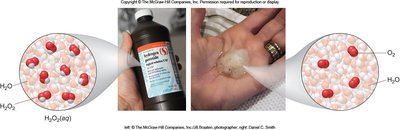
Chemical Change (Chemical Reaction): Converts one substance into another by breaking bonds in reactants and forming new bonds in products.
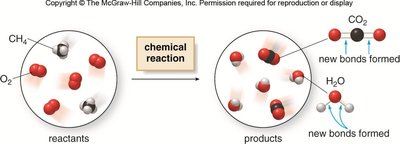
Example: The reaction of methane (CH4) with oxygen (O2) produces carbon dioxide (CO2) and water (H2O).
Writing and Balancing Chemical Equations
Structure of Chemical Equations
A chemical equation uses formulas and symbols to represent the reactants and products of a reaction. The reactants are written on the left, products on the right, and coefficients indicate the number of molecules or moles involved.
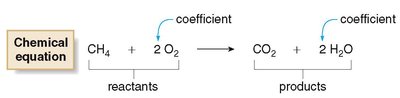
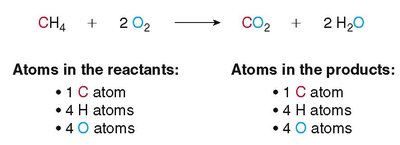
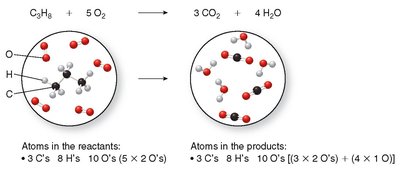
Law of Conservation of Mass: Atoms are neither created nor destroyed in a chemical reaction; equations must be balanced.
Coefficients: Used to balance equations, ensuring the same number of each atom on both sides.
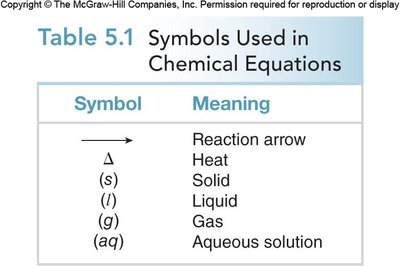
Symbols Used in Chemical Equations
Symbol | Meaning |
|---|---|
→ | Reaction arrow |
Δ | Heat |
(s) | Solid |
(l) | Liquid |
(g) | Gas |
(aq) | Aqueous solution |
Steps to Balance a Chemical Equation
Write the correct formulas for all reactants and products.
Balance one element at a time using coefficients (never change subscripts).
Check that the smallest set of whole numbers is used for coefficients.
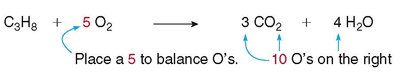
Example: Balancing the combustion of propane (C3H8):



The Mole and Avogadro’s Number
Definition and Use
The mole is a counting unit in chemistry, representing 6.02 × 10²³ items (Avogadro’s number). It allows chemists to relate the mass of substances to the number of particles (atoms, molecules).
1 mole of C atoms = 6.02 × 10²³ C atoms
1 mole of CO2 molecules = 6.02 × 10²³ CO2 molecules
Conversion factors:
Sample Calculation
How many molecules are in 5.0 moles of CO2?
Given: 5.0 mol CO2
Conversion:
Mass to Mole Conversions
Formula Weight and Molar Mass
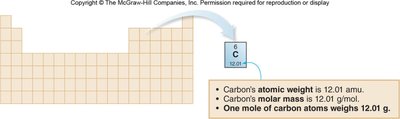
The formula weight is the sum of atomic weights of all atoms in a compound (in amu). The molar mass is the mass of one mole of a substance (in grams), numerically equal to the formula weight.
Example: FeSO4 has a formula weight of 151.877 amu, so its molar mass is 151.877 g/mol.
Relating Grams to Moles
The molar mass is used as a conversion factor between grams and moles:
Example: How many moles are in 100 g of aspirin (C9H8O4, molar mass 180.2 g/mol)?

Relating Grams to Number of Molecules
To find the number of molecules in a given mass:
Convert mass to moles using molar mass.
Convert moles to molecules using Avogadro’s number.
Example: How many molecules are in a 325-mg tablet of aspirin?
Convert mg to g:
Convert to moles:
Convert to molecules:

Mole Calculations in Chemical Equations
Using Balanced Equations for Mole Ratios
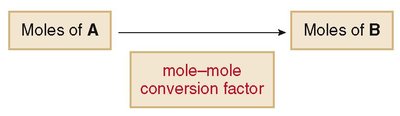
Balanced chemical equations provide the mole ratios of reactants and products, which are used as conversion factors in stoichiometric calculations.
Example:
Mole ratios:


Sample Calculation
How many moles of CO are produced from 3.5 moles of C2H6?
Balanced equation:
Conversion:

Mass Calculations in Chemical Equations
Converting Moles of Reactant to Grams of Product
To determine the mass of product formed from a given amount of reactant, use the following steps:
Convert moles of reactant to moles of product using the mole ratio from the balanced equation.
Convert moles of product to grams using the molar mass.








Example: How many grams of O3 are formed from 9.0 mol of O2?
Balanced equation:
Step 1:
Step 2:







Converting Grams of Reactant to Grams of Product
To convert grams of reactant to grams of product:
Convert grams of reactant to moles using molar mass.
Convert moles of reactant to moles of product using the mole ratio.
Convert moles of product to grams using molar mass.
Example: How many grams of ethanol (C2H6O) are formed from 14 g of ethylene (C2H4)?














Percent Yield
Theoretical vs. Actual Yield
The theoretical yield is the maximum amount of product expected based on stoichiometry. The actual yield is the amount actually obtained from the reaction. The percent yield is calculated as:
Example: If the theoretical yield is 23 g and the actual yield is 15 g, percent yield is .
Limiting Reactants
Identifying the Limiting Reactant
The limiting reactant is the reactant that is completely consumed first, thus limiting the amount of product formed. To determine the limiting reactant:
Convert the mass of each reactant to moles.
Use the balanced equation to determine which reactant produces less product; this is the limiting reactant.
Example: For the reaction , if 10.0 g of N2 and 10.0 g of O2 are used:
Convert grams to moles: ;
From stoichiometry, 0.357 mol N2 would require 0.357 mol O2, but only 0.313 mol O2 is available, so O2 is limiting.
Oxidation and Reduction (Redox Reactions)
General Features
Oxidation is the loss of electrons, while reduction is the gain of electrons. These processes always occur together in redox reactions, involving electron transfer between substances.
Oxidizing agent: Substance that is reduced (gains electrons) and causes oxidation.
Reducing agent: Substance that is oxidized (loses electrons) and causes reduction.
Example:
Zn is oxidized (loses electrons), acts as reducing agent.
Cu2+ is reduced (gains electrons), acts as oxidizing agent.
Half-reactions:
Oxidation:
Reduction:
Examples of Redox Reactions
Iron rusting:
Alkaline battery:
Oxidation can also be described as gain of oxygen or loss of hydrogen, while reduction is loss of oxygen or gain of hydrogen.
