Back
BackChapter 7: Gases, Liquids, and Solids – Study Notes
Study Guide - Smart Notes
 Tailored notes based on your materials, expanded with key definitions, examples, and context.
States of Matter
The Three States of Matter
Matter exists in three primary states: gas, liquid, and solid. Each state is characterized by distinct physical properties, particle arrangements, and types of movement.
Gas: Expands to fill its container, particles are far apart and move rapidly, low density, negligible interactions between particles.
Liquid: Has a fixed volume but takes the shape of its container, particles are close but can move past each other, higher density than gases, moderate interactions.
Solid: Has a definite shape and volume, particles are closely packed in a fixed arrangement, high density, strong interactions.
Property | Gas | Liquid | Solid |
|---|---|---|---|
Shape & Volume | Expands to fill container | Fixed volume, shape of container | Definite shape & volume |
Arrangement | Random, far apart | Random, close | Fixed, very close |
Density | Low (<0.01 g/mL) | High (~1 g/mL) | High (1–10 g/mL) |
Particle Movement | Very fast | Moderate | Slow |
Interactions | None | Strong | Very strong |
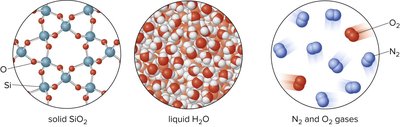
Key Point: The state of a substance depends on the balance between the kinetic energy of its particles and the strength of intermolecular forces.
Gas Laws
Kinetic-Molecular Theory of Gases
The kinetic-molecular theory explains the behavior of gases:
Gas particles move randomly and rapidly.
They are small compared to the space between them.
No attractive forces exist between particles.
Kinetic energy increases with temperature.
Collisions are elastic; particles rebound without energy loss.
Gas Pressure
Gas pressure is the force exerted by gas particles colliding with the walls of a container. It is defined as:
1 atmosphere (atm) = 760 mm Hg = 760 torr = 14.70 psi = 101,325 Pa
Boyle’s Law
For a fixed amount of gas at constant temperature, pressure and volume are inversely related:
or for two sets of conditions:
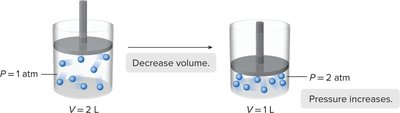
Example: If the volume of a gas is halved, the pressure doubles.
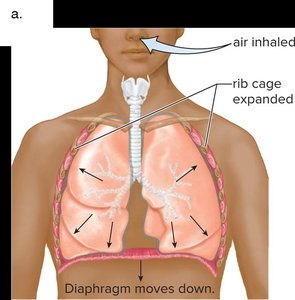
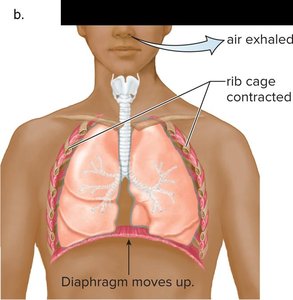
Application: Breathing
Inhalation increases lung volume, decreasing pressure and drawing air in. Exhalation decreases volume, increasing pressure and expelling air.
Charles’s Law
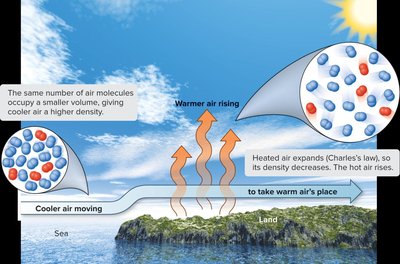
For a fixed amount of gas at constant pressure, volume is proportional to Kelvin temperature:
or
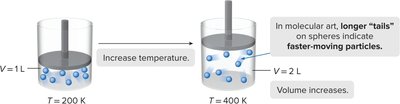
Example: Doubling the temperature (in K) doubles the volume.
Gay-Lussac’s Law
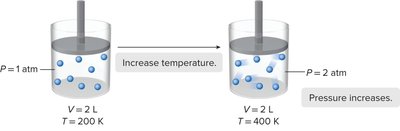
For a fixed amount of gas at constant volume, pressure is proportional to Kelvin temperature:
or
Combined Gas Law
Combines Boyle’s, Charles’s, and Gay-Lussac’s laws:
Avogadro’s Law
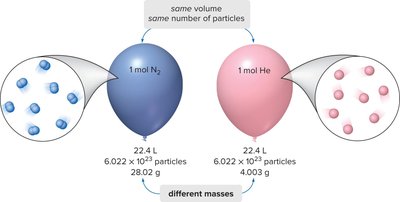
At constant temperature and pressure, the volume of a gas is proportional to the number of moles:
or
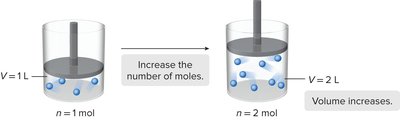
At STP (0°C, 1 atm), 1 mole of any gas occupies 22.4 L (standard molar volume).
The Ideal Gas Law
Relates pressure, volume, temperature, and moles:
R = 0.08206 L·atm/(mol·K) or 62.37 L·mmHg/(mol·K)
Dalton’s Law of Partial Pressures
The total pressure of a gas mixture is the sum of the partial pressures of each component:
Intermolecular Forces
Types of Intermolecular Forces
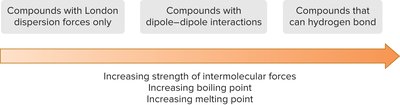
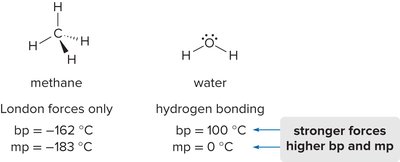
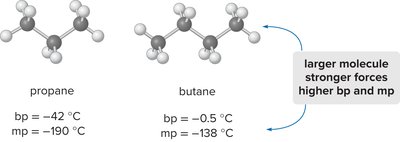
Intermolecular forces are attractions between molecules, influencing physical properties like boiling and melting points.
London Dispersion Forces: Weak, present in all molecules due to temporary dipoles.
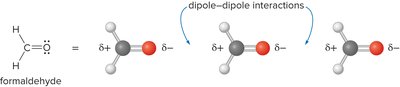
Dipole-Dipole Interactions: Moderate, occur between polar molecules with permanent dipoles.
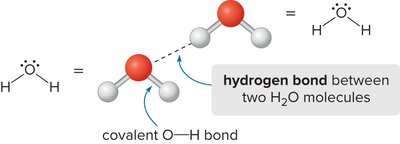
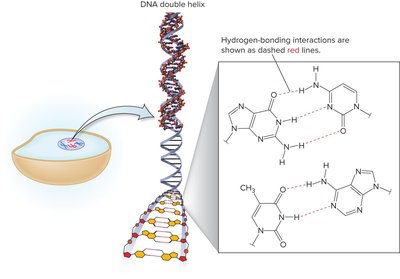
Hydrogen Bonding: Strongest, occurs when H is bonded to O, N, or F and attracted to O, N, or F in another molecule.
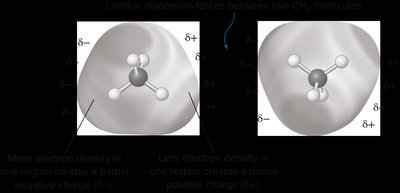
Type of Force | Relative Strength | Exhibited by | Example |
|---|---|---|---|
London dispersion | Weak | All molecules | CH4, H2CO, H2O |
Dipole-dipole | Moderate | Polar molecules | H2CO, H2O |
Hydrogen bonding | Strong | O–H, N–H, or H–F bonds | H2O |
Boiling and Melting Points
The stronger the intermolecular forces, the higher the boiling and melting points of a substance.
Liquids: Properties and Behavior
Evaporation and Condensation
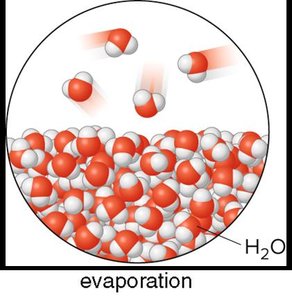
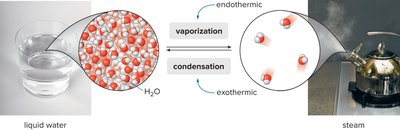
Evaporation is the endothermic process where a liquid becomes a gas. Condensation is the exothermic process where a gas becomes a liquid.
Vapor Pressure
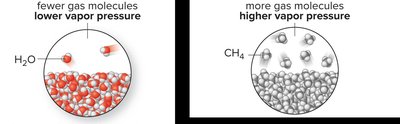
Vapor pressure is the pressure exerted by a vapor in equilibrium with its liquid. It increases with temperature and is lower for substances with strong intermolecular forces.
Viscosity and Surface Tension
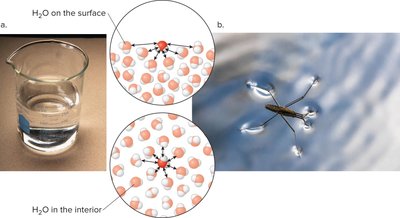
Viscosity is a liquid's resistance to flow; higher with stronger intermolecular forces or larger molecules. Surface tension is the resistance of a liquid to spread out, also higher with stronger forces.
Solids: Structure and Types
Crystalline and Amorphous Solids
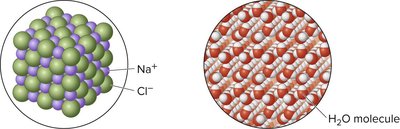
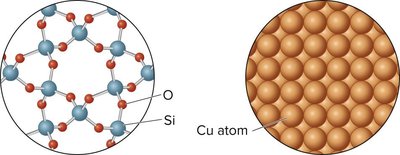
Solids can be crystalline (ordered, repeating structure) or amorphous (no regular arrangement). Crystalline solids are further classified as ionic, molecular, network, or metallic.
Ionic: Composed of ions (e.g., NaCl).
Molecular: Composed of molecules (e.g., H2O).
Network: Atoms covalently bonded in a network (e.g., SiO2).
Metallic: Metal cations in a sea of electrons (e.g., Cu).
Energy and Phase Changes
Specific Heat
Specific heat is the energy required to raise the temperature of 1 g of a substance by 1°C:
Phase Changes and Heats of Transformation
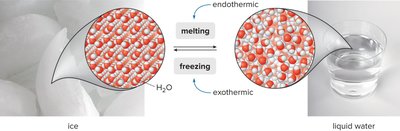
Heat of fusion: Energy to melt 1 g of a solid.
Heat of vaporization: Energy to vaporize 1 g of a liquid.
Process | Phases | Energy Change |
|---|---|---|
Melting | Solid → liquid | Endothermic (absorbs energy) |
Freezing | Liquid → solid | Exothermic (releases energy) |
Vaporization | Liquid → gas | Endothermic |
Condensation | Gas → liquid | Exothermic |
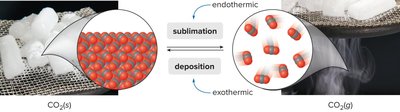
Sublimation | Solid → gas | Endothermic |
Deposition | Gas → solid | Exothermic |
Heating and Cooling Curves
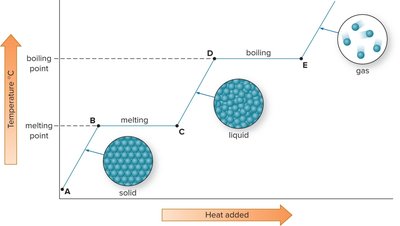
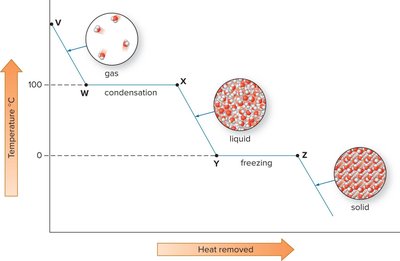
A heating curve shows temperature changes as heat is added; a cooling curve shows temperature changes as heat is removed. Plateaus indicate phase changes where temperature remains constant as energy is used to change state.