 Back
BackChapter 8: Chemical Reactions – Study Notes
Study Guide - Smart Notes
 Tailored notes based on your materials, expanded with key definitions, examples, and context.
Chapter 8: Chemical Reactions
Introduction to Chemical Reactions
Chemical reactions are fundamental processes in chemistry where substances (reactants) are transformed into new substances (products) through the breaking and forming of chemical bonds. These reactions are central to both natural phenomena and industrial applications, often accompanied by observable changes such as energy release, color change, or gas formation.
Chemical change involves the rearrangement of atoms to form new substances.
Energy is often released or absorbed during chemical reactions.
Example: The reaction between hydrogen and oxygen to produce water powers hydrogen fuel cell vehicles.
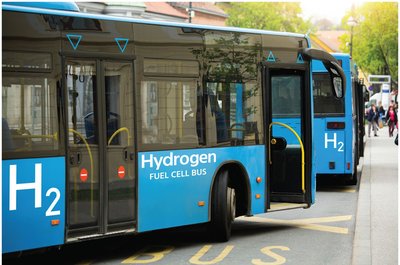
Indicators of Chemical Reactions
Several observable signs can indicate that a chemical reaction has occurred:
Color change
Formation of a gas (bubbles)
Formation of a precipitate (solid)
Energy change (heat, light)
Example: Leaves changing color in autumn is a result of multiple chemical reactions in plant cells.
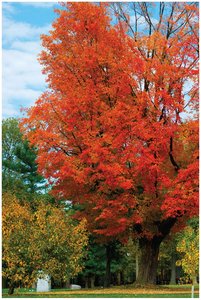
Chemical Equations
Structure and Symbols
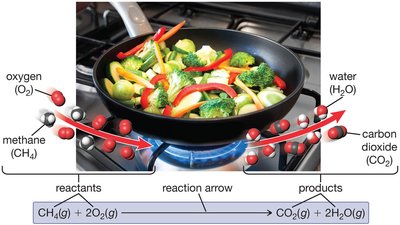
A chemical equation uses chemical formulas and symbols to represent a chemical reaction. It shows the reactants on the left, the products on the right, and an arrow indicating the direction of the reaction.
Reactants: Starting substances (left side)
Products: New substances formed (right side)
Arrow (→): Separates reactants from products
Physical states: Indicated as (s) solid, (l) liquid, (g) gas, (aq) aqueous (dissolved in water)
Balancing Chemical Equations
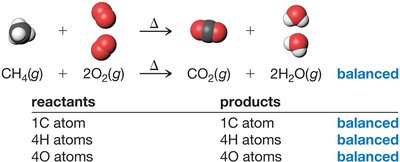
Balancing a chemical equation ensures the law of conservation of mass is obeyed—there must be the same number of each type of atom on both sides of the equation. This is achieved by adjusting coefficients (whole numbers in front of formulas), not subscripts.
Coefficients indicate the number of molecules or moles.
Subscripts indicate the number of atoms in a molecule and must not be changed to balance equations.
Balance elements that appear in only one reactant and one product first.
Types of Chemical Reactions
Classification of Reactions
Chemists classify reactions into four main types to better understand and communicate the changes occurring:
Combination (Synthesis) Reaction: Two or more substances combine to form one product.
Decomposition Reaction: A single compound breaks down into two or more products.
Replacement Reaction: Atoms in a compound are replaced by atoms of another element (single or double replacement).
Combustion Reaction: A hydrocarbon reacts with oxygen to produce carbon dioxide, water, and energy.
Combination Reactions
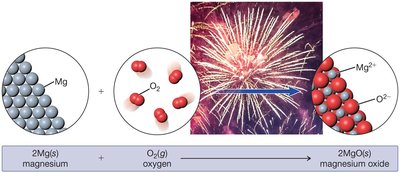
In a combination reaction, two or more elements or compounds form a single product.
General form: A + B → AB
Example: 2Mg(s) + O2(g) → 2MgO(s)
Decomposition Reactions
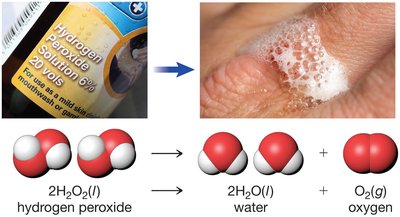
A decomposition reaction involves a single reactant splitting into two or more products.
General form: AB → A + B
Example: 2H2O2(l) → 2H2O(l) + O2(g)
Single Replacement Reactions
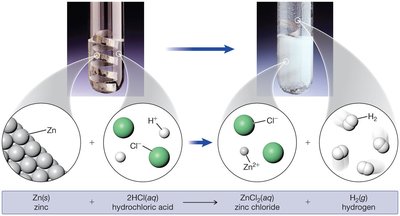
In a single replacement reaction, one element replaces another in a compound.
General form: A + BC → AC + B
Example: Zn(s) + 2HCl(aq) → ZnCl2(aq) + H2(g)
Double Replacement Reactions
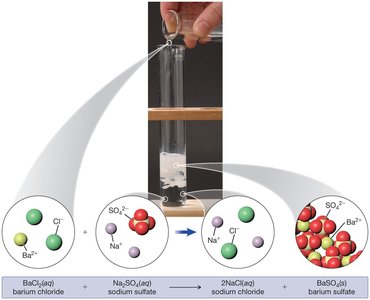
Double replacement reactions involve two compounds exchanging ions to form two new compounds.
General form: AB + CD → AD + CB
Example: BaCl2(aq) + Na2SO4(aq) → 2NaCl(aq) + BaSO4(s)
Combustion Reactions
Combustion reactions occur when a hydrocarbon reacts with oxygen to produce carbon dioxide, water, and energy (heat and/or light).
General form: Hydrocarbon + O2 → CO2 + H2O
Example: CH4(g) + 2O2(g) → CO2(g) + 2H2O(g)
Summary Table: Types of Reactions
Type | General Form | Description |
|---|---|---|
Combination | A + B → AB | Two or more substances form one product |
Decomposition | AB → A + B | One substance splits into two or more products |
Single Replacement | A + BC → AC + B | One element replaces another in a compound |
Double Replacement | AB + CD → AD + CB | Two elements switch places |
Oxidation-Reduction (Redox) Reactions
Definition and Identification
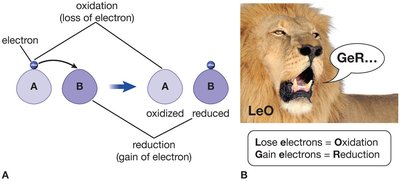
Redox reactions involve the transfer of electrons between substances. Oxidation is the loss of electrons, while reduction is the gain of electrons. These reactions are essential in both industrial and biological processes.
Oxidation: Loss of electrons
Reduction: Gain of electrons
Mnemonic: "LEO the lion says GER" (Lose Electrons = Oxidation, Gain Electrons = Reduction)
Electron Transfer in Redox Reactions
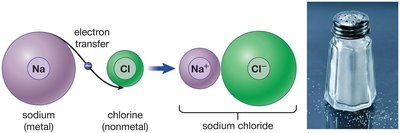
Metals tend to lose electrons (oxidized), forming positive ions, while nonmetals gain electrons (reduced), forming negative ions. This electron transfer is the basis for many important chemical and biological processes.
Example: Sodium (Na) transfers an electron to chlorine (Cl) to form sodium chloride (NaCl).
Applications of Redox Reactions
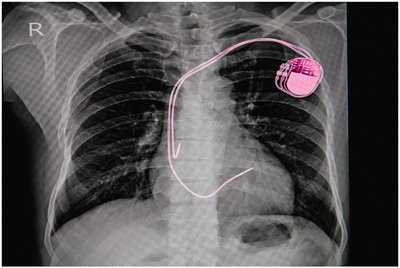
Batteries: Use redox reactions to generate electricity (e.g., pacemakers).
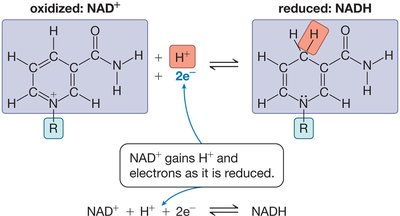
Biological systems: Redox reactions involve the transfer of oxygen and hydrogen, as seen with NAD+ and NADH in cellular respiration.
The Mole and Avogadro’s Number
Definition of the Mole
The mole (mol) is a counting unit in chemistry, representing 6.02 × 10²³ particles (Avogadro’s number). It allows chemists to count atoms, molecules, or ions in a given sample.
1 mole O atoms = 6.02 × 10²³ O atoms
1 mole CO2 molecules = 6.02 × 10²³ CO2 molecules
Conversions Using Avogadro’s Number
Avogadro’s number is used as a conversion factor between moles and number of particles:
From moles to particles:
From particles to moles:
Molar Mass and Calculations
Molar Mass
Molar mass is the mass of one mole of a substance, expressed in grams per mole (g/mol). It is numerically equal to the atomic or molecular mass in atomic mass units (amu).
Find molar mass by adding atomic masses of all atoms in a formula.
Example: H2O: 2(1.01) + 16.00 = 18.02 g/mol
Mass-to-Mole and Mole-to-Mass Conversions
Molar mass is used to convert between mass and moles:
From mass to moles:
From moles to mass:
Stoichiometry: Calculations in Chemical Reactions
Mole Ratios and Balanced Equations
The coefficients in a balanced chemical equation indicate the mole ratios of reactants and products. These ratios are used to calculate the amount of one substance from the amount of another.
Example: N2(g) + O2(g) → 2NO(g) gives the mole ratios 1:1:2.
Theoretical Yield and Mass Calculations
The theoretical yield is the maximum amount of product that can be formed from a given amount of reactant. Calculations often involve converting mass of reactant to moles, using mole ratios, and then converting to mass of product.
Step | Description |
|---|---|
1 | Convert grams of reactant to moles (using molar mass) |
2 | Use mole ratio from balanced equation to find moles of product |
3 | Convert moles of product to grams (using molar mass) |


Summary of Key Concepts
Chemical reactions involve the rearrangement of atoms and are represented by balanced chemical equations.
There are four main types of reactions: combination, decomposition, replacement, and combustion.
Redox reactions involve electron transfer and are essential in both technology and biology.
The mole and Avogadro’s number allow chemists to count particles and relate mass to number of particles.
Molar mass is used to convert between mass and moles in chemical calculations.
Stoichiometry uses balanced equations and mole ratios to calculate amounts of reactants and products.
