 Back
BackChapter 9: Energy, Rate, and Equilibrium – Study Notes
Study Guide - Smart Notes
 Tailored notes based on your materials, expanded with key definitions, examples, and context.
Energy, Rate, and Equilibrium
Introduction
This chapter explores the fundamental concepts of energy in chemical systems, how energy changes during reactions, the factors affecting reaction rates, and the principles of chemical equilibrium. Understanding these topics is essential for predicting and controlling chemical processes in both laboratory and biological contexts.
Energy in Chemistry
Forms of Energy
Energy is defined as the capacity to do work. In chemistry, energy exists primarily in two forms:
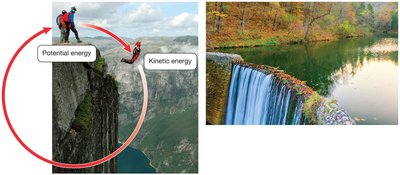
Kinetic Energy: The energy of motion. Any moving object or particle possesses kinetic energy.
Potential Energy: Stored energy due to position or composition. Chemical bonds store potential energy.
Example: A person standing on a cliff has potential energy due to their position. When they jump, this energy is converted to kinetic energy as they fall.
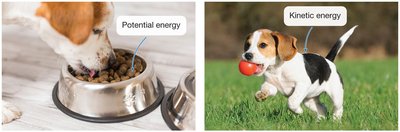
Example: Food contains potential energy, which is converted to kinetic energy when an animal moves.
Law of Conservation of Energy
The law of conservation of energy states that energy cannot be created or destroyed, only converted from one form to another. For example, the chemical energy in food or fuel is transformed into kinetic energy and heat during metabolism or combustion.
Units of Energy
Calorie (cal): The amount of energy needed to raise the temperature of 1 gram of water by 1°C.
Joule (J): The SI unit of energy. 1 cal = 4.184 J.
Kilocalorie (kcal): 1 kcal = 1000 cal. In nutrition, 1 Calorie (with a capital C) = 1 kcal.
Kilojoule (kJ): 1 kJ = 1000 J. 1 kcal = 4.184 kJ.
Example Calculation: To convert 530 kcal to kJ: kJ.
Energy Changes in Chemical Reactions
Bond Energy
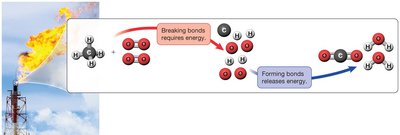
Chemical reactions involve breaking bonds in reactants (which requires energy) and forming new bonds in products (which releases energy). The energy required to break a specific bond is called its bond energy.
Bond | Bond Energy (kJ/mol) |
|---|---|
H–H | 436 |
H–C | 410 |
H–O | 460 |
C–O | 350 |
C–N | 300 |
O=O | 499 |
Additional info: Table values are typical bond dissociation energies used to estimate reaction enthalpy changes.
Enthalpy Change (ΔH) and Types of Reactions
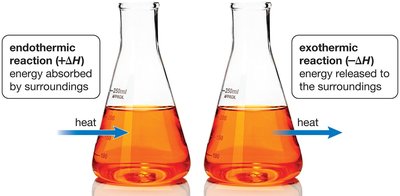
The enthalpy change (ΔH) of a reaction is the heat absorbed or released during a chemical reaction at constant pressure.
Endothermic Reaction: Absorbs heat from surroundings. ΔH is positive (+ΔH).
Exothermic Reaction: Releases heat to surroundings. ΔH is negative (−ΔH).
Examples of Endothermic and Exothermic Reactions
Endothermic Reactions
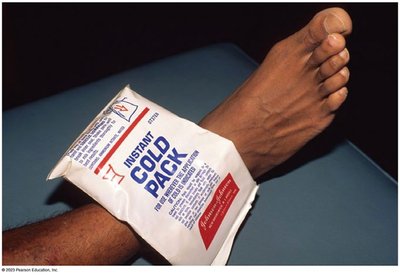
Instant Cold Packs: Use the endothermic dissolution of ammonium nitrate to absorb heat and reduce swelling.
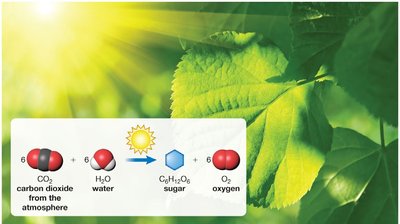
Photosynthesis: Plants absorb energy from sunlight to convert carbon dioxide and water into glucose and oxygen.
Exothermic Reactions
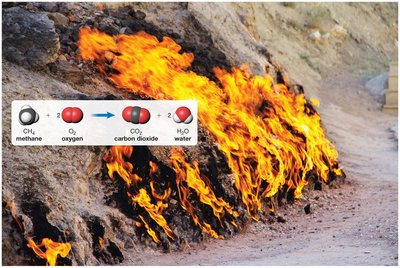
Combustion: The burning of methane (CH4) in oxygen releases a large amount of energy as heat and light.
ATP and Energy in Biological Systems
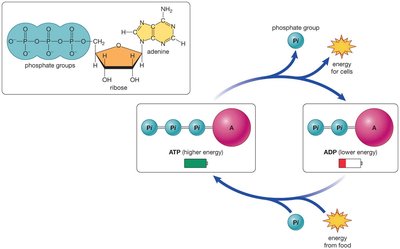
Many biological reactions are exothermic, providing the energy needed for life processes. Adenosine triphosphate (ATP) is the primary energy carrier in cells. ATP hydrolysis releases energy, which is used for cellular work, and ADP is recharged back to ATP using energy from food.
Calculations Using Enthalpy of Reaction
The enthalpy change (ΔH) in a balanced chemical equation can be used as a conversion factor to calculate the amount of energy absorbed or released for a given amount of reactant or product.
Example: For the reaction NH4NO3(s) → NH4+(aq) + NO3−(aq), ΔH = +26 kJ, the number of moles required to absorb a specific amount of heat can be calculated using stoichiometry.
Energy Diagrams and Activation Energy
Energy Diagrams
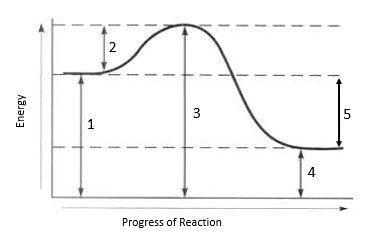
An energy diagram plots the energy of a system versus the progress of a reaction. It shows the energy of reactants, products, and the activation energy barrier.
In exothermic reactions, products are lower in energy than reactants.
In endothermic reactions, products are higher in energy than reactants.
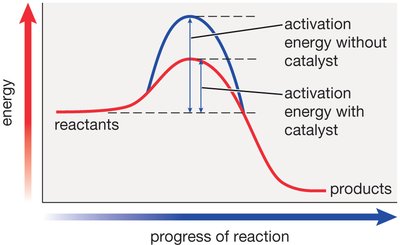
Activation energy (Ea): The minimum energy required for a reaction to proceed, represented by the peak of the energy diagram.
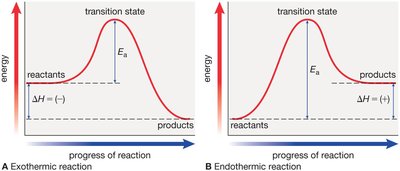
Example: Identifying activation energy on a reaction energy diagram.
Reaction Rates
Definition and Measurement
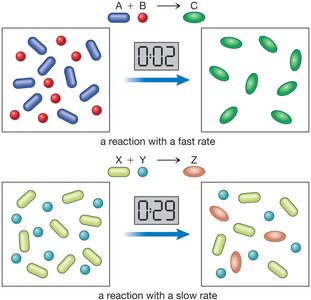
The rate of a chemical reaction is the speed at which reactants are converted to products. It is measured as the change in concentration of a reactant or product per unit time.
Factors Affecting Reaction Rate
Concentration: Increasing the concentration of reactants increases the rate by increasing the frequency of collisions.
Temperature: Raising the temperature increases the rate by providing more energy for collisions.
Catalysts: Catalysts increase reaction rates by providing an alternative pathway with lower activation energy. They are not consumed in the reaction.
Chemical Equilibrium
Dynamic Equilibrium
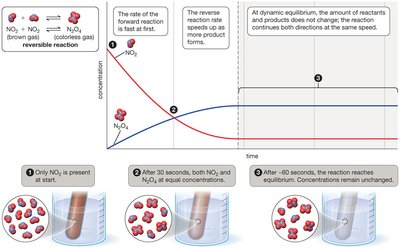
Some chemical reactions are reversible. At dynamic equilibrium, the rates of the forward and reverse reactions are equal, and the concentrations of reactants and products remain constant.
The Equilibrium Constant (K)
The equilibrium constant (K) expresses the ratio of the concentrations of products to reactants at equilibrium, each raised to the power of their coefficients in the balanced equation:

If K is much greater than 1, the equilibrium mixture contains mostly products.
If K is much less than 1, the equilibrium mixture contains mostly reactants.
Example Calculation: For the reaction 2NO(g) + 2H2(g) ⇄ N2(g) + 2H2O(g), K can be calculated using measured equilibrium concentrations.
Summary Table: Key Concepts
Concept | Definition/Key Point |
|---|---|
Energy | Capacity to do work; kinetic (motion) or potential (stored) |
Law of Conservation of Energy | Energy cannot be created or destroyed |
Enthalpy Change (ΔH) | Heat absorbed or released in a reaction |
Endothermic Reaction | Absorbs heat (+ΔH) |
Exothermic Reaction | Releases heat (−ΔH) |
Activation Energy (Ea) | Minimum energy required for reaction |
Catalyst | Lowers activation energy, increases rate |
Dynamic Equilibrium | Forward and reverse reaction rates equal |
Equilibrium Constant (K) | Ratio of product to reactant concentrations at equilibrium |
