 Back
BackChapter 9: Solutions – Properties, Preparation, and Behavior
Study Guide - Smart Notes
 Tailored notes based on your materials, expanded with key definitions, examples, and context.
Mixtures and Solutions
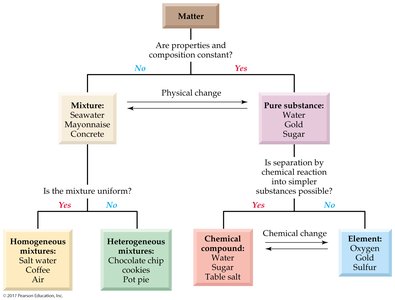
Classification of Matter
Matter can be classified based on the uniformity of its composition and the ability to separate its components by physical or chemical means. Mixtures can be either homogeneous or heterogeneous, while pure substances are classified as elements or compounds.
Mixture: A physical blend of two or more substances where each retains its own identity and properties.
Homogeneous mixture (Solution): Uniform composition throughout (e.g., salt water, air).
Heterogeneous mixture: Non-uniform composition (e.g., chocolate chip cookies, pot pie).
Pure substance: Matter with constant composition, either an element or a compound.
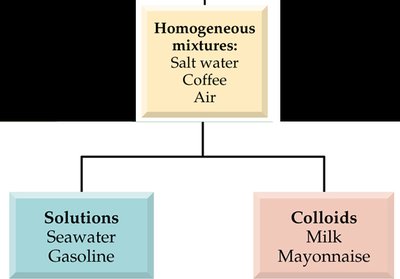
Types of Mixtures: Solutions and Colloids
Homogeneous mixtures can be further divided into solutions and colloids based on particle size and behavior.
Solution: Very small particles (<2 nm), transparent, does not separate on standing (e.g., seawater, gasoline).
Colloid: Intermediate particle size (2–500 nm), appears cloudy, does not separate on standing (e.g., milk, mayonnaise).
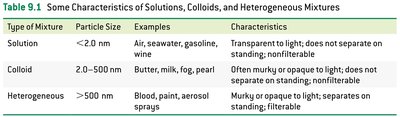
Comparison of Solutions, Colloids, and Heterogeneous Mixtures
The following table summarizes the main differences between solutions, colloids, and heterogeneous mixtures:
Type of Mixture | Particle Size | Examples | Characteristics |
|---|---|---|---|
Solution | <2.0 nm | Air, seawater, gasoline, wine | Transparent to light; does not separate on standing; nonfilterable |
Colloid | 2.0–500 nm | Butter, milk, fog, pearl | Often murky or opaque to light; does not separate on standing; nonfilterable |
Heterogeneous | >500 nm | Blood, paint, aerosol sprays | Murky or opaque to light; separates on standing; filterable |
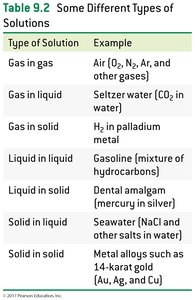
Types of Solutions
Solutions can exist in various combinations of physical states. The following table summarizes different types of solutions and examples:
Type of Solution | Example |
|---|---|
Gas in gas | Air (O2, N2, Ar, other gases) |
Gas in liquid | Seltzer water (CO2 in water) |
Gas in solid | H2 in palladium metal |
Liquid in liquid | Gasoline (mixture of hydrocarbons) |
Liquid in solid | Dental amalgam (mercury in silver) |
Solid in liquid | Seawater (NaCl and other salts in water) |
Solid in solid | Metal alloys (e.g., 14-karat gold: Au, Ag, Cu) |
Components of Solutions
Solute, Solvent, and Solution
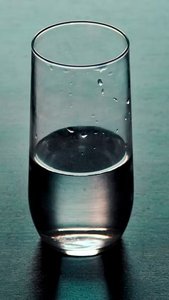
A solution consists of a solute (the substance present in the lesser amount) dissolved in a solvent (the substance present in the greater amount). The solvent determines the phase of the solution.
Solute: Substance being dissolved (e.g., salt in salt water).
Solvent: Substance doing the dissolving (e.g., water in salt water).
Solution: Homogeneous mixture of solute and solvent.
Practice: Identifying Solutes and Solvents
2 g sugar and 100 mL water: Solute = sugar, Solvent = water
60.0 mL ethyl alcohol and 30.0 mL methyl alcohol: Solute = methyl alcohol, Solvent = ethyl alcohol
55.0 mL water and 1.50 g NaCl: Solute = NaCl, Solvent = water
Air: 200 mL O2 and 800 mL N2: Solute = O2, Solvent = N2
The Solution Process
How Solutions Form
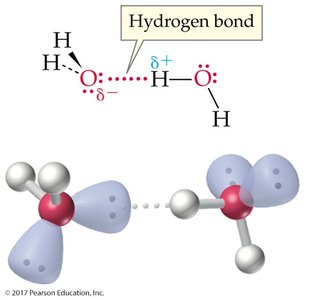
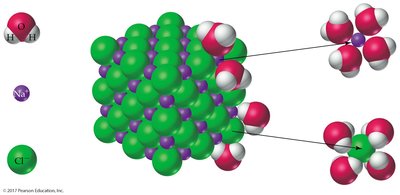
The process of dissolving involves interactions between solute and solvent particles. For ionic compounds, water molecules surround and separate the ions due to their polarity and ability to form hydrogen bonds.
"Like dissolves like": Polar solutes dissolve in polar solvents; nonpolar solutes dissolve in nonpolar solvents.
Aqueous solution: A solution where water is the solvent.
Predicting Solubility
Solubility depends on the relative polarity and intermolecular forces between solute and solvent. For example, ionic and polar compounds are generally soluble in water, while nonpolar compounds are not.
Soluble: Dissolves to a significant extent in a solvent (e.g., NaCl in water).
Insoluble: Does not dissolve significantly (e.g., PbI2 in water).
Solubility and Its Dependence on Temperature
Solubility Definitions
Solubility: Maximum amount of solute that will dissolve in a solvent at a given temperature and pressure.
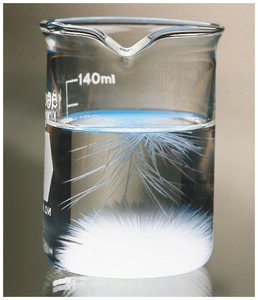
Saturated solution: Contains the maximum possible solute at a given temperature.
Unsaturated solution: Contains less than the maximum possible solute.
Supersaturated solution: Contains more than the maximum possible solute (unstable).
Effect of Temperature on Solubility
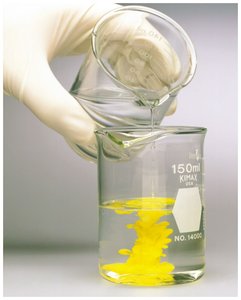
The solubility of most solids increases with temperature (endothermic process), while the solubility of most gases decreases with temperature (exothermic process).
Units of Concentration
Common Units
Concentration expresses the amount of solute in a given amount of solution. Common units include:
Molarity (M):
Mass Percent (m/m%):
Volume Percent (v/v%):
Mass/Volume Percent (m/v%):
Example Calculation
Calculate the molarity and mass/volume % of a solution containing 23 g KI in 350 mL solution:
Moles of KI:
Liters of solution:
Molarity:
Mass/volume %:
Preparation and Dilution of Solutions
Preparing Solutions from Solids
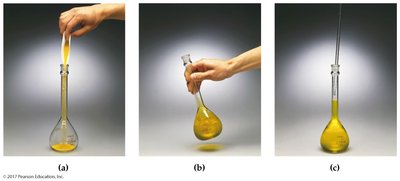
To prepare a solution of known concentration from a solid solute:
Weigh the correct amount of solute.
Add to a volumetric flask.
Add some solvent and swirl to dissolve.
Fill to the calibration mark with solvent and mix thoroughly.
Dilution of Solutions
To dilute a concentrated solution to a lower concentration, use the formula:
M1: Initial molarity
V1: Initial volume
M2: Final molarity
V2: Final volume
Ions in Solution: Electrolytes
Electrolytes and Conductivity
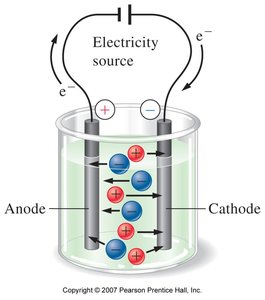
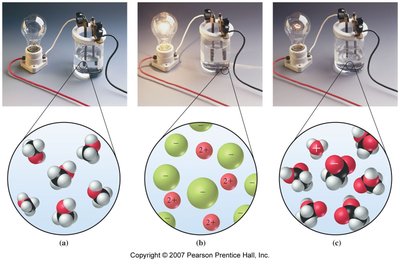
Electrolytes are substances that conduct electricity when dissolved in water due to the presence of ions.
Strong electrolytes: Dissociate completely into ions (e.g., soluble salts, strong acids/bases).
Weak electrolytes: Partially dissociate into ions (e.g., weak acids/bases).
Non-electrolytes: Do not produce ions in water (e.g., molecular compounds like sugar).
Chemical Equations for Dissolution
Ionic compound:
Strong acid:
Weak acid:
Properties of Solutions: Colligative Properties
Colligative Properties
Colligative properties depend on the number of solute particles, not their identity. These include:
Vapor pressure lowering: Solute particles reduce the number of solvent molecules able to escape into the vapor phase.
Boiling point elevation: Solutions boil at higher temperatures than pure solvents.
Freezing point depression: Solutions freeze at lower temperatures than pure solvents.
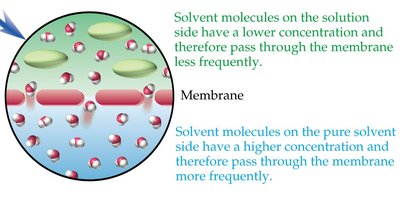
Osmosis and osmotic pressure: Solvent moves through a semipermeable membrane from lower to higher solute concentration.
Osmosis and Osmotic Pressure
Osmosis
Osmosis is the movement of solvent molecules through a semipermeable membrane from a region of lower solute concentration to higher solute concentration. Osmotic pressure is the pressure required to stop this flow.

Osmotic Pressure in Biological Systems
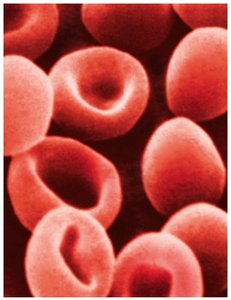
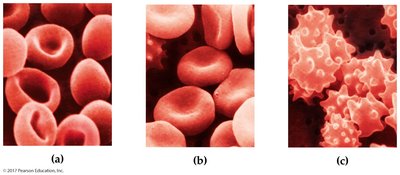
Red blood cells must maintain osmotic balance with their environment to avoid damage:
Isotonic solution: Same osmotic pressure as cells; no net water movement.
Hypotonic solution: Lower osmotic pressure; water enters cells, causing swelling (hemolysis).
Hypertonic solution: Higher osmotic pressure; water leaves cells, causing shrinkage (crenation).
Summary Table: Key Concepts in Solutions
Concept | Definition/Key Point |
|---|---|
Solution | Homogeneous mixture of solute and solvent |
Solubility | Maximum amount of solute that dissolves at a given temperature |
Molarity (M) | Moles of solute per liter of solution |
Electrolyte | Substance that conducts electricity in solution |
Colligative properties | Depend on number of solute particles, not identity |
Osmosis | Solvent movement through a semipermeable membrane |
