 Back
BackChapter 9: Solutions – Properties, Types, and Biological Relevance
Study Guide - Smart Notes
 Tailored notes based on your materials, expanded with key definitions, examples, and context.
Solutions: Properties and Types
Definition and Characteristics of Solutions
Solutions are homogeneous mixtures composed of a solute dissolved in a solvent. They are fundamental in chemistry and biology, especially in physiological processes.
Transparent: Solutions allow light to pass through and appear clear.
Do not separate: The solute remains evenly distributed and does not settle out.
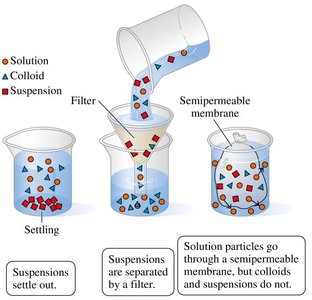
Small particles: Contain ions or molecules that cannot be filtered and pass through semipermeable membranes.
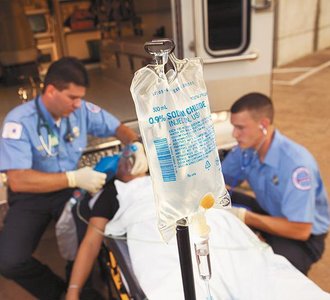
Example: Saline solution (0.9% NaCl) used in medical settings is isotonic with blood.
Colloids
Colloids are mixtures where the dispersed particles are larger than those in solutions but smaller than those in suspensions. They exhibit unique properties and are common in both natural and industrial contexts.
Medium-size particles: Larger than solution particles but do not settle out.
Cannot be filtered: Particles pass through filters but can be separated by semipermeable membranes.
Examples: Fog, mayonnaise, blood plasma, gelatin.
Colloid | Substance Dispersed | Dispersing Medium |
|---|---|---|
Fog, clouds, hairsprays | Liquid | Gas |
Dust, smoke | Solid | Gas |
Shaving cream, whipped cream, soap suds | Gas | Liquid |
Styrofoam, marshmallows | Gas | Solid |
Mayonnaise, homogenized milk | Liquid | Liquid |
Cheese, butter | Liquid | Solid |
Blood plasma, paints (latex), gelatin | Solid | Liquid |
Suspensions
Suspensions are heterogeneous mixtures with very large particles that settle out over time. They require agitation to remain mixed and can be separated by filtration.
Heterogeneous: Nonuniform mixtures.
Large particles: Visible and settle out rapidly.
Can be filtered: Particles are easily separated.
Examples: Blood platelets, muddy water, calamine lotion.
Comparison of Solutions, Colloids, and Suspensions
The three types of mixtures differ in particle size, settling behavior, and separation methods.
Type of Mixture | Type of Particle | Settling | Separation |
|---|---|---|---|
Solution | Small particles (atoms, ions, molecules) | Do not settle | Cannot be separated by filters or semipermeable membranes |
Colloid | Larger molecules or groups of molecules/ions | Do not settle | Can be separated by semipermeable membranes, not by filters |
Suspension | Very large particles | Settle rapidly | Can be separated by filters |
Osmosis and Osmotic Pressure
Osmosis
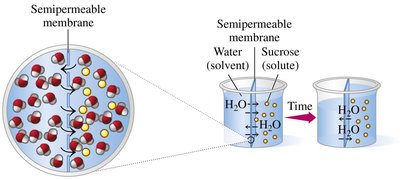
Osmosis is the movement of water (solvent) across a semipermeable membrane from a region of lower solute concentration to higher solute concentration. This process is vital in biological systems for maintaining cell volume and function.
Water flows: From low to high solute concentration.
Level rises: In the solution with higher solute concentration.
Equilibrium: Concentrations become equal over time.
Example: Water movement in plant roots and animal cells.
Osmotic Pressure
Osmotic pressure is the pressure required to prevent the flow of water into a more concentrated solution. It increases with the number of dissolved particles.
Prevents water flow: Equalizes concentrations across the membrane.
Depends on particle number: More particles, higher osmotic pressure.
Formula: Osmotic pressure () can be estimated by:
where is the van 't Hoff factor, is molarity, is the gas constant, and is temperature in Kelvin.
Reverse Osmosis
Reverse osmosis is a process where pressure greater than the osmotic pressure is applied to force water through a purification membrane, leaving solute particles behind. It is used in desalination to obtain pure water from seawater.
Requires energy: To reverse natural osmotic flow.
Purifies water: Removes ions and molecules.
Biological Relevance: Isotonic, Hypotonic, and Hypertonic Solutions
Isotonic Solutions
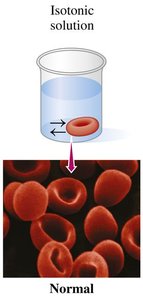
An isotonic solution has the same osmotic pressure as body fluids, such as red blood cells (RBCs). Cells retain their normal volume in isotonic environments.
Examples: 0.9% (m/v) NaCl or 5.0% (m/v) glucose.
Medical use: IV fluids are isotonic to prevent cell damage.
Hypotonic Solutions
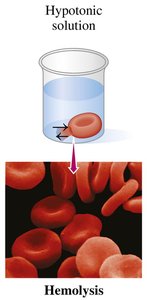
A hypotonic solution has a lower solute concentration than RBCs, causing water to flow into cells by osmosis. This can lead to cell swelling and bursting (hemolysis).
Hemolysis: Cells swell and burst due to excess water intake.
Example: 0.5% NaCl solution.
Hypertonic Solutions
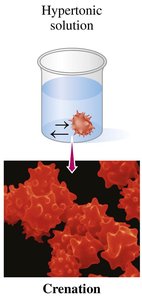
A hypertonic solution has a higher solute concentration than RBCs, causing water to leave the cells by osmosis. Cells shrink, a process called crenation.
Crenation: Cells lose water and shrink.
Example: 2% NaCl solution.
Dialysis
Dialysis and Hemodialysis
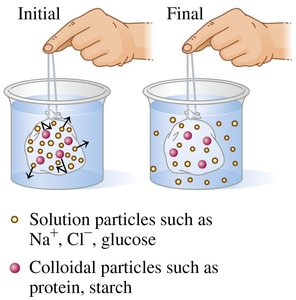
Dialysis is a process where solvent and small solute particles pass through an artificial membrane, while large particles are retained. Hemodialysis is used to remove waste from blood in patients with kidney failure.
Selective separation: Small particles (e.g., urea) pass through; large particles (e.g., proteins) do not.
Medical application: Artificial kidney removes waste from blood.
Concept Map: Solutions
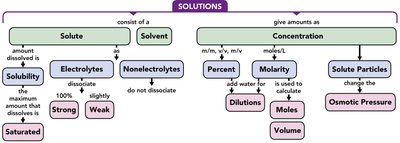
The concept map summarizes the relationships between solute, solvent, concentration, electrolytes, and osmotic pressure in solutions.
Additional info:
Electrolytes dissociate in water to produce ions, affecting osmotic pressure.
Non-electrolytes do not dissociate and have a lesser effect on osmotic pressure.
Percent concentration and molarity are common ways to express solution concentration.
