 Back
BackChapter 9: Solutions – Structure and Properties
Study Guide - Smart Notes
 Tailored notes based on your materials, expanded with key definitions, examples, and context.
Solutions
Introduction to Solutions
Solutions are homogeneous mixtures composed of two or more substances. They are fundamental in chemistry and biology, as they allow for the even distribution of solutes within solvents, enabling chemical reactions and biological processes to occur efficiently.
Homogeneous mixture: The composition is uniform throughout the sample.
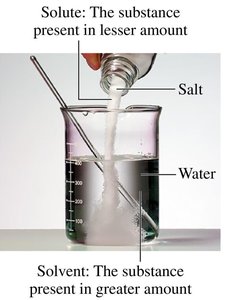
Solute: The substance present in a lesser amount and dissolved in the solvent.
Solvent: The substance present in a greater amount, which dissolves the solute.
Solutions form when there is sufficient attraction between solute and solvent molecules.
Biological Relevance of Solutions
The regulation of water and electrolytes in body fluids is crucial for health. For example, dialysis patients must carefully manage the concentration of solutes in their blood to maintain proper cellular function.
Electrolyte concentration and waste removal are vital for cellular water balance.
Imbalances can lead to significant physiological side effects.
Properties of Solutes and Solvents
Characteristics of Solutes
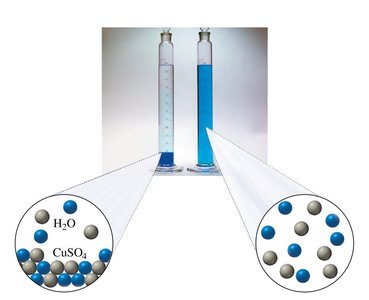
Solutes can be liquids, gases, or solids and are evenly distributed throughout the solution. They are not visible but may impart color to the solution.
Mix with solvents to form a single physical state.
Cannot be separated by filtration but can be separated by evaporation.
Examples: Salt in water, sugar in tea, oxygen in air.
Types of Solutions
Solutions can be classified based on the physical state of their solute and solvent. The following table summarizes common types:
Type | Example | Primary Solute | Solvent |
|---|---|---|---|
Gas in gas | Air | O2 (gas) | N2 (gas) |
Gas in liquid | Soda water | CO2 (gas) | H2O (liquid) |
Liquid in liquid | Vinegar | HC2H3O2 (liquid) | H2O (liquid) |
Solid in liquid | Seawater | NaCl (solid) | H2O (liquid) |
Solid in solid | Brass | Zn (solid) | Cu (solid) |
Water as a Solvent
Polarity and Hydrogen Bonding
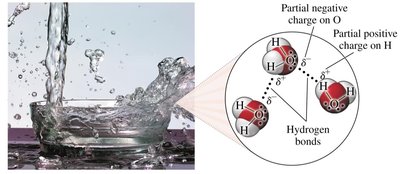
Water is the most common solvent in nature due to its polarity and ability to form hydrogen bonds. These properties make water especially effective at dissolving ionic and polar substances.
Polar molecule: Water has a partial negative charge on oxygen and partial positive charges on hydrogen atoms.
Hydrogen bonds: Intermolecular attractions between the hydrogen atom of one water molecule and the oxygen atom of another.
Formation of Solutions
Solute-Solvent Interactions
Solutions form when the interactions between solute and solvent molecules are strong enough to overcome the forces holding the solute and solvent particles together in their pure states.
Solute–solvent attractions must be greater than or equal to solute–solute and solvent–solvent attractions.
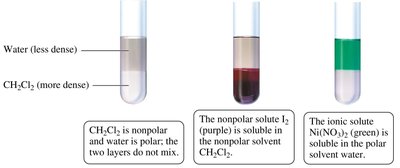
This process is often described as "like dissolves like." Polar solutes dissolve in polar solvents, and nonpolar solutes dissolve in nonpolar solvents.
Like Dissolves Like Principle
The solubility of a substance depends on the similarity in polarity between the solute and solvent. The following table summarizes possible combinations:
Solute-Solvent | Will Solutions Form? | Examples |
|---|---|---|
Polar-Polar | Yes | Methanol-Water |
Nonpolar-Nonpolar | Yes | Cyclohexane-Benzene |
Polar-Nonpolar | No | Water-Carbon Tetrachloride |
Nonpolar-Polar | No | Cyclohexane-Water |
Solutions with Ionic and Polar Solutes
Hydration of Ionic Compounds
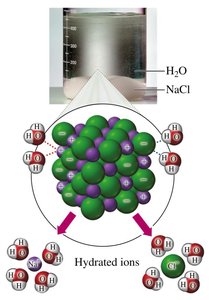
When ionic compounds such as NaCl dissolve in water, the ions are surrounded by water molecules in a process called hydration. The positive sodium ions are attracted to the partially negative oxygen atoms of water, while the negative chloride ions are attracted to the partially positive hydrogen atoms.
Equation for dissolution:
Hydrated ions are stabilized in solution by ion-dipole interactions.
Solutions with Polar Molecular Solutes
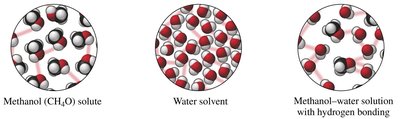
Polar molecular compounds, such as methanol (CH3OH), dissolve in water due to their ability to form hydrogen bonds with water molecules. This interaction allows for the even distribution of the solute within the solvent.
Polar solutes require polar solvents for dissolution.
Hydrogen bonding is a key factor in the solubility of many biological molecules.
Practice and Application
Identifying Solutes and Solvents
Example 1: 2 g of sugar and 100 mL of water – Sugar is the solute, water is the solvent.
Example 2: 60.0 mL of ethyl alcohol and 30.0 mL of methyl alcohol – Methyl alcohol is the solute, ethyl alcohol is the solvent.
Example 3: 55.0 mL of water and 1.50 g of NaCl – NaCl is the solute, water is the solvent.
Example 4: Air: 200 mL of O2 and 800 mL of N2 – O2 is the solute, N2 is the solvent.
Solubility of Ionic Compounds in Water
When solid LiCl is added to water, Li+ ions are attracted to the oxygen atom (δ−) of water, and Cl− ions are attracted to the hydrogen atom (δ+) of water.
Which Solutes Will Dissolve in Water?
Na2SO4: Will dissolve (ionic compound).
Gasoline: Will not dissolve (nonpolar).
I2: Will not dissolve (nonpolar).
HCl: Will dissolve (polar molecule).
