 Back
BackCHEM 1123 – Comprehensive Final Study Guidance
Study Guide - Smart Notes
 Tailored notes based on your materials, expanded with key definitions, examples, and context.
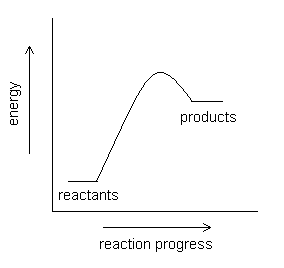
Q26. Show the energy of activation on the graph below. Is the reaction exothermic or endothermic?
Background
Topic: Reaction Energy Diagrams
This question tests your understanding of reaction energy diagrams, specifically how to identify the activation energy and determine whether a reaction is exothermic or endothermic based on the relative energies of reactants and products.
Key Terms and Concepts:
Activation Energy (Ea): The minimum energy required for a reaction to proceed, represented by the energy difference between the reactants and the highest point on the curve.
Exothermic Reaction: A reaction where the products have lower energy than the reactants (energy is released).
Endothermic Reaction: A reaction where the products have higher energy than the reactants (energy is absorbed).
Step-by-Step Guidance
Examine the energy diagram. Identify the starting point (reactants) and the ending point (products) on the y-axis (energy).
Locate the highest point on the curve between reactants and products. This peak represents the transition state.
Draw or imagine a vertical arrow from the reactants' energy level up to the peak. This vertical distance is the activation energy ().
Compare the energy of the products to the energy of the reactants. If the products are lower, the reaction is exothermic; if higher, it is endothermic.
Try solving on your own before revealing the answer!
Final Answer:
The activation energy is the vertical distance from the reactants to the peak of the curve. Since the products are lower in energy than the reactants, the reaction is exothermic.
