 Back
BackChem 140A Exam 3 Study Guidance
Study Guide - Smart Notes
 Tailored notes based on your materials, expanded with key definitions, examples, and context.
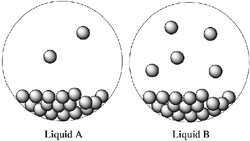
Q21. Consider the two liquids A and B shown in closed containers. Which liquid exhibits the stronger intermolecular forces?
Background
Topic: Intermolecular Forces and Vapor Pressure
This question tests your understanding of how intermolecular forces affect the vapor pressure of a liquid. The number of particles in the vapor phase above each liquid is an indicator of how easily molecules escape from the liquid to the gas phase.
Key Terms and Concepts:
Intermolecular Forces (IMFs): The forces of attraction between molecules. Stronger IMFs make it harder for molecules to escape into the vapor phase.
Vapor Pressure: The pressure exerted by a vapor in equilibrium with its liquid. Liquids with strong IMFs have lower vapor pressures.
Step-by-Step Guidance
Observe the number of vapor particles above each liquid. More vapor particles indicate a higher vapor pressure.
Recall that a higher vapor pressure means weaker intermolecular forces, because molecules escape more easily into the gas phase.
Compare the two diagrams: Liquid A has fewer vapor particles than Liquid B.
Think about which liquid must have stronger intermolecular forces based on the number of vapor particles present.
Try solving on your own before revealing the answer!
Final Answer: Liquid A exhibits the stronger intermolecular forces.
Liquid A has fewer vapor particles, indicating a lower vapor pressure and thus stronger intermolecular forces compared to Liquid B.
