 Back
BackCHEM B11: Introduction to General, Organic, and Biochemistry – Syllabus and Course Schedule Study Guide
Study Guide - Smart Notes
 Tailored notes based on your materials, expanded with key definitions, examples, and context.
Course Overview
Introduction
This study guide summarizes the syllabus and schedule for CHEM B11: Introduction to General, Organic, and Biochemistry. The course covers foundational concepts in general, organic, and biological chemistry, with a focus on applications relevant to health sciences and nursing.
Course Structure and Requirements
Required Materials
Textbook: Chemistry: An Introduction to General, Organic, and Biological Chemistry, 14th edition, by Karen Timberlake.
Lab Manual: Provided by instructor.
Online Homework: Aktiv Chemistry access code.
Scientific Calculator: TI 30X or similar (non-programmable).
Safety Goggles: Must meet ANSI Z-87.1 standard.
Lab Apron/Coat, Nitrile Gloves, Cleaning Supplies: Required for lab safety.
Online System Requirements
Reliable computer and internet access.
Use Google Chrome for Canvas and Aktiv Chemistry.
Course Description and Objectives
Course Description
Introduction to general, organic, and biochemistry using qualitative and quantitative approaches.
Topics include physical principles, inorganic compounds and reactions, organic chemistry (classification, composition, reactions, nomenclature), and biochemistry (classification, composition, reactions of living organisms).
Student Learning Outcomes
Employ dimensional analysis as a problem-solving tool.
Relate the periodic table to prediction of properties of chemical compounds.
Describe basic organic chemical compounds.
Explain fundamental biological compounds.
Describe processes of metabolism.
Apply laboratory safety rules and manipulate laboratory equipment properly.
Course Objectives
Create conversion factors from metric/American equalities, percent, density, molar mass, and use dimensional analysis.
Describe periodic table arrangement, physical properties, and trends; convert atoms to ions and construct compounds.
Illustrate how matter and energy are related; calculate temperature, specific heat, and dietary calories.
Explain chemical systems and behaviors: electrolytes, buffers, equilibria, osmosis.
Apply nomenclature rules for inorganic and organic compounds.
Distinguish between reaction types and predict products.
Identify solution properties, calculate percent, molarity, dilutions, Kw, and pH.
Recognize organic functional groups and associate with properties.
Recognize chemical structure of lipids, carbohydrates, proteins; describe functions and metabolic breakdown.
Employ personal protective equipment and proper lab techniques.
Policies and Procedures
Attendance and Participation
Attendance is mandatory; participation and punctuality required.
Absences, tardies, and missed assignments affect course standing.
Laboratory Safety
Strict adherence to lab safety rules and dress code.
Safety violations result in grade deductions or removal from lab.
Academic Integrity
Zero tolerance for academic dishonesty and plagiarism.
Improper collaborations and use of unauthorized materials are prohibited.
Use of Electronics
Electronics allowed only for class-related purposes.
Prohibited during exams and quizzes.
Classroom Decorum
Respectful behavior and punctuality required.
Disruptive behavior results in removal and disciplinary action.
Grading and Evaluation
Grade Breakdown
Quizzes: 7%
Worksheets: 3%
Homework: 5%
Lab Reports: 25%
Exams (4): 45%
Final Exam: 15%
Letter Grade Scale
A: 90.00% – 100.00%
B: 80.00% – 89.99%
C: 70.00% – 79.99%
D: 60.00% – 69.99%
F: Below 60.00%
Lecture Schedule
Topics Covered
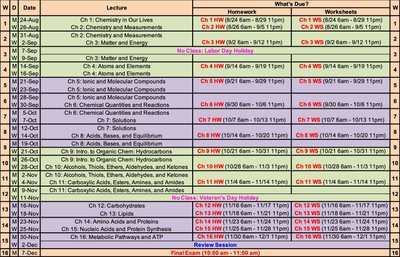
Ch. 1: Chemistry in Our Lives
Ch. 2: Chemistry and Measurements
Ch. 3: Matter and Energy
Ch. 4: Atoms and Elements
Ch. 5: Nuclear Chemistry
Ch. 6: Ionic and Molecular Compounds
Ch. 7: Chemical Quantities and Reactions
Ch. 8: Gases
Ch. 9: Solutions
Ch. 10: Acids and Bases and Equilibrium
Ch. 11: Introduction to Organic Chemistry: Hydrocarbons
Ch. 12: Alcohols, Thiols, Ethers, Aldehydes, and Ketones
Ch. 13: Carbohydrates
Ch. 14: Carboxylic Acids, Esters, Amines, and Amides
Ch. 15: Lipids
Ch. 16: Amino Acids, Proteins, and Enzymes
Ch. 17: Nucleic Acids and Protein Synthesis
Ch. 18: Metabolic Pathways and ATP Production
Lecture Schedule Table
The following table summarizes the weekly lecture topics, homework, and worksheet deadlines:
Laboratory Schedule
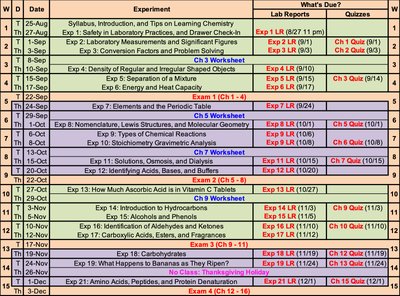
Laboratory Experiments and Assessments
Experiments cover measurement, safety, chemical reactions, properties of matter, periodic table, solution chemistry, acids/bases, organic and biological compounds.
Lab reports and skill assessments are required for each experiment.
Lab quizzes are administered throughout the semester.
Laboratory Schedule Table
The following table summarizes the weekly laboratory experiments, lab report deadlines, and quizzes:
Important Dates
Last day to add class: 13-Sep
Last day to drop with refund: 3-Sep
Last day to drop without "W": 11-Sep
Census Day: 14-Sep
Last day to drop with "W": 29-Oct
Final Exam: 11-Dec (10:00 am – 11:50 am)
Summary of Key Study Strategies
Attend all lectures and labs; participation is essential.
Complete all assignments, homework, and lab reports on time.
Use dimensional analysis, understand periodic table trends, and master chemical nomenclature.
Practice laboratory safety and proper technique.
Utilize campus resources for tutoring and academic support.
Additional Info
This course is designed for students in health-related majors, including nursing and paramedical fields.
Success requires consistent study, organization, and communication with the instructor.
