 Back
BackChemical Bonding: Molecular and Lewis Structures
Study Guide - Smart Notes
 Tailored notes based on your materials, expanded with key definitions, examples, and context.
Chemical Bonding: Molecular and Lewis Structures
Introduction to Molecular Compounds
Molecular compounds are formed when atoms of two or more nonmetals share electrons, resulting in the formation of covalent bonds. These compounds are distinct from ionic compounds, which involve the transfer of electrons between metals and nonmetals. The sharing of valence electrons allows atoms to achieve stable electron configurations, often resembling those of noble gases.
Covalent bond: A chemical bond formed by the sharing of one or more pairs of electrons between nonmetal atoms.
Molecule: A group of two or more atoms held together by covalent bonds.
There are many more molecular compounds than ionic compounds due to the variety of possible combinations among nonmetals.

Naming Molecular Compounds
Naming molecular compounds follows a systematic approach to indicate both the elements present and the number of each atom in the molecule. Prefixes are used to denote the number of atoms, and the second element's name is modified to end with "-ide."
Name the first nonmetal by its element name.
Name the second nonmetal by using the first syllable of its element name followed by "ide."
Add prefixes to indicate the number of atoms (subscripts).
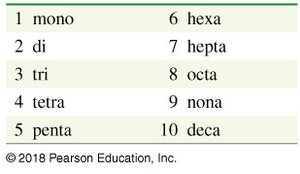
Example Prefixes:
Number | Prefix |
|---|---|
1 | mono |
2 | di |
3 | tri |
4 | tetra |
5 | penta |
6 | hexa |
7 | hepta |
8 | octa |
9 | nona |
10 | deca |
Examples:
CO: carbon monoxide
N2O: dinitrogen monoxide
PF3: phosphorus trifluoride
CCl4: carbon tetrachloride
Writing Formulas of Molecular Compounds
To write the formula of a molecular compound, use the chemical symbols in the order given by the name and apply the appropriate prefixes as subscripts to indicate the number of each atom.
Examples:
Phosphorus pentachloride: PCl5
Dinitrogen trioxide: N2O3
Sulfur hexafluoride: SF6
Distinguishing Ionic and Molecular Compounds
It is important to distinguish between ionic and molecular compounds based on their composition:
Ionic compounds: The first element is a metal or the polyatomic ion NH4+ (e.g., K2O: potassium oxide).
Molecular compounds: The first element is a nonmetal (e.g., N2O: dinitrogen oxide).
Lewis Structures for Molecules
Lewis structures are diagrams that represent the arrangement of valence electrons among atoms in a molecule. They help visualize how atoms share electrons to achieve octets (except hydrogen, which achieves a duet).
Bonding pairs (shared electrons) are shown as two dots or a single line between atoms.
Non-bonding pairs (lone pairs) are placed on the outside of atoms.
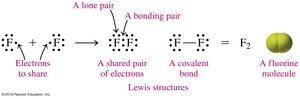
Diatomic molecules contain two like atoms (e.g., F2).
Steps for Drawing Lewis Structures
To draw a Lewis structure for a molecule:
Determine the arrangement of atoms (central atom is usually the least electronegative).
Calculate the total number of valence electrons for all atoms.
Attach each bonded atom to the central atom with a pair of electrons (single bond).
Use remaining electrons to complete the octets of the outer atoms, then the central atom.
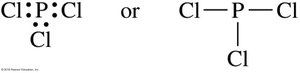
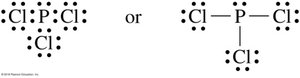
Example: Lewis Structure for PCl3
P is the central atom (5 valence electrons).
Each Cl atom has 7 valence electrons.
Attach Cl atoms to P and complete octets. L
Double and Triple Bonds
Some molecules require double or triple bonds to satisfy the octet rule for all atoms. Double bonds involve two pairs of shared electrons, while triple bonds involve three pairs. Atoms such as nitrogen, oxygen, carbon, and sulfur are most likely to form multiple bonds.
Double bond: Two pairs of electrons are shared between two atoms.
Triple bond: Three pairs of electrons are shared between two atoms.
Multiple bonds form when there are not enough valence electrons to complete octets with single bonds alone.
Example: Lewis Structure for Carbon Dioxide (CO2)
To draw the Lewis structure for CO2:
Carbon is the central atom (4 valence electrons), oxygen atoms each have 6 valence electrons.
Attach each O to C with a single bond, then complete octets.
If the central atom's octet is incomplete, convert lone pairs from outer atoms into bonding pairs to form double bonds.
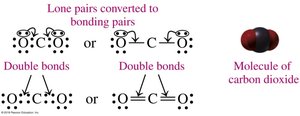
Result: CO2 has two double bonds between carbon and each oxygen atom.
Additional info: Lewis structures are foundational for understanding molecular geometry, polarity, and reactivity in chemistry. Mastery of these representations is essential for further study in chemical bonding and molecular structure.
