 Back
BackChemical Quantities and Energy in Chemical Reactions
Study Guide - Smart Notes
 Tailored notes based on your materials, expanded with key definitions, examples, and context.
Chemical Quantities and Reactions
Mass Calculations for Chemical Reactions
Chemical reactions often require the calculation of the mass of one substance needed to react with or produce a given mass of another substance. This process is fundamental in laboratory and industrial chemistry, such as determining the amount of acetylene required for welding metals.
Step 1: Convert mass of substance A to moles using the molar mass of A.
Step 2: Convert moles of A to moles of B using the mole ratio from the balanced chemical equation.
Step 3: Convert moles of B to grams using the molar mass of B.

Example: To find the mass of ammonia (NH3) produced from a given mass of nitrogen gas (N2):
Write the balanced equation.
Identify the given and needed quantities.
Plan the conversion: grams N2 → moles N2 → moles NH3 → grams NH3.

General Equation:
Learning Check Example: How many grams of Fe2O3 are needed to produce 45.8 grams of O2?

Solution Steps:
State the given and needed quantities.
Write a plan for the conversion.
Use coefficients from the balanced equation for mole-mole factors.
Set up the calculation to solve for the needed mass.
Another Example: How many grams of H2O are needed to produce a certain mass of O2?

Additional info: These stepwise conversions are essential for quantitative chemical analysis and industrial synthesis.
Energy in Chemical Reactions
Exothermic and Endothermic Reactions
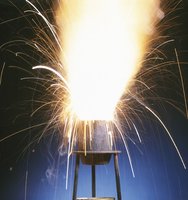
Chemical reactions involve energy changes, which can be classified as exothermic or endothermic. The thermite reaction, for example, releases a large amount of heat and is used in welding applications.
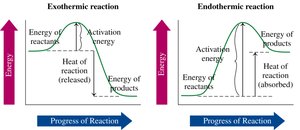
Exothermic Reaction: Releases heat; the energy of the products is less than that of the reactants. Heat is a product.
Endothermic Reaction: Absorbs heat; the energy of the products is greater than that of the reactants. Heat is a reactant.
Key Points:
In exothermic reactions, temperature of the surroundings increases.
In endothermic reactions, temperature of the surroundings decreases.
Collision Theory and Reaction Rate
For a chemical reaction to occur, molecules must collide with proper orientation and sufficient energy (activation energy).
Collision: Reactants must physically collide.
Orientation: Reactants must align properly to break and form bonds.
Energy: Collisions must provide enough energy to overcome the activation barrier.
Reaction Rate: The speed at which reactants are converted to products. It increases with temperature, concentration, and the presence of a catalyst.
Catalysts
A catalyst increases the rate of a reaction by lowering the activation energy required, without being consumed in the process.
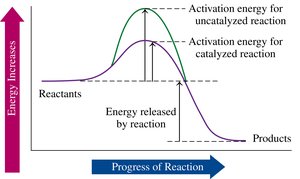
Lowers activation energy for the reaction.
Is not used up during the reaction.
Factors Affecting Reaction Rate
The rate of a chemical reaction can be influenced by several factors:
Factor | Effect on Rate |
|---|---|
Increasing temperature | Increases |
Removing reactants | Decreases |
Adding a catalyst | Increases |
Placing in ice (lowering temperature) | Decreases |
Increasing concentration | Increases |
Summary Table:
Higher temperature and concentration increase reaction rate.
Catalysts increase reaction rate by lowering activation energy.
Lower temperature or removing reactants decreases reaction rate.
Concept Map: Chemical Quantities and Reactions
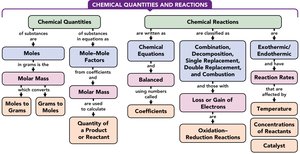
This concept map summarizes the relationships between chemical quantities, equations, and reaction types, including the factors that affect reaction rates.
Additional info: Mastery of these concepts is essential for understanding stoichiometry, reaction energetics, and the practical control of chemical processes in both laboratory and industrial settings.
