 Back
Chemical Quantities and Reactions: Study Guide for GOB Chemistry
Study Guide - Smart Notes
 Tailored notes based on your materials, expanded with key definitions, examples, and context.
Chapter 7: Chemical Quantities and Reactions
The Mole and Avogadro’s Number
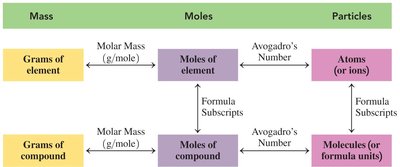
The concept of the mole is fundamental in chemistry for quantifying substances. The mole allows chemists to count atoms, molecules, or ions in practical laboratory quantities. Avogadro’s number provides the link between the microscopic world of atoms and the macroscopic world of grams and moles.
Mole (mol): The amount of substance that contains particles (atoms, molecules, or ions).
Avogadro’s Number: particles per mole.
Formula unit: The smallest collection of ions that represents an ionic compound.
Example: 1 mol of Na+ ions contains Na+ ions.
Atomic Mass and Molar Mass
Atomic mass units (amu) are used to express the mass of individual atoms. Molar mass is the mass of one mole of a substance, expressed in grams per mole (g/mol), and is calculated by summing the atomic masses of all atoms in a compound’s formula.
Atomic Mass Unit (amu):
Molar Mass: The mass in grams of one mole of a substance.
Example: Molar mass of H2O is calculated as .
Interconverting Mass, Moles, and Particles
Chemists use conversion factors to relate mass, moles, and number of particles. These relationships are essential for stoichiometric calculations in chemical reactions.
Conversion Factors:
From mass to moles:
From moles to particles:
Example: How many carbon atoms are in 2.00 moles of graphite? atoms.
Calculations Using Molar Mass
Stoichiometric calculations often require converting between mass, moles, and number of particles. The molar mass serves as a bridge between mass and moles.
Example: How many moles of He are in 25.0 g of He?
Find molar mass of He.
Use conversion factor:
Example: How many grams of KI are in 0.450 moles of KI?
Find molar mass of KI.
Use conversion factor:
Writing and Balancing Chemical Equations
Chemical equations represent chemical reactions, showing the conversion of reactants to products. Balancing equations ensures the law of conservation of mass is obeyed.
Reactants: Substances present before the reaction, written to the left of the arrow.
Products: Substances formed by the reaction, written to the right of the arrow.
Coefficients: Numbers placed in front of formulas to balance the equation.
Physical States: Indicated by (s), (l), (g), or (aq).
Example: Combustion of propane:
Balancing Tips: Balance diatomic molecules (e.g., O2, H2) last.
Equations with Polyatomic Ions
When balancing equations involving polyatomic ions, treat the ion as a single unit if it appears unchanged on both sides of the equation.
Example:
Oxidation-Reduction (Redox) Reactions
Redox reactions involve the transfer of electrons between substances. Oxidation is the loss of electrons, while reduction is the gain of electrons. These reactions are fundamental in processes such as combustion and respiration.
Oxidation: Loss of electrons.
Reduction: Gain of electrons.
Mnemonic: OIL RIG (Oxidation Is Loss, Reduction Is Gain).
Example: Zinc reacts with copper(II) ions: Zn(s) loses electrons (oxidized), Cu2+(aq) gains electrons (reduced).
Energy in Chemical Reactions
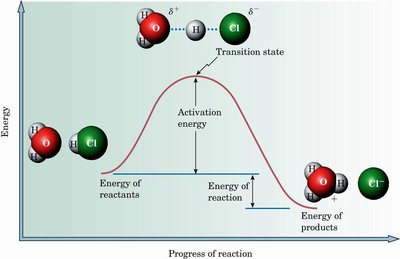
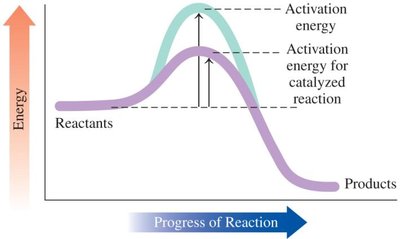
Chemical reactions involve energy changes, typically as heat. The minimum energy required for a reaction to occur is called the activation energy. The transition state is the highest energy point during the reaction.
Activation Energy (Ea): The minimum energy required for reactants to form products.
Transition State: The point at which reactants are transformed into products.
Effective Collision: A collision with sufficient energy and correct orientation to result in a reaction.
Exothermic and Endothermic Reactions
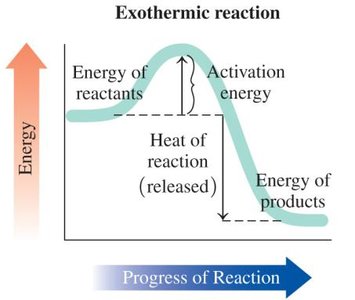
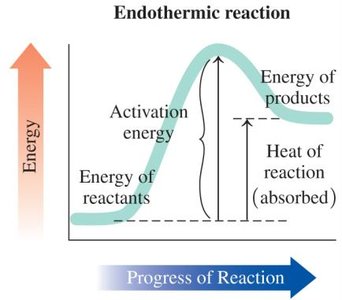
Reactions can either release or absorb energy. Exothermic reactions release heat, while endothermic reactions absorb heat. Energy diagrams visually represent these changes.
Exothermic Reaction: Energy of products is lower than reactants; heat is released.
Endothermic Reaction: Energy of products is higher than reactants; heat is absorbed.
Rate of Reaction
The rate of a chemical reaction is influenced by temperature, concentration of reactants, and the presence of a catalyst. Higher temperature and concentration generally increase the rate, while catalysts lower the activation energy required.
Temperature: Increasing temperature increases kinetic energy and reaction rate.
Concentration: Higher concentration increases the frequency of collisions and reaction rate.
Catalyst: A substance that increases the rate of reaction without being consumed, by lowering the activation energy.
Summary Table: Mass, Moles, and Particles
The following table summarizes the relationships between mass, moles, and particles for elements and compounds:
Mass | Moles | Particles |
|---|---|---|
Grams of element | Moles of element | Atoms (or ions) |
Grams of compound | Moles of compound | Molecules (or formula units) |
Key Terms to Know
Mole
Avogadro’s number
Molar mass
Balanced chemical equation
Oxidation and reduction
Exothermic and endothermic reactions
Rate of reaction
Additional info: Academic context and examples were added to clarify calculation steps and chemical concepts.
