 Back
BackChemical Quantities and Reactions: Study Notes
Study Guide - Smart Notes
 Tailored notes based on your materials, expanded with key definitions, examples, and context.
Chemical Quantities and Reactions
Introduction
Chemical quantities and reactions are foundational concepts in general chemistry, enabling the calculation and prediction of the amounts of substances involved in chemical changes. This chapter covers the mole concept, Avogadro’s number, molar mass, and the principles of writing and balancing chemical equations.
The Mole and Avogadro’s Number
Counting Particles: The Mole
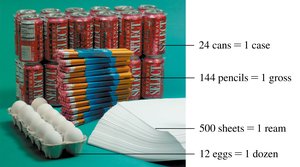
The mole is a counting unit used to express amounts of a chemical substance. Just as a dozen means 12 items, a mole represents a specific number of particles—Avogadro’s number.
Avogadro’s Number: particles (atoms, molecules, or ions) per mole.
Application: Used to count extremely small entities such as atoms and molecules.
Using Avogadro’s Number in Calculations
Avogadro’s number allows conversion between moles and the number of particles.
Equality: particles
Conversion Factors:
From moles to particles:
From particles to moles:

Example: Converting Moles to Atoms
To find the number of atoms in 2.0 moles of aluminum (Al):
Given: 2.0 moles of Al
Needed: Number of atoms of Al
Calculation:

Moles of Elements in a Formula
Interpreting Chemical Formulas
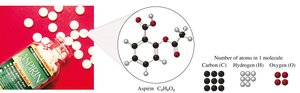
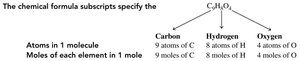
The subscripts in a chemical formula indicate the number of atoms of each element in one molecule and the number of moles of each element in one mole of the compound.
For aspirin, C9H8O4:
1 molecule contains 9 C, 8 H, and 4 O atoms.
1 mole contains 9 moles C, 8 moles H, 4 moles O.
Example: Atoms in a Given Amount of Compound
To find the number of O atoms in 0.150 mole of aspirin (C9H8O4):
Step 1: 0.150 mol C9H8O4
Step 2: Use the subscript (4 mol O per 1 mol aspirin)
Step 3: Multiply by Avogadro’s number
Calculation:

Molar Mass
Definition and Calculation
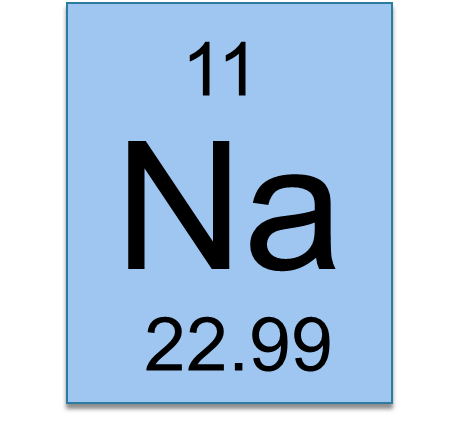
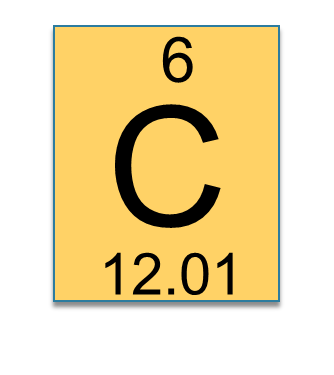
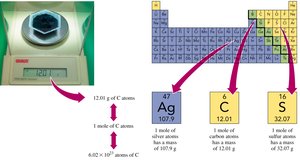
The molar mass of an element or compound is the mass in grams of one mole of that substance. For elements, it is numerically equal to the atomic mass from the periodic table, expressed in grams per mole (g/mol).
Example: 1 mole of Na = 22.99 g
Example: 1 mole of C = 12.01 g
Calculating Molar Mass of Compounds
To calculate the molar mass of a compound, sum the molar masses of all atoms in the formula, each multiplied by its subscript.
Example: Lithium carbonate (Li2CO3)
Calculation:
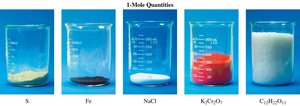
Visualizing 1-Mole Quantities
One mole of different substances contains the same number of particles but has different masses and volumes.
Calculations Using Molar Mass
Conversions Between Mass and Moles
Molar mass is used as a conversion factor to relate the mass of a substance to the number of moles, and vice versa.
From grams to moles:
From moles to grams:

Example: Converting Mass to Moles
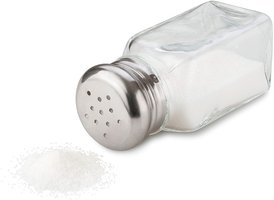
To find the number of moles in 737 g of NaCl:
Step 1: Given mass = 737 g NaCl
Step 2: Molar mass of NaCl = 58.44 g/mol
Step 3:

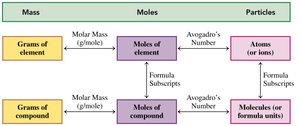
Summary Map: Mass, Moles, and Particles
The following diagram summarizes the relationships between mass, moles, and particles for elements and compounds:
Equations for Chemical Reactions
Writing and Balancing Chemical Equations
A chemical equation represents a chemical reaction, showing the substances involved (reactants and products) and their quantities. Equations must be balanced to obey the law of conservation of mass.
Reactants: Substances present before the reaction (left side).
Products: Substances formed by the reaction (right side).
Arrow (→): Separates reactants from products.
Physical states: (s) solid, (l) liquid, (g) gas, (aq) aqueous.
Delta (Δ): Indicates heat is used.
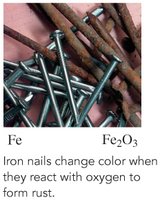
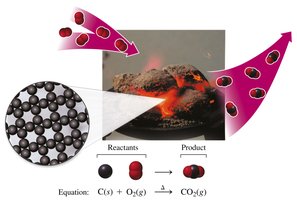
Symbols Used in Chemical Equations
Symbol | Meaning |
|---|---|
+ | Separates two or more reactants or products |
→ | Separates reactants from products |
(s) | Solid state |
(l) | Liquid state |
(g) | Gaseous state |
(aq) | Aqueous (dissolved in water) |
Δ | Heat is added |
Balancing Chemical Equations
To balance a chemical equation, adjust the coefficients (not subscripts) so that the number of atoms of each element is the same on both sides.
Step 1: Write correct formulas for all reactants and products.
Step 2: Count the number of atoms of each element on both sides.
Step 3: Use coefficients to balance each element.
Step 4: Check that all elements are balanced and coefficients are in the lowest ratio.
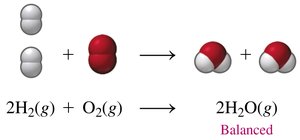
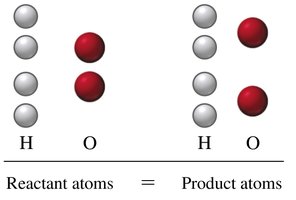
Balancing Equations with Polyatomic Ions
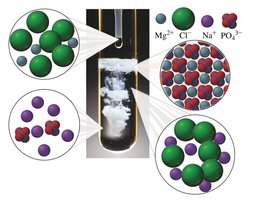
When polyatomic ions appear unchanged on both sides of the equation, balance them as units to simplify the process.
Summary Table: Key Concepts
Concept | Definition/Key Point |
|---|---|
Mole | Counting unit for particles; 1 mole = particles |
Molar Mass | Mass of 1 mole of substance (g/mol) |
Balanced Equation | Same number of each atom on both sides |
Conversion Factors | Used to convert between grams, moles, and particles |
