 Back
BackChemical Quantities and Reactions: Types, Redox, and Mole Relationships
Study Guide - Smart Notes
 Tailored notes based on your materials, expanded with key definitions, examples, and context.
Types of Chemical Reactions
Classification of Chemical Reactions
Chemical reactions can be systematically classified into five main types based on the rearrangement of atoms and the nature of the reactants and products. Understanding these types is essential for predicting reaction outcomes and balancing equations.
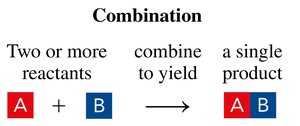
Combination (Synthesis) Reactions: Two or more substances combine to form a single product.
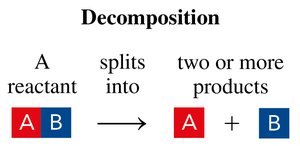
Decomposition Reactions: A single compound breaks down into two or more simpler substances.
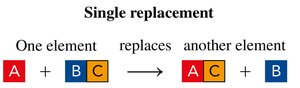
Single Replacement Reactions: One element replaces another in a compound.
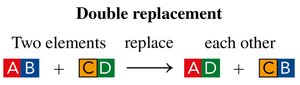
Double Replacement Reactions: The positive ions in two compounds exchange places.
Combustion Reactions: A carbon-containing compound reacts with oxygen to produce carbon dioxide, water, and energy.
Combination Reactions
In a combination reaction, two or more reactants (elements or simple compounds) combine to yield a single product. These reactions are fundamental in the synthesis of new compounds.
General Equation:
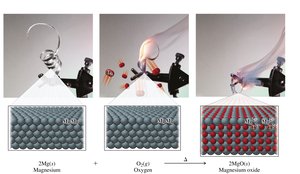
Example: Formation of magnesium oxide from magnesium and oxygen.
Decomposition Reactions
Decomposition reactions involve a single compound splitting into two or more simpler substances. These reactions often require energy input, such as heat, light, or electricity.
General Equation:
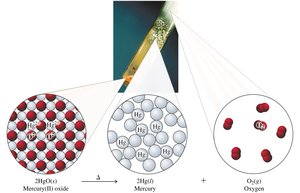
Example: Decomposition of mercury(II) oxide into mercury and oxygen.
Single Replacement Reactions
In single replacement reactions, one element replaces another in a compound. These reactions typically occur between a more reactive element and a less reactive one in a compound.
General Equation:
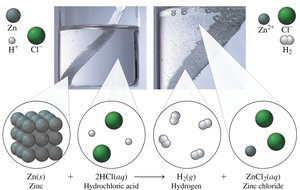
Example: Zinc reacts with hydrochloric acid to produce zinc chloride and hydrogen gas.
Double Replacement Reactions
Double replacement reactions involve the exchange of positive ions between two compounds, resulting in the formation of two new compounds. These reactions often occur in aqueous solutions and may produce a precipitate, gas, or water.
General Equation:
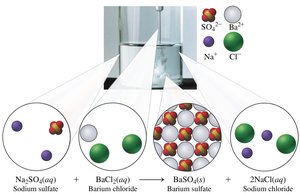
Example: Reaction of sodium sulfate with barium chloride to form barium sulfate and sodium chloride.
Combustion Reactions
Combustion reactions involve a carbon-containing compound burning in oxygen to produce carbon dioxide, water, and energy (usually as heat or light). Complete combustion requires sufficient oxygen; otherwise, incomplete combustion may occur, producing carbon monoxide.
General Equation:
Example: Burning of a candle (paraffin wax) in air.

Health Link: Incomplete Combustion and Carbon Monoxide
Incomplete combustion occurs when oxygen is limited, producing carbon monoxide (CO), a colorless, odorless, and poisonous gas. CO binds to hemoglobin in the blood, reducing oxygen transport and causing symptoms from mild headache to death, depending on exposure level.
10% COHb: Shortness of breath, mild headache, drowsiness
30% COHb: Dizziness, mental confusion, severe headache, nausea
50% COHb: Unconsciousness and possible death without immediate treatment
Summary Table: Types of Chemical Reactions
The following table summarizes the main types of chemical reactions, their general forms, and key characteristics.
Type | General Equation | Description |
|---|---|---|
Combination | Two or more reactants form one product | |
Decomposition | One reactant splits into two or more products | |
Single Replacement | One element replaces another in a compound | |
Double Replacement | Positive ions in two compounds exchange places | |
Combustion | Carbon compound burns in oxygen, releasing energy |
Oxidation–Reduction (Redox) Reactions
Definition and Importance
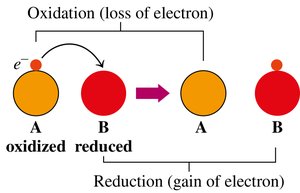
Oxidation–reduction (redox) reactions involve the transfer of electrons between substances. These reactions are fundamental to energy production in biological systems, corrosion, and many industrial processes.
Oxidation: Loss of electrons, addition of oxygen, or loss of hydrogen
Reduction: Gain of electrons, loss of oxygen, or gain of hydrogen
Mnemonic: OIL RIG (Oxidation Is Loss, Reduction Is Gain of electrons)

Examples of Redox Reactions
Rusting of Iron: Iron reacts with oxygen to form iron oxide (rust).
Patina Formation: Copper oxidizes to form a green patina (copper(II) oxide), as seen on the Statue of Liberty.

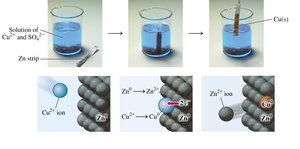
Electron Transfer Example: Zinc and Copper(II) Ion
When zinc metal is placed in a solution of copper(II) ions, zinc is oxidized (loses electrons) and copper(II) is reduced (gains electrons), resulting in the deposition of copper metal.
Redox in Biological Systems
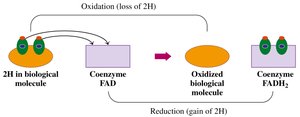
Redox reactions are crucial in metabolism. For example, the coenzyme FAD (flavin adenine dinucleotide) is reduced to FADH2 by accepting hydrogen atoms during cellular respiration.
Characteristics of Oxidation and Reduction
Oxidation: Always involves loss of electrons; may also involve addition of oxygen or loss of hydrogen.
Reduction: Always involves gain of electrons; may also involve loss of oxygen or gain of hydrogen.
Mole Relationships in Chemical Equations
Law of Conservation of Mass
The law of conservation of mass states that matter cannot be created or destroyed in a chemical reaction. Thus, the total mass of reactants equals the total mass of products.
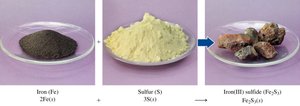
Example: The reaction of iron and sulfur to form iron(II) sulfide demonstrates mass conservation.
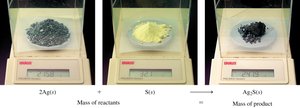
Information from a Balanced Equation
A balanced chemical equation provides quantitative relationships between reactants and products, including the number of atoms, moles, and masses involved.
Equation | Atoms | Avogadro's Number of Atoms | Moles | Mass (g) | Total Mass (g) |
|---|---|---|---|---|---|
2 Ag(s) + S(s) → Ag2S(s) | 2 Ag atoms + 1 S atom → 1 Ag2S formula unit | 200 Ag atoms + 100 S atoms → 100 Ag2S formula units | 2 moles Ag + 1 mole S → 1 mole Ag2S | 2(107.9) Ag + (32.07) S → (247.9) Ag2S | 247.9 g = 247.9 g |
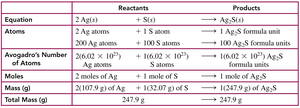
Mole–Mole Factors and Calculations
Balanced equations allow the use of mole–mole factors (ratios) to convert between amounts of reactants and products. These factors are derived from the coefficients in the balanced equation.
Example: For the reaction , the mole–mole factor between Fe and S is .
Calculation: To find how many moles of Fe are needed for 12.0 moles of S:

Key Steps in Mole Calculations:
Identify the given and needed quantities.
Write a plan to convert the given to the needed quantity using mole–mole factors.
Use coefficients from the balanced equation to set up the conversion factor.
Calculate the answer.
Additional info: Mastery of these concepts is foundational for further study in stoichiometry, limiting reactants, and yield calculations in chemistry.
