 Back
Chemical Reaction Equations, Mole Concept, and Stoichiometry: Study Notes for GOB Chemistry
Study Guide - Smart Notes
 Tailored notes based on your materials, expanded with key definitions, examples, and context.
Chemical Reaction Equations
Introduction to Chemical Equations
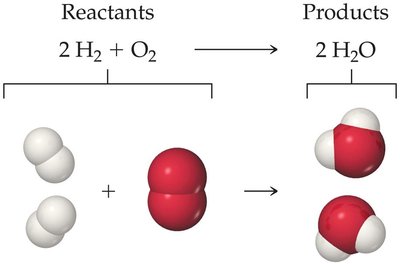
Chemical equations are symbolic representations of chemical reactions, showing the transformation of reactants into products. They are fundamental to understanding chemical processes and are governed by the Law of Conservation of Mass, which states that matter is neither created nor destroyed in a chemical reaction.
Reactants: Substances present at the start of a reaction (left side of the equation).
Products: Substances formed as a result of the reaction (right side of the equation).
Arrows (→): Indicate the direction of the reaction.
Plus signs (+): Separate multiple reactants or products.
Law of Conservation of Mass
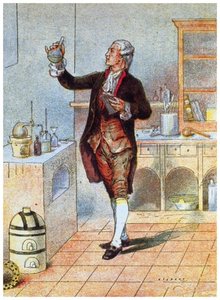
This law, established by Antoine Lavoisier, asserts that the total mass of reactants equals the total mass of products in a chemical reaction. Balancing equations ensures this law is upheld.
Balancing Chemical Equations
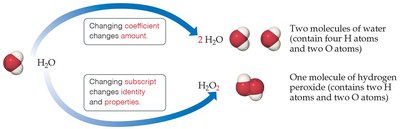
Balancing equations involves adjusting coefficients (not subscripts) to ensure the same number of each type of atom on both sides of the equation. This process maintains the conservation of mass.
Start with elements that appear in only one reactant and one product.
Balance polyatomic ions as units if they appear unchanged on both sides.
Check all elements at the end.
Symbols in Chemical Equations
(s): Solid
(l): Liquid
(g): Gas
(aq): Aqueous (dissolved in water)
Δ (above arrow): Heat is required
Types of Chemical Reactions
Chemical reactions can be classified into several types based on the patterns of reactants and products.
Combination (Synthesis) Reactions: Two or more substances combine to form one product.
Decomposition Reactions: One substance breaks down into two or more simpler substances.
Combustion Reactions: A substance reacts rapidly with oxygen, often producing a flame, CO2, and H2O.
Single Replacement Reactions: One element replaces another in a compound.
Double Replacement Reactions: Exchange of ions between two compounds.
Combination Reactions
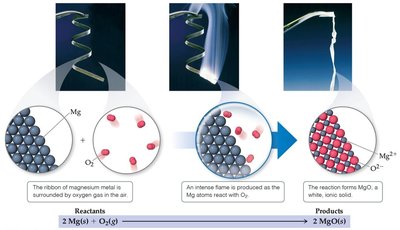
In these reactions, two or more reactants form a single product. For example, the reaction of magnesium with oxygen to form magnesium oxide:
General form: A + B → C
Decomposition Reactions
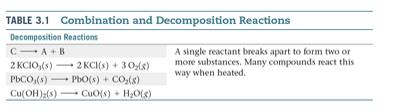
A single compound breaks down into two or more products, often requiring heat.
General form: C → A + B
Combustion Reactions
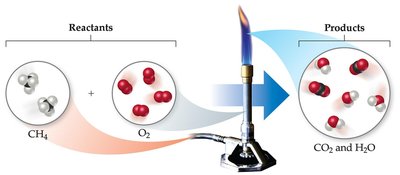
Combustion reactions involve a hydrocarbon reacting with oxygen to produce carbon dioxide and water, releasing energy as heat and light.
General form: Hydrocarbon + O2 → CO2 + H2O
Mole Concept and Formula Weights
Formula Weight and Molecular Weight
The formula weight (FW) is the sum of the atomic weights of all atoms in a chemical formula. For molecules, this is also called the molecular weight (MW).
FW (H2SO4) = 2(1.0 u) + 32.1 u + 4(16.0 u) = 98.1 u
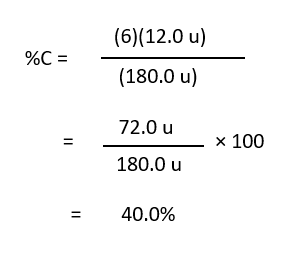
MW (C6H12O6) = 6(12.0 u) + 12(1.0 u) + 6(16.0 u) = 180.0 u
Percent Composition
Percent composition expresses the mass percentage of each element in a compound. The formula is:
Avogadro’s Number and the Mole
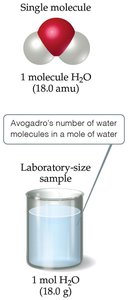
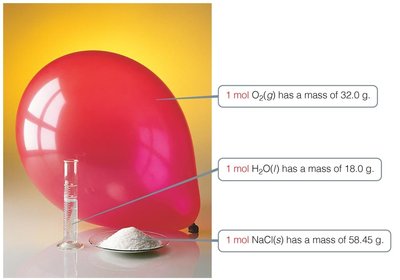
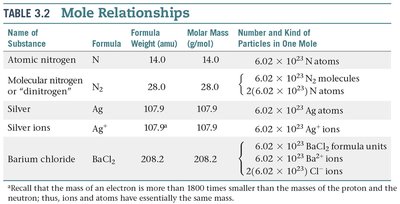
One mole (mol) is defined as 6.02 × 10²³ particles (atoms, molecules, or ions). This is Avogadro’s number and allows chemists to count particles by weighing them.
Molar Mass
The molar mass is the mass of one mole of a substance, expressed in grams per mole (g/mol). For elements, it is the atomic weight from the periodic table; for compounds, it is the sum of the atomic weights of all atoms in the formula.
Converting Between Mass, Moles, and Number of Particles
Conversions between mass, moles, and number of particles use the molar mass and Avogadro’s number as conversion factors.
To convert grams to moles:
To convert moles to particles:
Empirical and Molecular Formulas
The empirical formula gives the simplest whole-number ratio of atoms in a compound, while the molecular formula gives the actual number of atoms of each element in a molecule.
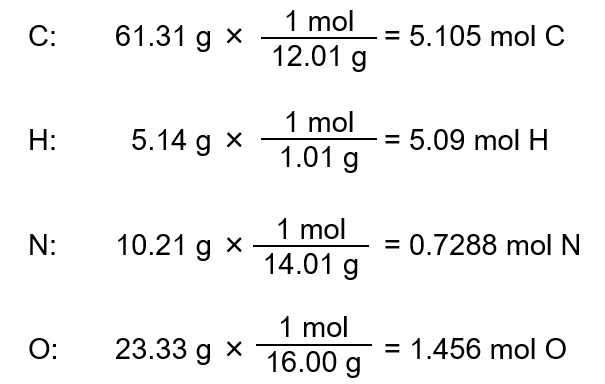
To determine the empirical formula from percent composition:
Assume 100 g of the compound.
Convert mass of each element to moles.
Divide by the smallest number of moles to get the ratio.

Combustion Analysis
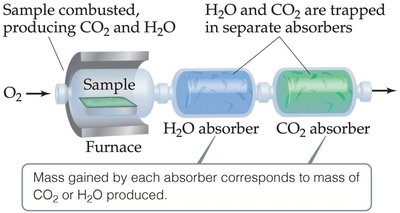
Combustion analysis is used to determine the empirical formula of compounds containing C, H, and O. The masses of CO2 and H2O produced are used to calculate the amounts of C and H, and O is found by difference.
Reaction Stoichiometry and Limiting Reagents
Stoichiometry in Chemical Reactions
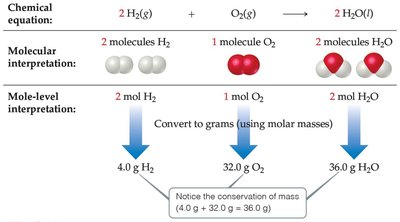
Stoichiometry involves using balanced chemical equations to calculate the quantitative relationships between reactants and products. The coefficients in the equation indicate the relative number of moles of each substance involved.
Use the mole ratio from the balanced equation to relate amounts of different substances.
Stoichiometric Calculations
To solve stoichiometry problems:
Convert the given quantity to moles.
Use the mole ratio from the balanced equation to find moles of the desired substance.
Convert moles back to grams if required.

Limiting Reactants
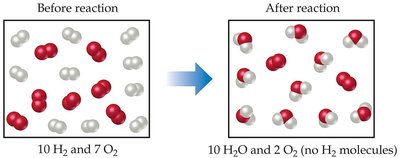
The limiting reactant is the reactant that is completely consumed first, limiting the amount of product formed. The excess reactant is the one that remains after the reaction is complete.
Identify the limiting reactant by comparing the mole ratios of reactants used to those required by the balanced equation.
Theoretical Yield and Percent Yield
The theoretical yield is the maximum amount of product that can be formed from the given amounts of reactants. The actual yield is the amount actually obtained from the reaction. Percent yield is calculated as:
Summary Table: Types of Chemical Reactions
Type | General Form | Description | Example |
|---|---|---|---|
Combination | A + B → C | Two or more reactants form one product | 2 Mg(s) + O2(g) → 2 MgO(s) |
Decomposition | C → A + B | One reactant breaks into two or more products | 2 KClO3(s) → 2 KCl(s) + 3 O2(g) |
Combustion | Hydrocarbon + O2 → CO2 + H2O | Rapid reaction with oxygen, producing heat and light | CH4(g) + 2 O2(g) → CO2(g) + 2 H2O(g) |
Additional info: These notes cover the core concepts of chemical equations, stoichiometry, the mole concept, empirical and molecular formulas, and limiting reagents, which are essential for GOB Chemistry students preparing for exams.
