 Back
BackChemical Reactions: Types, Calculations, and Stoichiometry
Study Guide - Smart Notes
 Tailored notes based on your materials, expanded with key definitions, examples, and context.
Basics of Chemical Reactions
Physical vs. Chemical Changes
Chemical reactions involve the transformation of one or more substances into new substances with different properties. Physical changes, in contrast, do not alter the chemical identity of a substance.
Physical Change: Alters the physical state (e.g., melting, boiling) without changing composition.
Chemical Change: Involves bond breaking and formation, resulting in new substances.
Indicators of Chemical Change: Color change, formation of a precipitate, gas production, heat/flame emission or absorption.
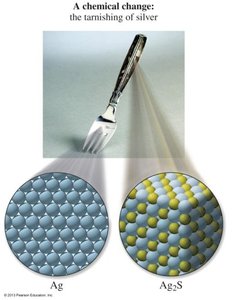
Example: The tarnishing of silver (Ag) to silver sulfide (Ag2S) is a chemical change.
Chemical Equations
A chemical equation uses formulas and symbols to represent the reactants and products in a reaction. It must be balanced to obey the Law of Conservation of Mass.
Reactants: Substances present before the reaction (left side).
Products: Substances formed by the reaction (right side).
Coefficients: Numbers in front of formulas indicating the number of molecules or moles.
Physical States: Indicated as (s), (l), (g), or (aq).
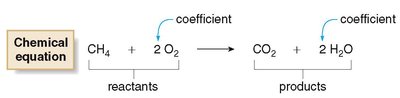
Law of Conservation of Mass: Atoms are neither created nor destroyed in a chemical reaction; equations must be balanced using whole-number coefficients.
Types of Chemical Reactions
Combination (Synthesis) Reactions
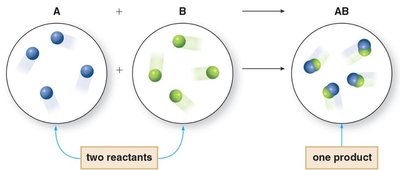
Two or more elements or compounds combine to form a single product.
General Form: A + B → AB
Example: 2Mg(s) + O2(g) → 2MgO(s)

Decomposition Reactions
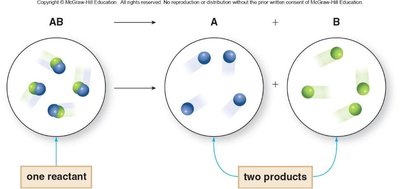
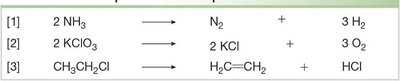
A single compound breaks down into two or more simpler substances.
General Form: AB → A + B
Example: 2HgO(s) → 2Hg(l) + O2(g)
Single Replacement Reactions
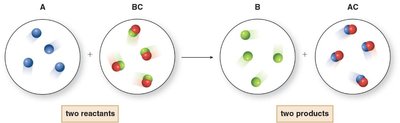
One element replaces another in a compound.
General Form: A + BC → B + AC
Example: Zn(s) + 2HCl(aq) → ZnCl2(aq) + H2(g)
Double Replacement Reactions
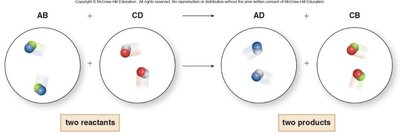
Two compounds exchange ions to form two new compounds.
General Form: AB + CD → AD + CB
Example: ZnS(s) + 2HCl(aq) → ZnCl2(aq) + H2S(g)
Summary Table: Types of Reactions
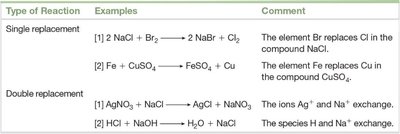
Type of Reaction | Examples | Comment |
|---|---|---|
Single replacement | 2NaCl + Br2 → 2NaBr + Cl2 Fe + CuSO4 → FeSO4 + Cu | Element replaces another in a compound |
Double replacement | AgNO3 + NaCl → AgCl + NaNO3 HCl + NaOH → H2O + NaCl | Ions exchange between compounds |
The Mole and Avogadro’s Number
Definition and Use
The mole (mol) is a counting unit in chemistry, representing 6.02 × 10²³ particles (Avogadro’s Number, NA).
1 mole of atoms, molecules, ions, or formula units = 6.02 × 10²³ entities
Used to relate macroscopic amounts to the number of particles
Example: 1 mole of CO2 molecules = 6.02 × 10²³ CO2 molecules
Using Avogadro’s Number in Calculations
To convert moles to particles: multiply by NA
To convert particles to moles: divide by NA
Example Calculation: How many molecules are in 5.0 moles of CO2?
Subscripts and Moles in Chemical Formulas
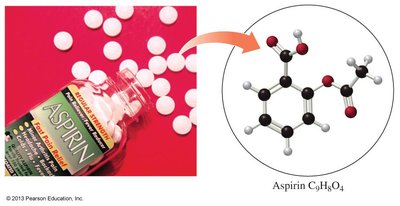
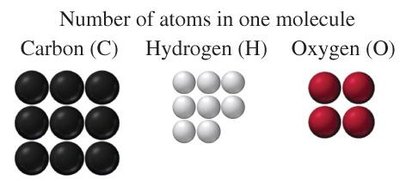
Subscripts in a chemical formula indicate the number of atoms of each element in one molecule and the mole ratio in one mole of the compound.
Mass to Mole Conversions
Molar Mass
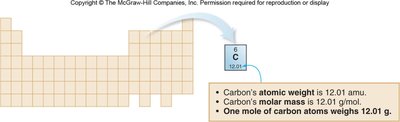
The molar mass is the mass of one mole of a substance, expressed in grams per mole (g/mol). It is numerically equal to the formula weight in atomic mass units (amu).
Formula:
Relating Grams to Moles
To convert grams to moles: divide by molar mass
To convert moles to grams: multiply by molar mass
Example: How many moles are in 36.5 g of CaCO3?
Mole Calculations in Chemical Equations
Stoichiometry
Balanced chemical equations provide the mole ratios needed to relate reactants and products. Calculations often require converting grams to moles, using the mole ratio, and then converting back to grams if needed.
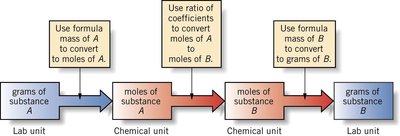
Example: Using the equation 2C2H6 + 5O2 → 4CO + 6H2O, how many moles of CO are produced from 3.5 moles of C2H6?
Limiting Reactants
Concept and Identification
The limiting reactant is the substance that is completely consumed first, thus limiting the amount of product formed. The other reactant is in excess.
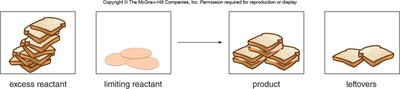
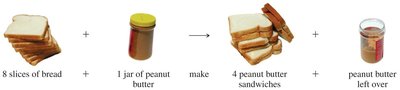
To identify the limiting reactant, calculate the amount of product formed from each reactant; the one producing less product is limiting.
Theoretical Yield and Percent Yield
Definitions
Theoretical Yield: Maximum amount of product predicted by stoichiometry.
Actual Yield: Amount of product actually obtained from the reaction.
Percent Yield: Measures reaction efficiency.
Formula:




Example: If the theoretical yield is 23 g and the actual yield is 15 g, then:
Summary Table: Reaction Types and Examples
Type | General Equation | Example |
|---|---|---|
Combination | A + B → AB | 2Na + Cl2 → 2NaCl |
Decomposition | AB → A + B | 2KClO3 → 2KCl + 3O2 |
Single Replacement | A + BC → B + AC | Zn + 2HCl → ZnCl2 + H2 |
Double Replacement | AB + CD → AD + CB | AgNO3 + NaCl → AgCl + NaNO3 |
