 Back
Chemical Thermodynamics: Energy, Enthalpy, Entropy, and Gibbs Free Energy
Study Guide - Smart Notes
 Tailored notes based on your materials, expanded with key definitions, examples, and context.
Chemical Thermodynamics
Thermodynamic Systems and Energy Transfer
Chemical thermodynamics studies the energy changes that occur during chemical reactions and physical transformations. The system is the part of the universe under study, while the surroundings are everything else. Energy and matter can be transferred between the system and surroundings, depending on the type of system.
Open system: Exchanges both energy and matter with surroundings.
Closed system: Exchanges energy but not matter.
Isolated system: No exchange of energy or matter.

Energy transfer occurs as heat or work. Many substances release or absorb energy when they interact, leading to exothermic (energy released) or endothermic (energy absorbed) reactions.
Thermodynamic Quantities: Intensive and Extensive Properties
Thermodynamic properties are classified as intensive or extensive:
Extensive properties: Depend on the amount of substance (e.g., mass, volume, energy, enthalpy).
Intensive properties: Independent of the amount of substance (e.g., temperature, density, concentration, specific heat capacity, boiling point).
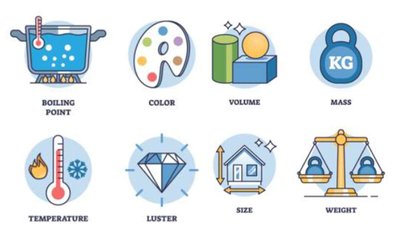
Heat capacity (C) is an extensive property, while specific heat capacity (c) is intensive.
State and Non-State Functions
State functions depend only on the initial and final states of the system, not the path taken. Examples include internal energy (U), enthalpy (H), entropy (S), and Gibbs free energy (G). Non-state functions, such as heat (Q) and work (W), depend on the process path.
State functions: U, H, S, G, T, ΔU, ΔH, ΔS, ΔG, ΔT
Non-state functions: W, Q, t
Heat Capacity and Specific Heat Capacity
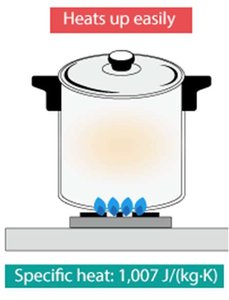
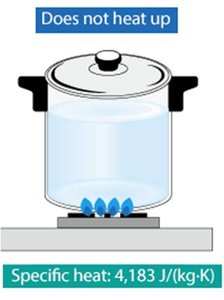
Heat is the transfer of energy due to temperature difference. Heat capacity (C) is the amount of energy required to raise the temperature of a substance by 1°C or 1 K. Specific heat capacity (c) is the amount of heat required to raise the temperature of 1 gram of a substance by 1°C.
Formula:
Example: If 209 J is required to increase the temperature of 50.0 g of water by 1.00 K,
Exothermic and Endothermic Processes
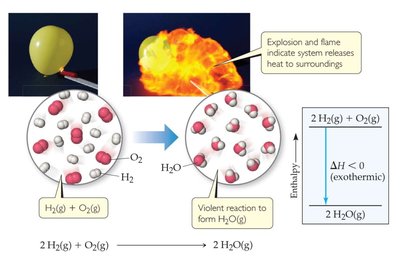
Exothermic reactions release energy to the surroundings (ΔH negative), while endothermic reactions absorb energy from the surroundings (ΔH positive).
Exothermic: Combustion, formation of water from hydrogen and oxygen.
Endothermic: Melting ice, vaporization.
The Laws of Thermodynamics
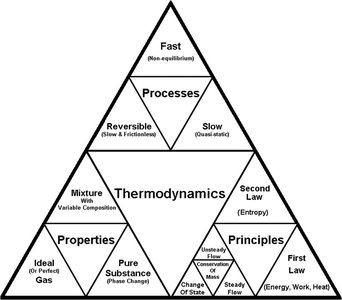
The three fundamental laws govern energy and entropy in chemical systems:
First Law: Energy cannot be created nor destroyed; it can only be transformed.
Second Law: Entropy of the universe increases for spontaneous processes.
Third Law: The entropy of a perfectly ordered pure crystal at absolute zero is zero.
Enthalpy (H) and Enthalpy Changes
Enthalpy is a state function defined as . The enthalpy change for a reaction (ΔrH) is the difference between the enthalpy of products and reactants:
Formula:
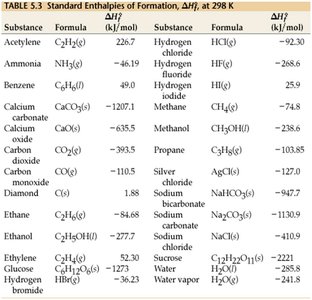
Standard enthalpy of formation (ΔfH°): Enthalpy change when 1 mole of a substance is formed from its elements in their standard states.
Calculation:

Hess's Law
Hess's Law states that the enthalpy change for a reaction is the sum of the enthalpy changes for individual steps, regardless of the path taken. This allows calculation of ΔH for reactions using known values from other reactions.
Entropy (S) and Entropy Change
Entropy measures the disorder or randomness in a system. Spontaneous reactions tend toward higher entropy. Entropy is a state function, and its change is given by:
Formula:
For reactions:
For isothermal processes:
Gibbs Free Energy (G)
Gibbs free energy determines the spontaneity of a process at constant temperature and pressure. The change in Gibbs free energy is:
Formula:
Spontaneity: If ΔG < 0, the process is spontaneous; if ΔG = 0, the system is at equilibrium; if ΔG > 0, the process is non-spontaneous.
Standard free energy of formation (ΔfG°): Free-energy change when 1 mole of a compound is formed from its elements in their standard states.
Calculation:
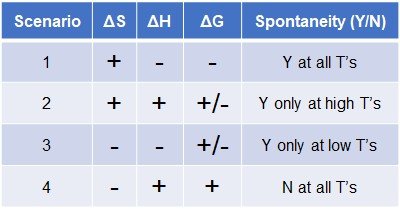
Summary Table: Spontaneity Based on ΔH and ΔS
Scenario | ΔS | ΔH | ΔG | Spontaneity (Y/N) |
|---|---|---|---|---|
1 | + | - | - | Y at all T's |
2 | + | + | +/- | Y only at high T's |
3 | - | - | +/- | Y only at low T's |
4 | - | + | + | N at all T's |
Example Calculation: Standard Thermodynamic Quantities
Given the following data:
S° (J/mol·K): Ag+ (aq) = 72.7, Ag (s) = 42.6, Cu2+ (aq) = 50.6, Cu (s) = 33.2
ΔfH° (kJ/mol): Ag+ (aq) = +105.6, Ag (s) = 0, Cu2+ (aq) = +64.4, Cu (s) = 0
For the reaction: 2Ag+ (aq) + Cu (s) → 2Ag (s) + Cu2+ (aq)
ΔH° = [2 × 0 + 64.4] − [2 × 105.6 + 0] = −146.8 kJ/mol
ΔS° = [2 × 42.6 + 50.6] − [2 × 72.7 + 33.2] = −42.8 J/mol·K
ΔG° = ΔH° − TΔS° = −146.8 kJ/mol − (298 K × −0.0428 kJ/mol·K) = −134.0 kJ/mol
Summary of Key Concepts
State functions depend only on initial and final states.
Heat capacity is extensive; specific heat is intensive.
Energy cannot be created nor destroyed (First Law).
Exothermic reactions release energy; endothermic absorb energy.
Hess's Law allows calculation of enthalpy changes from known reactions.
Spontaneous processes require ΔS > 0 (universe) and ΔG < 0 (system).
