 Back
Chemistry and Measurements: Foundations for GOB Chemistry
Study Guide - Smart Notes
 Tailored notes based on your materials, expanded with key definitions, examples, and context.
Chapter 2: Chemistry and Measurements
Introduction to Chemistry and Its Importance
Chemistry is often referred to as the central science because it connects and supports many other scientific disciplines, including biology, medicine, physics, geology, and environmental science. Understanding chemistry is essential for comprehending processes at the cellular and molecular levels, which is crucial for fields such as medicine and biology.
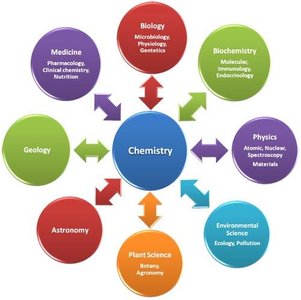
Chemistry and Chemicals
Fundamental Terms
Matter: Anything that has mass and occupies space.
Chemistry: The study of the composition, structure, properties, and changes of matter.
Chemical: Any substance that has a definite composition; chemicals are the building blocks of matter.
Changes and Properties of Matter
Chemical and Physical Changes
Chemical Change (Chemical Reaction): A process that results in the formation of one or more new substances with new chemical properties and compositions. Example: Burning methane (CH4) in oxygen produces carbon dioxide and water.
Physical Change: A change in the physical appearance or state of a substance without altering its composition or identity. Example: Melting ice changes water from solid to liquid but does not change its chemical composition.
Chemical Properties: Describe a substance's ability to undergo chemical changes or reactions. Example: Flammability, reactivity with acids.
Physical Properties: Can be observed or measured without changing the substance's composition. Example: Color, mass, density, melting point.
Units of Measurement
Metric and SI Systems
Measurements in chemistry require both a number and a unit. The metric system, and its modern form, the International System of Units (SI), is used worldwide in science for its simplicity and ease of conversion, as all units are based on powers of ten.
Base Units: Meter (m) for length, gram (g) for mass, liter (L) for volume, second (s) for time.
Prefixes: Used to indicate multiples or fractions of base units (e.g., kilo-, centi-, milli-, micro-).
Prefix | Symbol | Multiplier | Power of Ten |
|---|---|---|---|
mega- | M | 1,000,000 | 106 |
kilo- | k | 1,000 | 103 |
centi- | c | 0.01 | 10-2 |
milli- | m | 0.001 | 10-3 |
micro- | µ (or mc) | 0.000001 | 10-6 |
nano- | n | 0.000000001 | 10-9 |
Example Conversions:
1 centimeter (cm) = 0.01 meter (m)
1 kilogram (kg) = 1,000 grams (g)
1 microliter (µL) = 0.000001 liter (L)
SI and Metric Units in Chemistry
Common Units
Volume: Liter (L), milliliter (mL), cubic centimeter (cm3 or cc). 1 mL = 1 cm3.
Length: Meter (m), centimeter (cm), millimeter (mm). 1 m = 100 cm = 1000 mm.
Mass: Gram (g), kilogram (kg), milligram (mg). 1 kg = 1000 g; 1 g = 1000 mg.
Temperature: Celsius (°C), Kelvin (K), Fahrenheit (°F).
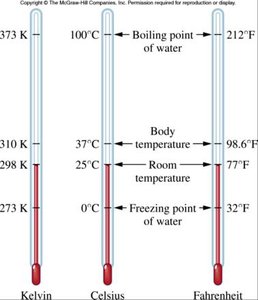
Time: Second (s).
Measured Numbers and Significant Figures
Understanding Significant Figures
Measured numbers are obtained when measuring a quantity, and their accuracy depends on the measuring device. Significant figures (SF) include all certain digits plus the first estimated digit in a measurement.
Nonzero numbers: Always significant.
Zeros between nonzero numbers: Always significant.
Trailing zeros: Significant only if a decimal point is present.
Leading zeros: Not significant.
Examples:
33.7 (3 SF)
4.611 (4 SF)
0.0045 (2 SF)
Measuring Length and Estimating Digits
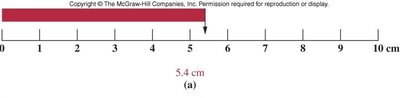
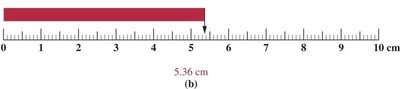
The precision of a measurement depends on the instrument used. For example, a ruler marked every 1 cm allows estimation to the nearest 0.1 cm, while a ruler marked every 0.1 cm allows estimation to the nearest 0.01 cm.
Exact Numbers
Counted numbers or defined values (e.g., 1 dozen = 12) are exact and have an infinite number of significant figures.
Significant Figures in Calculations
Addition and Subtraction
The answer should have the same number of decimal places as the measurement with the fewest decimal places.
Multiplication and Division
The answer should have the same number of significant figures as the measurement with the fewest significant figures.
Rounding Rules
If the digit to be dropped is less than 5, leave the last significant figure unchanged.
If the digit to be dropped is 5 or greater, increase the last significant figure by one.
Conversion Factors and Dimensional Analysis
Writing and Using Conversion Factors
Conversion factors are ratios derived from the equality between two units and are used to convert from one unit to another. The factor-label method (dimensional analysis) is a systematic approach to problem solving using conversion factors.
Example: 1 in. = 2.54 cm (exact)
Example: 1 lb. = 453.6 g
Quantity | English Unit | Metric Unit | Conversion Factor |
|---|---|---|---|
Length | 1 in. | 2.54 cm | 1 in. = 2.54 cm |
Mass | 1 lb. | 453.6 g | 1 lb. = 453.6 g |
Volume | 1 qt. | 0.946 L | 1 qt. = 0.946 L |
Problem Solving Steps:
Read the question carefully.
Identify the units given and the units required.
Determine the necessary conversion factor(s).
Set up a "road map" for the calculation.
Perform the calculation, including units.
Check if the answer is reasonable.
Density and Specific Gravity
Density
Density is the ratio of mass to volume and is a physical property of matter. It is independent of the amount of material and can be used to identify substances.
Formula:
m: mass (g)
v: volume (mL or cm3)
Example: If a 0.380 g sample of LDL has a volume of 0.362 mL, its density is .
Specific Gravity
Specific gravity is the ratio of the density of a substance to the density of a standard (usually water at 4°C for liquids and solids). It is a unitless quantity.
Formula:
Study Tips for Chemistry
Practice daily and minimize distractions.
Learn material in small chunks for better retention.
Prepare for class by reading ahead.
Review material soon after lecture.
Work problems independently to ensure understanding.
Key Learning Objectives
Define matter, chemistry, and chemical.
Understand and use the metric system and SI units.
Determine and apply significant figures in measurements and calculations.
Create and use conversion factors for unit conversions.
Apply the factor-label method for problem solving.
Calculate and interpret density and specific gravity.
