 Back
BackChemistry and Measurements: Foundations for Scientific Study
Study Guide - Smart Notes
 Tailored notes based on your materials, expanded with key definitions, examples, and context.
Matter and Measurements
Introduction to Chemistry and Measurement
Chemistry relies on precise measurement to describe matter and its changes. Scientists use standardized systems to ensure consistency and accuracy in reporting data. The International System of Units (SI) is the globally accepted standard for scientific measurements.
Units of Measurement
SI Units and Metric System
The SI system is used worldwide for scientific measurements. It includes base units for length, volume, mass, temperature, and time:
Length: meter (m)
Volume: cubic meter (m3), commonly liter (L) and milliliter (mL) in chemistry
Mass: kilogram (kg), often gram (g) in chemistry
Temperature: kelvin (K), also Celsius (°C)
Time: second (s)
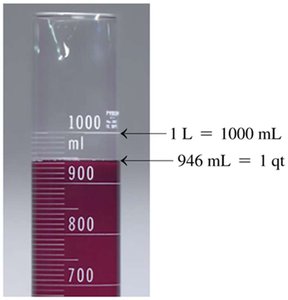
Volume
Volume is the space occupied by a substance. In chemistry, it is typically measured in liters (L) and milliliters (mL). Graduated cylinders are used for measuring small volumes.
1 L = 1000 mL
Length
Length is measured in meters (m) in the SI system, but centimeters (cm) are often used in chemistry.
1 m = 100 cm
2.54 cm = 1 inch
Mass
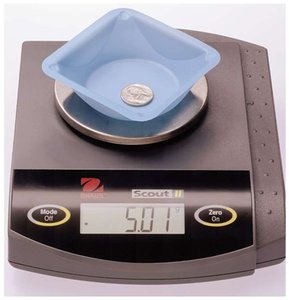
Mass is a measure of the quantity of material in an object. It is measured using an electronic balance, with the SI unit being the kilogram (kg), but grams (g) are commonly used in chemistry.
1 kg = 1000 g
1 kg = 2.20 lb
Temperature
Temperature measures how hot or cold an object is. It is measured in degrees Celsius (°C) and kelvin (K) in the SI system. Water freezes at 0°C (273 K) and boils at 100°C (373 K). The Kelvin scale starts at absolute zero (0 K).

Measured Numbers and Significant Figures
Measured Numbers
Measured numbers are obtained using measuring tools and always contain some degree of uncertainty. The last digit in a measured value is estimated.
Reporting Measurements
When reporting measurements, include all certain digits plus one estimated digit. For example, if a ruler is marked every 0.1 cm, a length might be reported as 4.55 cm.


Significant Figures (SFs)
Significant figures are the digits in a measurement that are known with certainty plus one estimated digit. They reflect the precision of a measurement.
All nonzero digits are significant.
Zeros between nonzero digits are significant.
Zeros at the end of a decimal number are significant.
Zeros at the beginning of a decimal number are not significant.
Zeros used as placeholders in large numbers without a decimal point are not significant.
All digits in the coefficient of scientific notation are significant.
Rounding Off
When rounding numbers:
If the first digit to be dropped is 4 or less, drop it and all following digits.
If the first digit to be dropped is 5 or greater, increase the last retained digit by 1.
Calculations with Significant Figures
Addition/Subtraction: The answer should have the same number of decimal places as the measurement with the fewest decimal places.
Multiplication/Division: The answer should have the same number of significant figures as the measurement with the fewest significant figures.
Prefixes and Conversion Factors
SI Prefixes
Prefixes are used to express multiples or fractions of units. Common prefixes include kilo- (k, 103), centi- (c, 10-2), milli- (m, 10-3), micro- (μ, 10-6), and nano- (n, 10-9).
Equalities and Conversion Factors
Equalities express the same quantity in different units (e.g., 1 kg = 1000 g). These can be written as conversion factors (fractions) to convert between units.
Conversion factor for 1 h = 60 min: or
Density
Definition and Calculation
Density compares the mass of an object to its volume. It is calculated as:
Units: g/mL or g/cm3
Substances with higher densities have closely packed particles (e.g., metals like gold and lead).
Substances with lower densities have particles that are farther apart.
Measuring Volume by Displacement
The volume of an irregular solid can be determined by the amount of water it displaces in a graduated cylinder. The density is then calculated using the measured mass and displaced volume.
Example Calculation:
Mass of zinc = 68.60 g
Volume of water rises from 35.5 mL to 45.0 mL (volume of zinc = 9.5 mL)
Density =
Applications: Bone Density and Health
Bone density is an important health indicator. Low bone density (osteoporosis) can be detected by X-ray techniques, as denser bones block more X-rays.
Relationship Between Units of Volume
The cubic centimeter (cm3 or cc) is the volume of a cube with sides of 1 cm. 1 cm3 = 1 mL, and 1000 cm3 = 1 L.

Summary Table: Common SI Units and Prefixes
Quantity | SI Unit | Common Metric Units |
|---|---|---|
Length | meter (m) | centimeter (cm), millimeter (mm) |
Mass | kilogram (kg) | gram (g), milligram (mg) |
Volume | cubic meter (m3) | liter (L), milliliter (mL), cubic centimeter (cm3) |
Temperature | kelvin (K) | degree Celsius (°C) |
Time | second (s) | minute (min), hour (h) |
Prefix | Symbol | Factor |
|---|---|---|
kilo | k | 103 |
centi | c | 10-2 |
milli | m | 10-3 |
micro | μ | 10-6 |
nano | n | 10-9 |
Practice Problems
Convert 2.44 meters to centimeters.
Calculate the density of a 48.0 g sample that raises the water level from 25.0 mL to 33.0 mL.
How many minutes are in 1.6 days?
Additional info: This guide covers foundational concepts in measurement, significant figures, unit conversions, and density, which are essential for all subsequent topics in general, organic, and biological chemistry.
