 Back
Chemistry and Measurements: Structured Study Notes for GOB Chemistry
Study Guide - Smart Notes
 Tailored notes based on your materials, expanded with key definitions, examples, and context.
Chemistry and Measurements
Introduction
Chemistry relies on precise measurements to describe matter and its properties. Understanding units, measurement tools, and the rules for reporting and converting values is foundational for all chemical calculations and laboratory work. 
Units of Measurement
Metric and SI Units
The metric system and International System of Units (SI) are the global standards for scientific measurement. These systems provide consistent units for length, volume, mass, temperature, and time. - Length: Measured in meters (m), centimeters (cm) - Volume: Measured in liters (L), milliliters (mL) - Mass: Measured in kilograms (kg), grams (g) - Temperature: Measured in Celsius (°C), Kelvin (K) - Time: Measured in seconds (s) 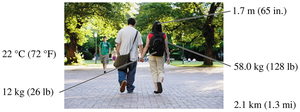
Measurement Tools
- Graduated cylinders are used for measuring volume. 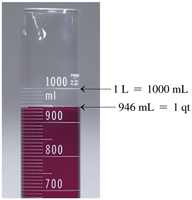 - Rulers and metersticks are used for measuring length.
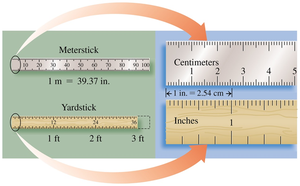 - Electronic balances are used for measuring mass.
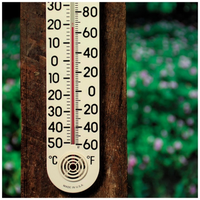
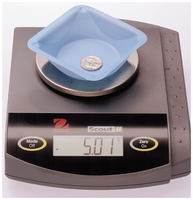 - Thermometers are used for measuring temperature.
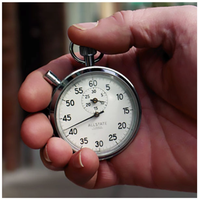
 - Stopwatches are used for measuring time.
Temperature Scales
There are three main temperature scales: Fahrenheit, Celsius, and Kelvin. - Celsius (°C): Water freezes at 0°C and boils at 100°C. - Fahrenheit (°F): Water freezes at 32°F and boils at 212°F. - Kelvin (K): Absolute zero is 0 K; water freezes at 273 K and boils at 373 K. 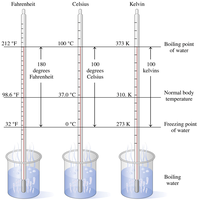
Temperature Conversion Equations
To convert between Celsius and Fahrenheit: To convert between Celsius and Kelvin: 
Prefixes in Metric and SI Units
Prefixes modify the size of units by powers of ten. Common prefixes include: - Kilo- (k): 1000 times the base unit - Milli- (m): 0.001 times the base unit - Micro- (mc or μ): 0.000001 times the base unit - Deci- (d): 0.1 times the base unit 
Measured Numbers and Significant Figures
Measured vs. Exact Numbers
- Measured numbers are obtained using tools and have uncertainty. - Exact numbers are obtained by counting or definition and have no uncertainty.
Reporting Measurements
- Always estimate one digit beyond the smallest marked unit. - The last digit is uncertain and is called the estimated digit.
Significant Figures (SFs)
Significant figures include all certain digits plus the estimated digit. Rules: - All nonzero digits are significant. - Zeros between nonzero digits are significant. - Zeros at the beginning of decimal numbers are not significant. - Zeros at the end of decimal numbers are significant. - Zeros used as placeholders in large numbers without a decimal point are not significant.
Significant Figures in Calculations
Rounding Off
- If the first digit to be dropped is 4 or less, drop it. - If the first digit to be dropped is 5 or greater, increase the last retained digit by 1.
Multiplication and Division
- The answer should have the same number of SFs as the measurement with the fewest SFs.
Addition and Subtraction
- The answer should have the same number of decimal places as the measurement with the fewest decimal places.
Conversion Factors and Equalities
Writing Conversion Factors
Equalities relate two units describing the same quantity. - Example: 1 meter = 1000 millimeters - Conversion factors can be written as fractions: or
Metric and U.S. System Equalities
- Equalities between metric units or U.S. units are exact. - Equalities between metric and U.S. units may have measured values and affect SFs.
Problem Solving Using Unit Conversions
Steps for Unit Conversion
1. State the given and needed quantities. 2. Write a plan to convert the given unit to the needed unit. 3. State the equalities and conversion factors. 4. Set up the problem to cancel units and calculate the answer.
Using Multiple Conversion Factors
- Sometimes, two or more conversion factors are needed to reach the desired unit. - Arrange factors so that each cancels the preceding unit.
Density
Definition and Calculation
Density compares the mass of an object to its volume. - Units: g/cm3, g/mL for solids and liquids; g/L for gases.
Volume Displacement
- The volume of a solid can be determined by the amount of water it displaces in a graduated cylinder.
Applications
- Density is used to identify substances and calculate mass or volume from known values. - Bone density is a health indicator; low bone density can indicate osteoporosis.
Summary Table: Common Units and Prefixes
Quantity | SI Unit | Common Metric Unit |
|---|---|---|
Length | meter (m) | centimeter (cm) |
Volume | cubic meter (m3) | liter (L), milliliter (mL) |
Mass | kilogram (kg) | gram (g) |
Temperature | kelvin (K) | Celsius (°C) |
Time | second (s) | second (s) |
Summary Table: Metric Prefixes
Prefix | Symbol | Value |
|---|---|---|
kilo- | k | 1000 |
deci- | d | 0.1 |
centi- | c | 0.01 |
milli- | m | 0.001 |
micro- | μ or mc | 0.000001 |
Summary Table: Temperature Conversions
Conversion | Equation |
|---|---|
Celsius to Fahrenheit | |
Fahrenheit to Celsius | |
Celsius to Kelvin |
Summary Table: Density Calculations
Calculation | Equation |
|---|---|
Density | |
Mass | |
Volume |
