Back
Chemistry and Measurements: Study Notes for GOB Chemistry
Study Guide - Smart Notes
 Tailored notes based on your materials, expanded with key definitions, examples, and context.
Chemistry and Measurements
Physical Quantities and SI Units
In chemistry, measurements are fundamental for describing matter and its changes. The International System of Units (SI) is used globally to ensure consistency in scientific communication.
Physical Quantity: A measurable property of matter, such as mass, length, or temperature.
SI Units: The standard units for scientific measurements. Each physical quantity has a specific SI unit and abbreviation.
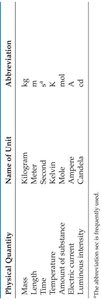
Physical Quantity | Name of Unit | Abbreviation |
|---|---|---|
Mass | Kilogram | kg |
Length | Meter | m |
Time | Second | s |
Temperature | Kelvin | K |
Amount of substance | Mole | mol |
Electric current | Ampere | A |
Luminous intensity | Candela | cd |
Metric Prefixes
Metric prefixes are used to express quantities that are much larger or smaller than the base unit. Understanding these prefixes is essential for converting between units.
Prefix: A word or letter placed before a unit to indicate a multiple or fraction of that unit.
Examples: Kilometer (km), milligram (mg), nanometer (nm).
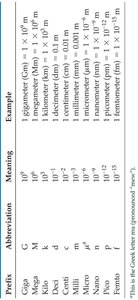
Prefix | Abbreviation | Meaning | Example |
|---|---|---|---|
Giga | G | 109 | 1 gigameter (Gm) = 1 x 10⁹ m |
Mega | M | 106 | 1 megameter (Mm) = 1 x 10⁶ m |
Kilo | k | 103 | 1 kilometer (km) = 1 x 10³ m |
Deci | d | 10-1 | 1 decimeter (dm) = 0.1 m |
Centi | c | 10-2 | 1 centimeter (cm) = 0.01 m |
Milli | m | 10-3 | 1 millimeter (mm) = 0.001 m |
Micro | μ | 10-6 | 1 micrometer (μm) = 1 x 10⁻⁶ m |
Nano | n | 10-9 | 1 nanometer (nm) = 1 x 10⁻⁹ m |
Pico | p | 10-12 | 1 picometer (pm) = 1 x 10-12 m |
Femto | f | 10-15 | 1 femtometer (fm) = 1 x 10-15 m |
Temperature Scales
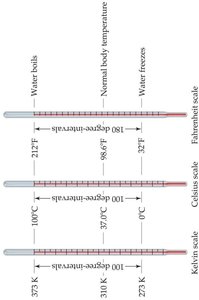
Temperature is measured using different scales: Celsius, Fahrenheit, and Kelvin. Each scale has its own reference points and conversion formulas.
Celsius (°C): Water freezes at 0°C and boils at 100°C.
Fahrenheit (°F): Water freezes at 32°F and boils at 212°F.
Kelvin (K): Absolute zero is 0 K; water freezes at 273 K and boils at 373 K.
Conversion formulas:
Volume and Its Measurement
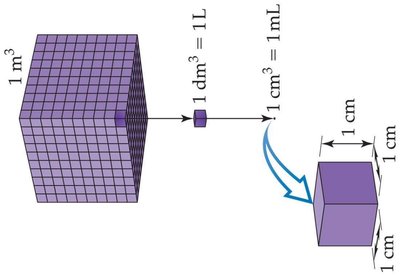
Volume is the amount of space occupied by a substance. In chemistry, volume is often measured in liters (L), milliliters (mL), or cubic centimeters (cm3).
1 m3 = 1000 L
1 L = 1 dm3
1 mL = 1 cm3
Laboratory Equipment for Measuring Volume
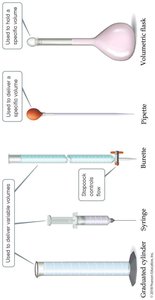
Accurate measurement of volume is essential in laboratory work. Different glassware and instruments are used depending on the required precision.
Volumetric flask: Used to hold a specific volume accurately.
Pipette: Used to deliver a specific volume.
Burette: Used to dispense and measure variable volumes, especially in titrations.
Syringe: Used to dispense and measure liquids.
Graduated cylinder: Used to determine various volumes.
Measuring Volume by Displacement
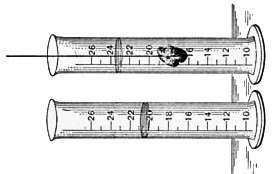
Volume can also be measured by displacement, especially for irregularly shaped objects. The object is submerged in water, and the change in water level indicates the volume.
Displacement method: The volume of water displaced equals the volume of the object.
Application: Useful for solids that do not dissolve in water.
Accuracy and Precision in Measurements
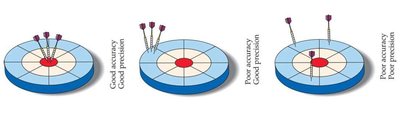
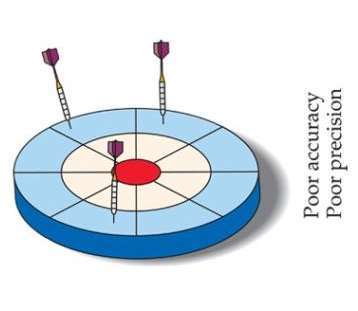
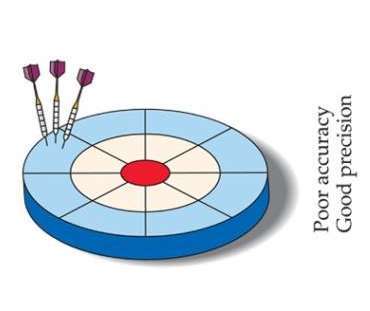
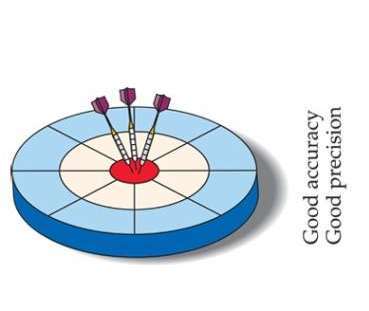
Accuracy and precision are important concepts in scientific measurements. They describe how close measurements are to the true value and how reproducible they are.
Accuracy: How close a measurement is to the true or accepted value.
Precision: How close repeated measurements are to each other.
Examples:
Poor accuracy, poor precision: Measurements are scattered and far from the true value.
Poor accuracy, good precision: Measurements are close to each other but far from the true value.
Good accuracy, good precision: Measurements are close to each other and to the true value.
Unit Conversion and Dimensional Analysis
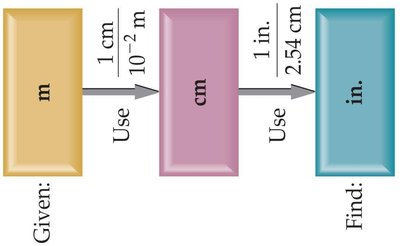
Unit conversion is a fundamental skill in chemistry. Dimensional analysis uses conversion factors to change units systematically.
Conversion factor: A ratio that expresses how many of one unit are equal to another unit.
Example: To convert meters to centimeters and then to inches:
Process: Multiply the given value by the appropriate conversion factors to obtain the desired unit.
Scientific Calculators in Chemistry
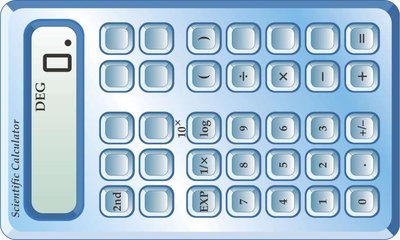
Scientific calculators are essential tools for performing calculations involving exponents, logarithms, and other mathematical functions in chemistry.
Functions: Exponential, logarithmic, trigonometric, and arithmetic operations.
Application: Used for calculations in chemical equations, unit conversions, and statistical analysis.
Summary Table: Accuracy and Precision
The following table summarizes the relationship between accuracy and precision in measurements:
Accuracy | Precision | Description |
|---|---|---|
Good | Good | Measurements are close to the true value and to each other. |
Poor | Good | Measurements are close to each other but far from the true value. |
Poor | Poor | Measurements are scattered and far from the true value. |