 Back
BackChemistry and Measurements: Units, Significant Figures, and Problem Solving
Study Guide - Smart Notes
 Tailored notes based on your materials, expanded with key definitions, examples, and context.
Chapter 2: Chemistry and Measurements
Units of Measurement
Chemists use the metric system and the International System of Units (SI) as standards for measurement. Understanding these units is essential for accurate scientific communication and calculations.
Length: meter (m)
Mass: kilogram (kg) in SI, gram (g) in metric
Volume: liter (L) in metric, cubic meter (m3) in SI
Temperature: degree Celsius (°C) in metric, Kelvin (K) in SI
Time: second (s)
Significant Figures
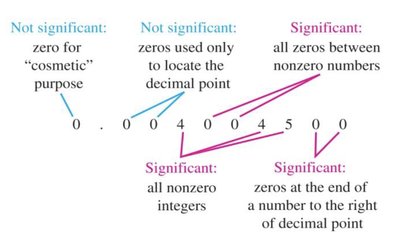
Significant figures (SFs) are all the digits in a measurement known with certainty plus one estimated digit. Correct use of significant figures ensures the precision of calculations and reporting in chemistry.
All nonzero digits are significant.
Zeros between nonzero digits are significant.
Leading zeros (before the first nonzero digit) are not significant.
Trailing zeros to the right of a decimal point are significant.
Trailing zeros in a whole number with no decimal shown are not significant.
Rounding Significant Figures
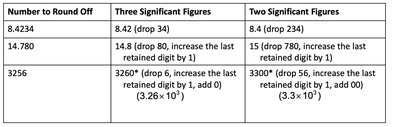
When rounding numbers, retain the correct number of significant figures based on the calculation:
For multiplication/division: The result should have the same number of SFs as the measurement with the fewest SFs.
For addition/subtraction: The result should have the same number of decimal places as the measurement with the fewest decimal places.
Exact Numbers
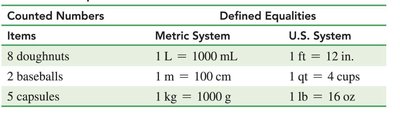
Exact numbers are values that are counted or defined, not measured. They have an infinite number of significant figures and do not affect the precision of calculated results.
Examples: 8 doughnuts, 2 baseballs, 5 capsules
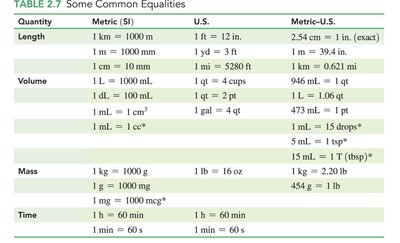
Defined equalities: 1 L = 1000 mL, 1 ft = 12 in., 1 kg = 1000 g
Metric Prefixes
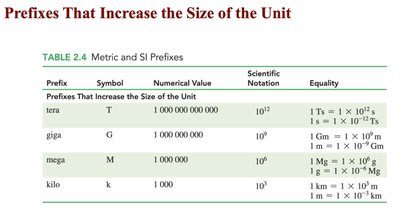
Prefixes are used to indicate multiples or fractions of units in the metric system. Memorizing common prefixes is essential for unit conversions.
Prefixes that increase the size of the unit: kilo (k), mega (M), giga (G), tera (T)
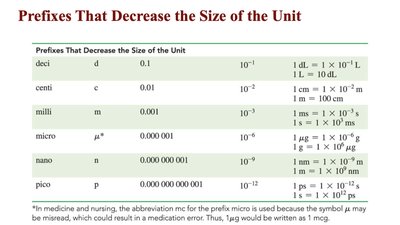
Prefixes that decrease the size of the unit: deci (d), centi (c), milli (m), micro (μ), nano (n), pico (p)
Conversion Factors and Problem Solving
Conversion factors are ratios derived from equalities that relate different units. They are used to convert one unit to another in calculations.
Example: 60 min = 1 h gives the conversion factors and
Example: 1 m = 100 cm gives the conversion factors and


Common equalities are summarized in tables for reference during calculations.
Steps for Problem Solving Using Conversion Factors
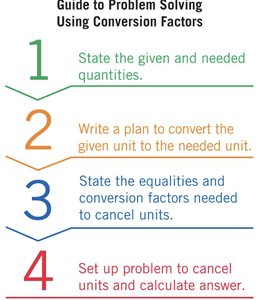
State the given and needed quantities.
Write a plan to convert the given unit to the needed unit.
State the equalities and conversion factors needed to cancel units.
Set up the problem to cancel units and calculate the answer.
Example: Mass Conversion
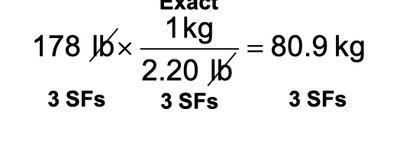
To convert 178 lb to kilograms:
Equality: 1 kg = 2.20 lb
Conversion factor:
Calculation: (rounded to 3 SFs)

Density
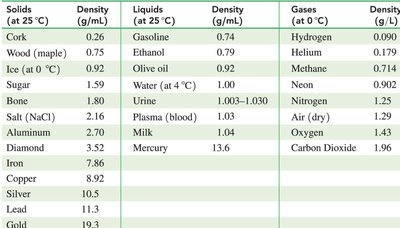
Density is the ratio of the mass of a substance to its volume. It is a physical property used to identify substances and predict whether an object will float or sink in a fluid.
Formula:
Units: g/mL (solids and liquids), g/L (gases)

Specific Gravity
Specific gravity is the ratio of the density of a substance to the density of water (1.00 g/mL at 4°C). It is a unitless quantity and is used in clinical and industrial applications.
Formula:
Chapter 3: Matter and Energy (Selected Tables)
States of Matter
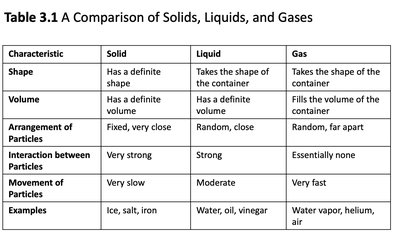
Matter exists in three primary states: solid, liquid, and gas. Each state has distinct characteristics regarding shape, volume, particle arrangement, and movement.
Characteristic | Solid | Liquid | Gas |
|---|---|---|---|
Shape | Definite | Takes shape of container | Takes shape of container |
Volume | Definite | Definite | Fills container |
Arrangement of Particles | Fixed, very close | Random, close | Random, far apart |
Interaction Between Particles | Very strong | Strong | Essentially none |
Movement of Particles | Very slow | Moderate | Very fast |
Examples | Ice, salt, iron | Water, oil, vinegar | Water vapor, helium, air |
Physical and Chemical Changes
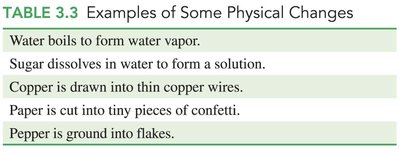
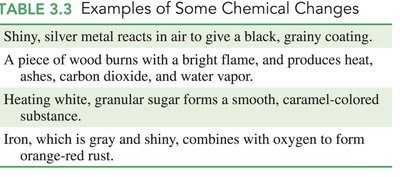
Physical changes do not alter the chemical composition of a substance, while chemical changes result in the formation of new substances with different properties.
Examples of Physical Changes:
Water boils to form water vapor. |
Sugar dissolves in water to form a solution. |
Copper is drawn into thin wires. |
Paper is cut into confetti. |
Pepper is ground into flakes. |
 Examples of Chemical Changes:
Silver reacts in air to give a black coating. |
Wood burns, producing heat, ashes, CO2, and water vapor. |
Sugar forms caramel when heated. |
Iron combines with oxygen to form rust. |
Chapter 4: Atoms and Elements (Selected Tables)
Elements and Symbols
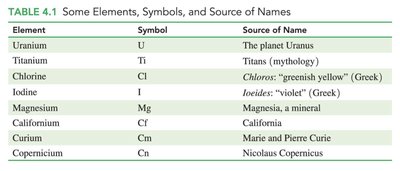
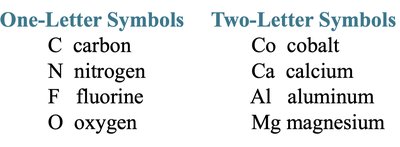
Each element is represented by a unique chemical symbol, usually one or two letters. The periodic table organizes elements by increasing atomic number and similar properties.
Element | Symbol | Source of Name |
|---|---|---|
Uranium | U | The planet Uranus |
Titanium | Ti | Titans (mythology) |
Chlorine | Cl | Chloros: "greenish yellow" (Greek) |
Iodine | I | Ioiedes: "violet" (Greek) |
Magnesium | Mg | Magnesia, a mineral |
Californium | Cf | California |
Curium | Cm | Marie and Pierre Curie |
Copernicium | Cn | Nicolaus Copernicus |
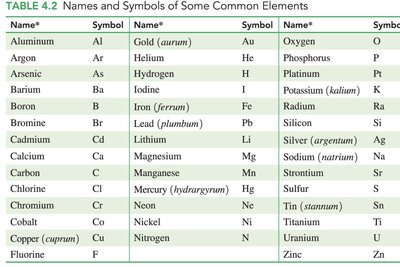
Names and Symbols of Common Elements
Name | Symbol | Name | Symbol |
|---|---|---|---|
Aluminum | Al | Gold | Au |
Argon | Ar | Hydrogen | H |
Calcium | Ca | Iron | Fe |
Carbon | C | Lead | Pb |
Chlorine | Cl | Magnesium | Mg |
Copper | Cu | Nitrogen | N |
Fluorine | F | Oxygen | O |
Phosphorus | P | Potassium | K |
Sodium | Na | Sulfur | S |
Zinc | Zn | Silver | Ag |
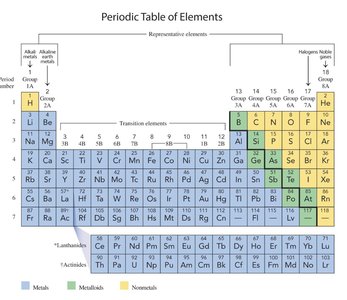
Periodic Table and Classification
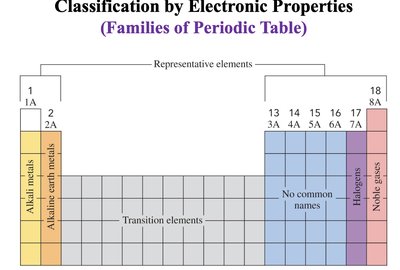
The periodic table groups elements by similar properties and electronic structure. Major classifications include metals, nonmetals, and metalloids.
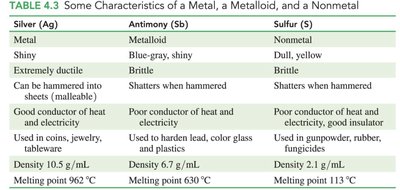
Metals, Metalloids, and Nonmetals
Property | Metal (Silver) | Metalloid (Antimony) | Nonmetal (Sulfur) |
|---|---|---|---|
Appearance | Shiny | Blue-gray, shiny | Dull, yellow |
Ductility | Extremely ductile | Brittle | Brittle |
Malleability | Can be hammered into sheets | Shatters when hammered | Shatters when hammered |
Conductivity | Good conductor of heat and electricity | Poor conductor | Poor conductor, good insulator |
Uses | Coins, jewelry, tableware | Harden lead, color glass, plastics | Gunpowder, rubber, fungicides |
Density (g/mL) | 10.5 | 6.7 | 2.1 |
Melting Point (°C) | 962 | 630 | 113 |
Subatomic Particles
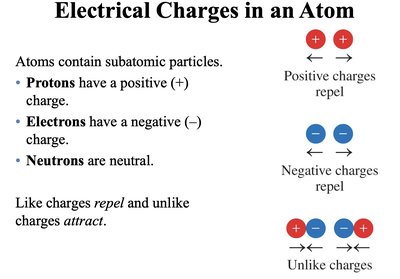
Particle | Symbol | Charge | Mass (amu) | Location |
|---|---|---|---|---|
Proton | p or p+ | 1+ | 1.007 | Nucleus |
Neutron | n or n0 | 0 | 1.008 | Nucleus |
Electron | e− | 1− | 0.000 55 | Outside nucleus |
Composition of Atoms
Element | Symbol | Atomic Number | Mass Number | Number of Protons | Number of Neutrons | Number of Electrons |
|---|---|---|---|---|---|---|
Hydrogen | H | 1 | 1 | 1 | 0 | 1 |
Nitrogen | N | 7 | 14 | 7 | 7 | 7 |
Oxygen | O | 8 | 16 | 8 | 8 | 8 |
Chlorine | Cl | 17 | 37 | 17 | 20 | 17 |
Iron | Fe | 26 | 58 | 26 | 32 | 26 |
Gold | Au | 79 | 197 | 79 | 118 | 79 |
Additional info: The above tables and images provide essential reference data for understanding the structure of matter, measurement, and the periodic table, which are foundational for further study in chemistry.
