 Back
Chemistry and Measurements: Units, Significant Figures, and Problem Solving
Study Guide - Smart Notes
 Tailored notes based on your materials, expanded with key definitions, examples, and context.
Chemistry and Measurements
Introduction
Chemistry relies on precise measurements to describe matter and its changes. Understanding units, significant figures, and conversion methods is essential for accurate scientific communication and calculations in general, organic, and biological chemistry.
Units of Measurement
Metric and SI Systems
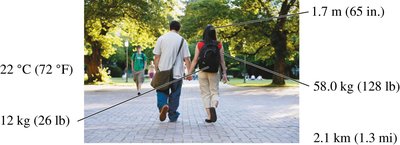
The metric system and the International System of Units (SI) are standardized systems used globally for scientific measurements. They provide units for length, volume, mass, temperature, and time.
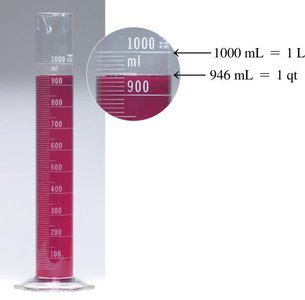
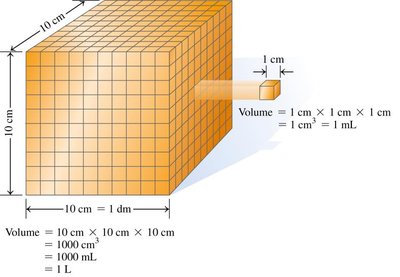
Volume: SI unit is the cubic meter (m3); chemists often use liters (L) and milliliters (mL).
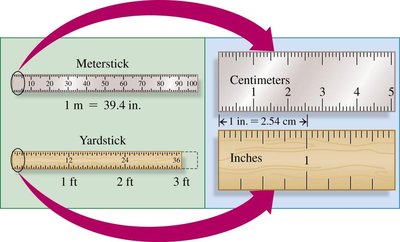
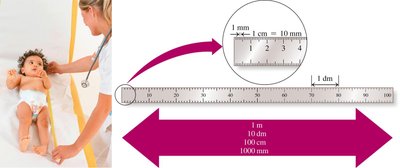
Length: Meter (m) is the base unit; centimeters (cm) are also common.
Mass: Kilogram (kg) is the SI unit; grams (g) are frequently used in chemistry.
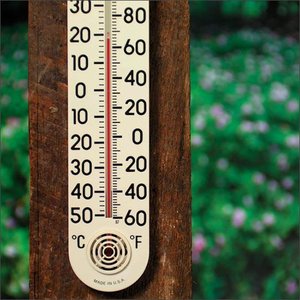
Temperature: Kelvin (K) is the SI unit; Celsius (°C) is commonly used in laboratories.
Time: Second (s) is the base unit in both systems.
Common Unit Relationships
1 L = 1000 mL
1 L = 1.06 qt
1 m = 100 cm = 39.4 in.
1 kg = 1000 g = 2.20 lb
Water freezes at 0°C (32°F) and boils at 100°C (212°F)

Measured Numbers and Significant Figures
Measured vs. Exact Numbers
Measured numbers are obtained using measuring tools and contain some uncertainty. Exact numbers are obtained by counting or by definition and have no uncertainty.
Examples of exact numbers: 8 cookies, 1 kg = 1000 g
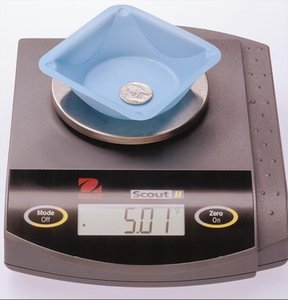
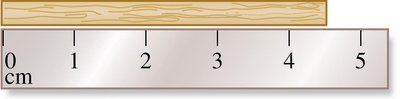
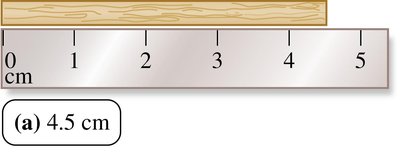
Examples of measured numbers: 5.01 g (from a balance), 4.5 cm (from a ruler)

Reporting Measurements
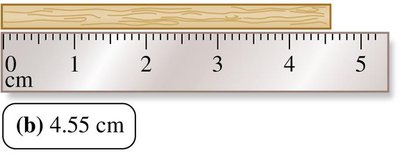
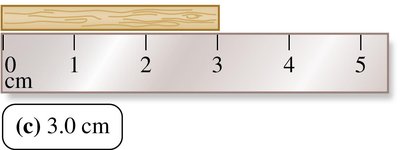
When reporting a measurement, include all certain digits plus one estimated digit. The estimated digit reflects the uncertainty in the measurement.

Significant Figures (SFs)
Significant figures are all the digits in a measured number, including the estimated digit. The rules for determining significant figures are:
All nonzero digits are significant.
Zeros between nonzero digits are significant.
Zeros at the end of a decimal number are significant.
Leading zeros are not significant.
Zeros used as placeholders in large numbers without a decimal point are not significant.
All digits in the coefficient of scientific notation are significant.

Examples and Practice
0.030 m (2 SFs)
4.050 L (4 SFs)
0.0008 g (1 SF)
2.80 m (3 SFs)
Significant Figures in Calculations
Rounding Off
When performing calculations, the number of significant figures in the result depends on the operation:
Multiplication/Division: The answer has the same number of SFs as the measurement with the fewest SFs.
Addition/Subtraction: The answer has the same number of decimal places as the measurement with the fewest decimal places.


Prefixes and Equalities
Metric Prefixes
Prefixes are used to express multiples or fractions of units. Each prefix represents a specific power of ten.
Kilo- (k): 1,000 (103)
Centi- (c): 0.01 (10-2)
Milli- (m): 0.001 (10-3)
Micro- (μ or mc): 0.000001 (10-6)
Nano- (n): 0.000000001 (10-9)

Equalities and Conversion Factors
An equality shows the relationship between two units that measure the same quantity. Each equality can be written as two conversion factors (fractions).
1 m = 100 cm → or
1 kg = 1000 g → or
Problem Solving Using Unit Conversion
Conversion Factor Method
To convert from one unit to another, multiply by conversion factors so that units cancel, leaving the desired unit.
Identify the given and needed units.
Write a plan using conversion factors.
Set up the calculation so units cancel appropriately.
Calculate and round the answer to the correct number of SFs.



Density
Definition and Calculation
Density is the ratio of the mass of a substance to its volume. It is a physical property used to identify substances and assess purity.
Formula:
Common units: g/mL (liquids/solids), g/L (gases)
Volume Displacement
The volume of an irregular solid can be determined by the amount of water it displaces. The density is then calculated using the measured mass and displaced volume.
Applications of Density
Identifying substances (e.g., gold vs. lead)
Determining body composition (e.g., bone density in health)
Specific Gravity
Specific gravity is the ratio of the density of a substance to the density of water (1.00 g/mL at 4°C). It is a unitless quantity and is commonly measured for bodily fluids in medical diagnostics.
Formula:
Summary Concept Map
