 Back
Chemistry Basics: Matter and Measurement – Essential Study Notes
Study Guide - Smart Notes
 Tailored notes based on your materials, expanded with key definitions, examples, and context.
Chemistry Basics: Matter and Measurement
Introduction to Chemistry and Matter
Chemistry is the study of matter, its properties, and the changes it undergoes. Matter is anything that has mass and occupies space. Understanding the classification and measurement of matter is fundamental to all chemistry courses.
Classification of Matter: Solids, Liquids, and Gases
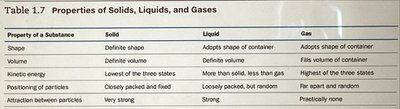
Matter exists in three primary states: solid, liquid, and gas. Each state has distinct physical properties that affect how substances behave and interact.
Solid: Definite shape and volume; particles are closely packed and fixed; very strong attraction between particles; lowest kinetic energy.
Liquid: Adopts the shape of its container; definite volume; particles are loosely packed and random; strong attraction between particles; more kinetic energy than solids, less than gases.
Gas: Adopts the shape and fills the volume of its container; particles are far apart and random; practically no attraction between particles; highest kinetic energy.
Property | Solid | Liquid | Gas |
|---|---|---|---|
Shape | Definite | Adopts shape of container | Adopts shape of container |
Volume | Definite | Definite | Fills container |
Kinetic Energy | Lowest | More than solid, less than gas | Highest |
Particle Position | Closely packed, fixed | Loosely packed, random | Far apart, random |
Attraction | Very strong | Strong | Practically none |
Measurement and Units in Chemistry
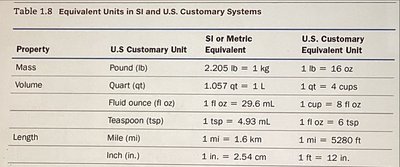
Accurate measurement is essential in chemistry. The SI (International System of Units) is the standard, but U.S. customary units are also used. Understanding conversions between these systems is crucial for laboratory work and calculations.
Mass: Measured in kilograms (kg) or pounds (lb).
Volume: Measured in liters (L), quarts (qt), fluid ounces (fl oz), teaspoons (tsp), and cups.
Length: Measured in meters (m), miles (mi), and inches (in).
Property | U.S. Customary Unit | SI or Metric Equivalent | U.S. Customary Equivalent Unit |
|---|---|---|---|
Mass | Pound (lb) | 2.205 lb = 1 kg | 1 lb = 16 oz |
Volume | Quart (qt) | 1.057 qt = 1 L | 1 qt = 4 cups |
Fluid ounce (fl oz) | 1 fl oz = 29.6 mL | 1 cup = 8 fl oz | |
Teaspoon (tsp) | 1 tsp = 4.93 mL | 1 fl oz = 6 tsp | |
Length | Mile (mi) | 1 mi = 1.6 km | 1 mi = 5280 ft |
Inch (in.) | 1 in. = 2.54 cm | 1 ft = 12 in. |
Counting Significant Figures in Measurements
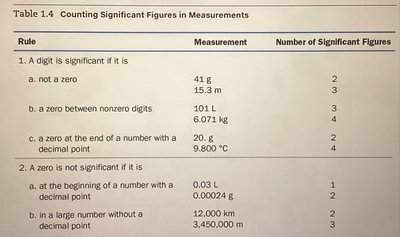
Significant figures reflect the precision of a measurement. Rules for determining significant figures help ensure accuracy in calculations and reporting results.
Non-zero digits are always significant.
Zeros between non-zero digits are significant.
Zeros at the end of a number with a decimal point are significant.
Zeros at the beginning of a number are not significant.
Zeros in a large number without a decimal point are not significant.
Rule | Measurement | Number of Significant Figures |
|---|---|---|
Not a zero | 41 g | 2 |
Not a zero | 15.3 m | 3 |
Zero between nonzero digits | 101 L | 3 |
Zero between nonzero digits | 6.071 kg | 4 |
Zero at end with decimal | 20.0 g | 3 |
Zero at end with decimal | 9.800 °C | 4 |
Zero at beginning with decimal | 0.03 L | 1 |
Zero at beginning with decimal | 0.00024 g | 2 |
Zero in large number without decimal | 12,000 km | 2 |
Zero in large number without decimal | 3,450,000 m | 3 |
Scientific Notation
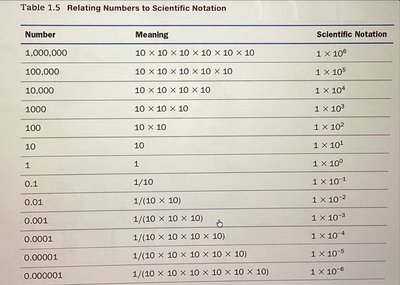
Scientific notation is used to express very large or very small numbers in a compact form. It is essential for handling measurements in chemistry.
Format: where a is a number between 1 and 10, and n is an integer.
Example: 1,000,000 is written as .
Example: 0.0001 is written as .
Number | Meaning | Scientific Notation |
|---|---|---|
1,000,000 | 10 × 10 × 10 × 10 × 10 × 10 | 1 × 10⁶ |
100,000 | 10 × 10 × 10 × 10 × 10 | 1 × 10⁵ |
10,000 | 10 × 10 × 10 × 10 | 1 × 10⁴ |
1000 | 10 × 10 × 10 | 1 × 10³ |
100 | 10 × 10 | 1 × 10² |
10 | 10 | 1 × 101 |
1 | 1 | 1 × 100 |
0.1 | 1/10 | 1 × 10⁻¹ |
0.01 | 1/(10 × 10) | 1 × 10⁻² |
0.001 | 1/(10 × 10 × 10) | 1 × 10⁻³ |
0.0001 | 1/(10 × 10 × 10 × 10) | 1 × 10⁻⁴ |
0.00001 | 1/(10 × 10 × 10 × 10 × 10) | 1 × 10⁻⁵ |
0.000001 | 1/(10 × 10 × 10 × 10 × 10 × 10) | 1 × 10⁻⁶ |
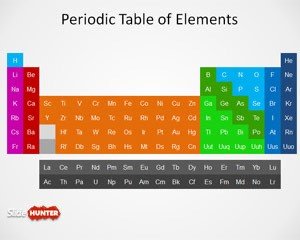
The Periodic Table of Elements
The periodic table organizes all known elements according to their atomic number, electron configuration, and recurring chemical properties. It is a fundamental tool for understanding chemical behavior and relationships.
Groups: Vertical columns; elements in the same group have similar properties.
Periods: Horizontal rows; properties change progressively across a period.
Element Categories: Metals, nonmetals, metalloids, transition metals, lanthanides, actinides.
Example: Sodium (Na) is an alkali metal, chlorine (Cl) is a halogen.
Additional info: These notes expand on the provided tables and images with academic context, definitions, and examples to ensure completeness and clarity for GOB Chemistry students.
