 Back
BackChemistry Basics: Matter, Measurement, and Atomic Structure – Study Guide
Study Guide - Smart Notes
 Tailored notes based on your materials, expanded with key definitions, examples, and context.
Chemistry Basics: Matter and Measurement
Classification of Matter
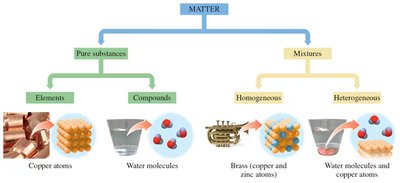
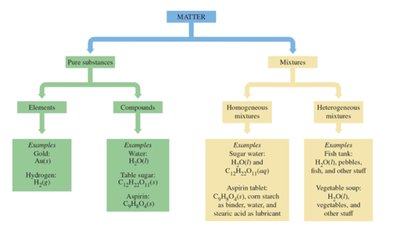
Matter is anything that occupies space and has mass. It can be classified as a pure substance or a mixture. Pure substances include elements and compounds, while mixtures are categorized as homogeneous or heterogeneous.
Pure Substances: Have a single chemical formula. Elements consist of only one type of atom (e.g., copper), while compounds are made of two or more atoms chemically combined (e.g., water).
Mixtures: Contain two or more substances physically combined. Homogeneous mixtures are uniform throughout (e.g., brass), while heterogeneous mixtures have visibly different components (e.g., water and copper atoms).
States of Matter and Changes of State
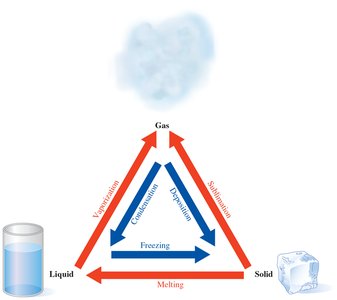
Matter exists in three primary states: solid, liquid, and gas. Changes between these states occur through physical processes such as melting, freezing, vaporization, condensation, sublimation, and deposition.
Solid ⇄ Liquid: Melting (solid to liquid) requires energy; freezing (liquid to solid) releases energy.
Liquid ⇄ Gas: Vaporization (liquid to gas) requires energy; condensation (gas to liquid) releases energy.
Solid ⇄ Gas: Sublimation (solid to gas) requires energy; deposition (gas to solid) releases energy.
These are physical changes—the chemical identity remains unchanged.
Metric Units and Prefixes
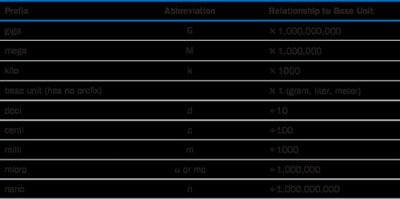
The metric system uses base units for length (meter, m), volume (liter, L), and mass (gram, g; kilogram, kg). Prefixes modify these units to represent larger or smaller quantities.
Common Prefixes: giga (G), mega (M), kilo (k), deci (d), centi (c), milli (m), micro (μ or mc), nano (n).
Example: 1 kg = 1000 g; 1 g = 1000 mg.
Prefix | Abbreviation | Relationship to Base Unit |
|---|---|---|
giga | G | × 1,000,000,000 |
mega | M | × 1,000,000 |
kilo | k | × 1,000 |
base unit | - | × 1 |
deci | d | ÷ 10 = × 0.1 |
centi | c | ÷ 100 = × 0.01 |
milli | m | ÷ 1000 = × 0.001 |
micro | μ or mc | ÷ 1,000,000 = × 0.000001 |
nano | n | ÷ 1,000,000,000 = × 0.000000001 |
Unit Conversions and Dimensional Analysis
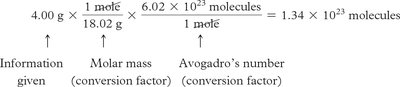
Unit conversions use conversion factors to change from one unit to another. Dimensional analysis is a systematic approach for solving these problems.
Identify the unit for the final answer.
Establish the given information.
Determine conversion factors (e.g., 1 g = 1000 mg).
Set up the equation so units cancel appropriately.
Perform the calculation.
Scientific Notation and Percent Calculations
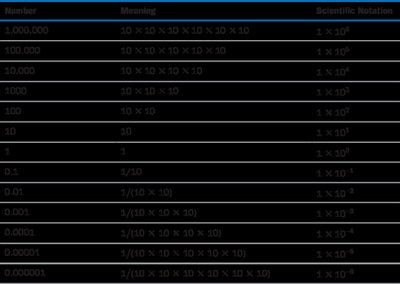
Scientific notation expresses numbers as a product of a coefficient and a power of ten. Percent calculations convert fractions to percentages.
Scientific Notation: where and is an integer.
Percent Calculation:
Number | Meaning | Scientific Notation |
|---|---|---|
1,000,000 | ||
100,000 | ||
10,000 | ||
1 | 1 | |
0.1 | ||
0.01 | ||
0.000001 |
Atoms and Radioactivity
Subatomic Particles
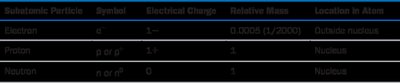
Atoms are composed of protons, neutrons, and electrons. Each has distinct properties and roles in atomic structure.
Proton: Charge +1, mass 1 amu, located in the nucleus.
Neutron: Charge 0, mass 1 amu, located in the nucleus.
Electron: Charge -1, mass ~1/2000 amu, located outside the nucleus.
Subatomic Particle | Symbol | Electrical Charge | Relative Mass | Location in Atom |
|---|---|---|---|---|
Electron | -1 | 0.0005 (1/2000) | Outside nucleus | |
Proton | or | +1 | 1 | Nucleus |
Neutron | or | 0 | 1 | Nucleus |
Atomic Number, Mass Number, and Atomic Mass
The atomic number (Z) is the number of protons in the nucleus and defines the element. The mass number (A) is the sum of protons and neutrons in a specific atom. Atomic mass is the weighted average mass of all isotopes of an element.
Atomic Number (Z): Identifies the element.
Mass Number (A): Protons + Neutrons.
Atomic Mass: Weighted average, not always a whole number.
Isotopes and Subatomic Particle Counts
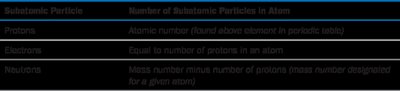
Isotopes are atoms of the same element with different numbers of neutrons. The number of protons (atomic number) remains constant, while neutrons vary.
Subatomic Particle | Number in Atom |
|---|---|
Protons | Atomic number (from periodic table) |
Electrons | Equal to number of protons in a neutral atom |
Neutrons | Mass number minus number of protons |
Types of Nuclear Radiation
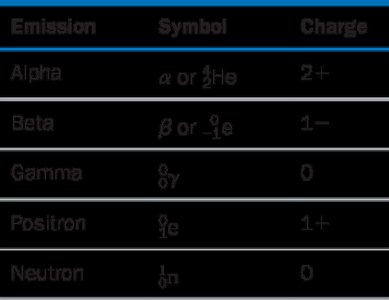
Nuclear radiation includes alpha, beta, gamma, positron, and neutron emissions, each with unique properties and symbols.
Emission | Symbol | Charge |
|---|---|---|
Alpha | or | 2+ |
Beta | or | 1− |
Gamma | 0 | |
Positron | 1+ | |
Neutron | 0 |
Penetrating Ability of Radiation
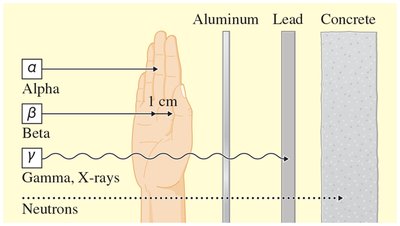
The ability of nuclear radiation to penetrate materials varies:
Alpha: Least penetrating; stopped by paper or skin.
Beta: Moderately penetrating; stopped by plastic or thin metal.
Gamma: Most penetrating; requires thick lead or concrete.
Radioisotopes in Medicine
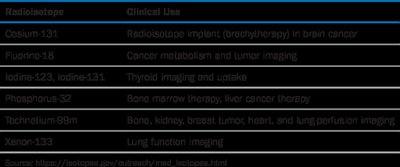
Radioisotopes are used in medicine for both diagnostic and therapeutic purposes. Diagnostic uses include imaging organs and tissues, while therapeutic uses involve targeting and destroying cancer cells.
Radioisotope | Clinical Use |
|---|---|
Cesium-131 | Brachytherapy in brain cancer |
Fluorine-18 | Cancer metabolism and tumor imaging |
Iodine-123, Iodine-131 | Thyroid imaging and uptake |
Phosphorus-32 | Bone marrow therapy, liver cancer therapy |
Technetium-99m | Bone, kidney, breast tumor, heart, and lung perfusion imaging |
Xenon-133 | Lung function imaging |
Additional Topics
Periodic Table and Element Classification
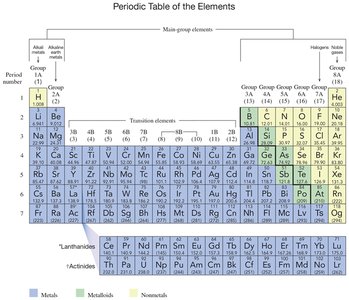
The periodic table organizes elements by atomic number and groups them by similar properties. Metals, nonmetals, and metalloids are distinguished by their location and characteristics.
Balancing Chemical Equations
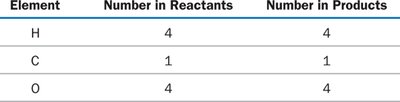
Balancing chemical equations ensures the same number of atoms for each element on both sides of the equation. This is fundamental for representing chemical reactions accurately.
Element | Number in Reactants | Number in Products |
|---|---|---|
H | 4 | 4 |
C | 1 | 1 |
O | 4 | 4 |
Chemical vs. Physical Changes
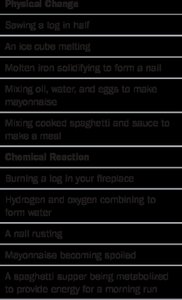
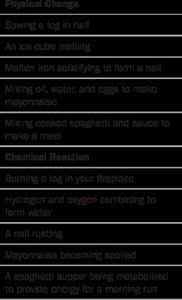
Physical changes alter the form or appearance of a substance without changing its chemical identity. Chemical changes result in the formation of new substances.
Physical Change: Melting, mixing, sawing.
Chemical Change: Burning, rusting, spoiling.
Counting Atoms in Chemical Formulas
To determine the number of atoms of each element in a chemical formula, read the subscripts next to each element symbol. If no subscript is present, it means one atom.
Example: In C6H12O6, there are 6 carbon, 12 hydrogen, and 6 oxygen atoms.
Summary Table: Subatomic Particles in Atoms
Subatomic Particle | Number in Atom |
|---|---|
Protons | Atomic number |
Electrons | Equal to protons (neutral atom) |
Neutrons | Mass number minus atomic number |
Summary Table: Types of Nuclear Radiation
Emission | Symbol | Charge |
|---|---|---|
Alpha | or | 2+ |
Beta | or | 1− |
Gamma | 0 | |
Positron | 1+ | |
Neutron | 0 |
Summary Table: Radioisotopes in Medicine
Radioisotope | Clinical Use |
|---|---|
Cesium-131 | Brachytherapy in brain cancer |
Fluorine-18 | Cancer metabolism and tumor imaging |
Iodine-123, Iodine-131 | Thyroid imaging and uptake |
Phosphorus-32 | Bone marrow therapy, liver cancer therapy |
Technetium-99m | Bone, kidney, breast tumor, heart, and lung perfusion imaging |
Xenon-133 | Lung function imaging |
