 Back
BackChemistry Fundamentals: Measurements, Significant Figures, and Density
Study Guide - Smart Notes
 Tailored notes based on your materials, expanded with key definitions, examples, and context.
Chemistry in Our Lives
What is Chemistry?
Chemistry is the scientific study of the composition, structure, properties, and reactions of matter. Matter is defined as anything that has mass and occupies space. Chemicals are substances that always have the same composition and properties wherever they are found, making them fundamental to the study of chemistry.
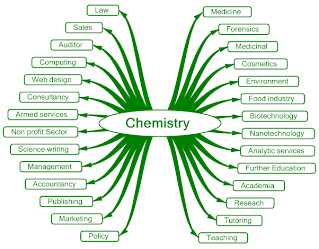

Examples of Chemistry in Everyday Life: Vitamins, cleaners, hormones, fire, paints, baking, synthetic fabrics, drugs, bug spray, cosmetics.
Chemistry and Measurements
Numbers in Chemistry
Chemistry relies heavily on quantitative experimentation, requiring proficiency with numbers, measurements, and calculations. Accurate measurement and proper handling of numerical data are essential for reliable results.
Rounding and Significant Figures
Significant figures (sig figs) are the digits in a measurement that are known with certainty plus one estimated digit. The rules for rounding and determining significant figures ensure that calculated results reflect the precision of the measurements used.
Rounding: If the digit removed is 5 or greater, round up; if less than 5, round down. Always round at the end of calculations.
Scientific Notation
Scientific notation expresses numbers as a coefficient between 1 and 10 multiplied by a power of ten. This format is especially useful for very large or very small numbers.
Numbers > 1: Move the decimal left; exponent is positive.
Numbers < 1: Move the decimal right; exponent is negative.
Example:
Types of Numbers in Chemistry
Exact Numbers: Known with complete certainty (e.g., counted objects, defined quantities). Infinite significant figures.
Measured Numbers: Obtained by measurement; contain some uncertainty. The number of significant figures depends on the measuring device.
Rules for Determining Significant Figures
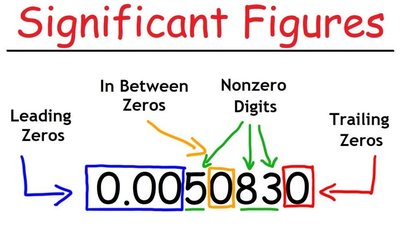
All nonzero digits are significant.
Trailing zeros (to the right of the last nonzero digit with a decimal) are significant.
Captive zeros (between nonzero digits) are significant.
Leading zeros (to the left of the first nonzero digit) are not significant.
Zeros with a decimal are significant.
Ambiguous zeros (ending zeros in numbers >1 without a decimal) should be written in scientific notation to clarify significance.
Significant Figures in Calculations
Multiplication/Division: The result should have the same number of significant figures as the measurement with the fewest significant figures.
Addition/Subtraction: The result should have the same number of decimal places as the measurement with the fewest decimal places.
Multistep Calculations
Perform addition/subtraction first, then multiplication/division.
Do not round until the final answer.
Units and Measurements
SI Units
The International System of Units (SI) is the standard for scientific measurements. It is based on the metric system, which is used globally for consistency in scientific communication.
Fundamental quantity | Unit name | Symbol |
|---|---|---|
length | meter | m |
mass | kilogram | kg |
temperature | kelvin | K |
time | second | s |
amount of substance | mole | mol |
electric current | ampere | A |
luminous intensity | candela | cd |

Metric Prefixes
Metric prefixes are used to express multiples or fractions of units and serve as conversion factors.
Metric Prefix | Symbol | Conversion factor |
|---|---|---|
atto | a | 1 a"unit" = 1E-18 "unit" |
femto | f | 1 f"unit" = 1E-15 "unit" |
pico | p | 1 p"unit" = 1E-12 "unit" |
nano | n | 1 n"unit" = 1E-9 "unit" |
micro | μ | 1 μ"unit" = 1E-6 "unit" |
milli | m | 1 m"unit" = 1E-3 "unit" |
centi | c | 1 c"unit" = 1E-2 "unit" |
deci | d | 1 d"unit" = 1E-1 "unit" |
deka | da | 1 da"unit" = 1E1 "unit" |
hecto | h | 1 h"unit" = 1E2 "unit" |
kilo | k | 1 k"unit" = 1E3 "unit" |
mega | M | 1 M"unit" = 1E6 "unit" |
giga | G | 1 G"unit" = 1E9 "unit" |
tera | T | 1 T"unit" = 1E12 "unit" |
peta | P | 1 P"unit" = 1E15 "unit" |
exa | E | 1 E"unit" = 1E18 "unit" |

Conversion Factors and Dimensional Analysis
Conversion factors are ratios used to express the same quantity in different units. Dimensional analysis is a systematic approach to problem-solving that uses conversion factors to move from one unit to another.
Example: To convert 2.6785 km to mm, use the conversion factors: and .
Density and Specific Gravity
Density
Density is a physical property defined as mass per unit volume. It is used to identify substances and predict whether an object will sink or float in a fluid.
Formula:

Volume by Displacement
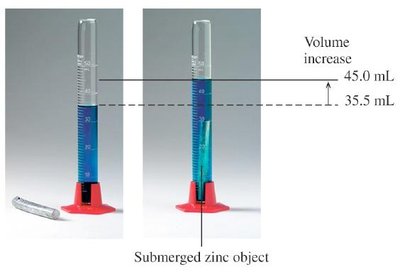
The volume of an irregular solid can be determined by the amount of water it displaces when submerged. The difference in water level before and after submersion equals the object's volume.

Specific Gravity
Specific gravity is the ratio of the density of a substance to the density of water (at 4°C, 1.00 g/mL). It is a unitless quantity commonly used in clinical and industrial settings.
Formula:
Summary Table: Key Concepts
Concept | Definition | Formula |
|---|---|---|
Density | Mass per unit volume | |
Specific Gravity | Ratio of density to water | |
Significant Figures | Digits that reflect precision | See rules above |
Scientific Notation | Number as coefficient × 10n |
Additional info: These foundational concepts are essential for all subsequent topics in general, organic, and biological chemistry.
