 Back
BackChemistry in Our Lives: Introduction and Key Math Skills
Study Guide - Smart Notes
 Tailored notes based on your materials, expanded with key definitions, examples, and context.
Chemistry in Our Lives
What Is Chemistry?
Chemistry is the scientific study of matter, focusing on its composition, structure, properties, and the reactions it undergoes. Understanding chemistry allows us to explain the behavior of substances and their interactions in everyday life.
Composition: What substances are made of, such as elements and compounds.
Structure: How atoms and molecules are arranged within a substance.
Properties: The characteristics and behaviors of substances, such as color, density, and reactivity.
Reactions: How substances change or interact with others, forming new products.
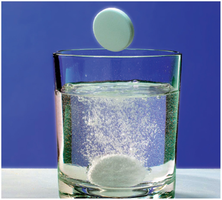
Example: An antacid tablet undergoes a chemical reaction when dropped in water, producing bubbles and neutralizing acid.
The Scientific Method
Thinking Like a Scientist
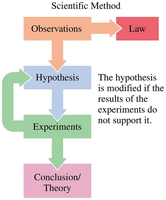
The scientific method is a systematic approach used by scientists to investigate phenomena, acquire new knowledge, or correct and integrate previous knowledge. It involves making observations, forming hypotheses, conducting experiments, and drawing conclusions.
Observation: Gathering information about nature and asking questions.
Hypothesis: Proposing a possible explanation for the observations.
Experiment: Testing the hypothesis through controlled procedures.
Conclusion: Analyzing results to determine if the hypothesis is supported or refuted.
Modification: If experiments do not support the hypothesis, it is revised and retested.
Key Math Skills for Chemistry
Identifying Place Values
Understanding place values is essential for accurate measurement and calculation in chemistry. Each digit in a number represents a specific value depending on its position.
Whole Numbers: Each digit has a place value (e.g., thousands, hundreds, tens, ones).
Decimal Numbers: Digits to the right of the decimal point represent tenths, hundredths, thousandths, etc.
Example: In 15.24 grams, 1 is in the tens place, 5 in the ones, 2 in the tenths, and 4 in the hundredths.

Using Positive and Negative Numbers in Calculations
Positive and negative numbers are used in chemistry to represent quantities such as temperature changes, energy, and charge.
Positive Numbers: Greater than zero, often written without a sign (e.g., 8).
Negative Numbers: Less than zero, written with a minus sign (e.g., -8).
Multiplication/Division:
Two positives or two negatives yield a positive result.
One positive and one negative yield a negative result.
Addition:
Adding positives yields a positive result.
Adding negatives yields a negative result.
Adding a positive and a negative: subtract the smaller from the larger; the sign matches the larger number.
Subtraction: Change the sign of the number to be subtracted and add.

Calculating Percentages
Percentages are used to express the proportion of a part relative to the whole, such as concentration of a substance in a solution.
Formula:
Example: If an aspirin tablet contains 325 mg of aspirin and the total mass is 545 mg, the percentage of aspirin is .

Interpreting Graphs
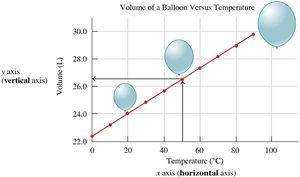
Graphs are visual tools used to represent relationships between variables in chemistry, such as temperature and volume.
Axes: The vertical (y) axis typically represents the dependent variable, while the horizontal (x) axis represents the independent variable.
Direct Relationship: When one variable increases, the other also increases, as shown by a straight line.
Example: The volume of a balloon increases as the temperature rises, demonstrating a direct relationship.
Writing Numbers in Scientific Notation
Scientific Notation
Scientific notation is a method for expressing very large or very small numbers in a compact form, commonly used in chemistry for measurements and calculations.
Format: , where a is the coefficient (at least 1 but less than 10) and n is the exponent.
Example: The width of a human hair is 0.000008 meters, written as meters.
Example: The number of hairs on a human scalp is 100,000, written as hairs.

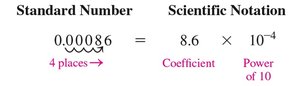
Writing Numbers in Scientific Notation
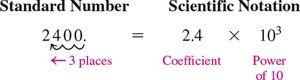
To convert a standard number to scientific notation:
Move the decimal point to obtain a coefficient between 1 and 10.
Count the number of places moved; this becomes the exponent of 10.
Write the product of the coefficient and the power of 10.
Example: 64,000 becomes .
Example: 0.021 becomes .
Using Scientific Notation on Calculators
Many scientific calculators allow entry and display of numbers in scientific notation using keys such as EE or EXP.
Number to Enter | Procedure | Calculator Display |
|---|---|---|
4 × 10⁶ | 4 EE 6 | 4.06 or 4^06 or 4E06 |
2.5 × 10⁻⁴ | 2.5 EE -4 | 2.5-04 or 2.5E-04 or 2.5E-04 |

Calculator Display | Expressed in Scientific Notation |
|---|---|
7.52 04 or 7.52^04 or 7.52E04 | 7.52 × 10⁴ |
5.8-02 or 5.8^–02 or 5.8E–02 | 5.8 × 10⁻² |

Some Powers of 10
Powers of 10 are used in scientific notation to represent the scale of numbers. Common powers include:
= 1,000
= 1,000,000
= 0.001
= 0.000001
Additional info: Understanding powers of 10 is essential for converting between standard and scientific notation, and for interpreting calculator displays.
