 Back
BackCHM 104: Introduction to Chemistry I – Syllabus and Course Overview
Study Guide - Smart Notes
 Tailored notes based on your materials, expanded with key definitions, examples, and context.
Course Overview
This syllabus outlines the structure, requirements, and policies for CHM 104: Introduction to Chemistry I at Gadsden State Community College. The course is designed as a general chemistry survey for non-science majors, covering foundational topics in chemistry and laboratory techniques.
Course Information
Course Code: CHM 104, Section 02 (CRN: 20686)
Credits: 4 (3 theory hours, 1 lab hour)
Delivery Method: Online (ONL)
Prerequisite: Minimum of MTH 098 or equivalent placement score
Required Materials: External web camera, lab kit

Instructor and Contact Information
Instructor: Dr. James Easton, Ph.D.
Email: aeaston@gadsdenstate.edu
Office: SB-205 (by appointment)
Division Chair: Dr. Brian Geislinger (bgeislinger@gadsdenstate.edu)
Instructional Dean: Dr. Derrick Griffey (dgriffey@gadsdenstate.edu)
Course Description
This course provides a broad introduction to general chemistry, emphasizing key facts, principles, and theories. Topics include mathematical operations, matter and energy, atomic structure, chemical symbols and formulas, nomenclature, the periodic table, bonding, chemical equations and reactions, stoichiometry, gas laws, phases of matter, solutions, and acids and bases. Laboratory work is required.
Course Objectives
Demonstrate proper laboratory techniques and safety.
Apply scientific reasoning to interpret experimental data.
Describe fundamental concepts of atomic structure, periodicity, bonding, states of matter, solutions, acids and bases, and nuclear chemistry.
Explain the behavior of gases using kinetic molecular theory.
Write and interpret chemical formulas and names.
Describe basic principles of thermochemistry.
Solve problems related to measurement, stoichiometry, thermochemistry, gases, solutions, and acids and bases using dimensional analysis and equations.
Required Textbook and Materials
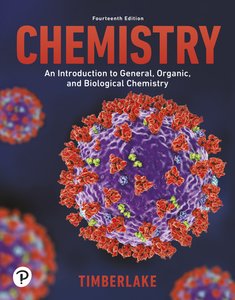
Textbook: Chemistry: An Introduction to General, Organic, and Biological Chemistry, 14th Edition, Karen C. Timberlake (ISBN: 9780138176839)
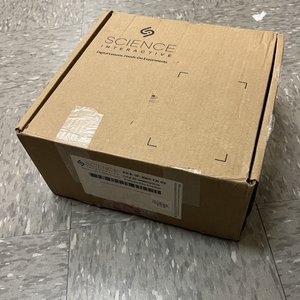
Lab Kit: Science Interactive, Kit # SP-3005-CK-02 (not covered by First Day Complete)
Calculator: Scientific calculator with EE and LOG functions (TI-30Xa recommended)
Web Camera: External camera required for remote proctoring
Course Schedule and Topics
The course follows a structured weekly schedule, covering the following chapters and laboratory activities:
Week | Topic | Lab Activity |
|---|---|---|
1 | Chapter 1 – Chemistry In Our Lives | Acquire lab kit |
2 | Chapter 2 – Chemistry & Measurement | Getting Started, Lab Safety, Lab Kit Inventory |
3 | Chapter 3 – Matter & Energy | Techniques & Measurements |
4 | Chapter 4 – Atoms & Elements | |
5 | Exam 1 (Chapters 2, 3, 4) | |
6 | Chapter 5 – Nuclear Chemistry | |
7 | Chapter 6 – Ionic & Molecular Compounds | Molecular Modeling & Lewis Structures, Naming Compounds |
8 | Exam 2 (Chapters 5, 6) | |
9 | Chapter 7 – Chemical Quantities & Reactions | The Mole Concept, Stoichiometry of a Precipitation Reaction |
10 | Chapter 8 – Gases | Properties of Gases |
11 | Spring Break | |
12 | Exam 3 (Chapters 7, 8) | |
13 | Chapter 9 – Solutions | |
14 | Chapter 10 – Acids & Bases & Equilibrium | pH of Common Materials, Titration of Acetic Acid in Vinegar |
16 | Exam 4 (Chapters 9, 10) |
Assessment and Grading
Exams: 37.5%
Mastering Homework: 25%
Laboratory: 37.5%
Letter grades are assigned as follows:
Percentage | Letter Grade |
|---|---|
90 - 100 | A |
80 - 89 | B |
70 - 79 | C |
60 - 69 | D |
59 and below | F |
Policies and Student Support
Attendance: Required for academic success; online attendance may be verified through assignments.
Academic Honesty: Cheating, plagiarism, and misrepresentation are strictly prohibited and may result in course failure.
AI Usage: Generative AI tools are not permitted unless explicitly authorized by the instructor.
Withdrawal: Students may withdraw according to college policy; withdrawal does not impact GPA but may affect financial aid.
Student Support: Tutoring, disability services, library resources, and technology support are available.
Additional Information
Students are responsible for acquiring required materials and adhering to all deadlines.
Canvas is the official learning management system for course content and communication.
For grievances, safety, or policy questions, refer to the Student Handbook & Catalog.
