 Back
Classification and Balancing of Chemical Reactions: Study Notes for GOB Chemistry
Study Guide - Smart Notes
 Tailored notes based on your materials, expanded with key definitions, examples, and context.
Classification and Balancing of Chemical Reactions
Introduction to Chemical Equations
Chemical equations are symbolic representations of chemical reactions, showing the reactants and products involved. Understanding how to write and balance these equations is fundamental in chemistry, as it ensures the law of conservation of mass is upheld.
Chemical equation: Uses symbols and formulas to represent a chemical reaction.
Law of conservation of mass: Matter is neither created nor destroyed in any physical or chemical change.
Balanced equation: The numbers and kinds of atoms are the same on both sides of the reaction arrow.
Coefficients: Numbers placed in front of formulas to balance a chemical equation.
Example: Chemical Equation
Reactants are written on the left side of the arrow, and products on the right. For example, the decomposition of sodium bicarbonate:
Reactant: 2 NaHCO3
Products: Na2CO3 + H2O + CO2

Rules for Writing Balanced Chemical Equations
Balancing chemical equations requires that the numbers and kinds of atoms are equal on both sides. Coefficients multiply all atoms in a formula, and physical states are indicated by (s), (l), (g), or (aq).
Subscripts in chemical formulas must not be changed.
Coefficients are used to balance equations.
Physical states are shown: solid (s), liquid (l), gas (g), aqueous (aq).
Steps for Balancing Chemical Equations
Balancing equations involves a systematic approach:
Write the unbalanced equation with correct formulas.
Add coefficients to balance the number of atoms for each element.
Balance elements one at a time, often leaving pure elements for last.
Reduce coefficients to their lowest whole-number values.

Classification of Chemical Reactions
Chemical reactions of ionic compounds are grouped into three main classes: precipitation, acid–base neutralization, and oxidation–reduction (redox) reactions.
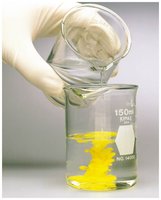
Precipitation reactions: Formation of an insoluble solid (precipitate) when reactants are combined in aqueous solution.
Acid–base neutralization reactions: H+ ions from an acid react with OH- ions from a base to yield water and a salt.
Oxidation–reduction (redox) reactions: Transfer of electrons between reaction partners, changing the charges on atoms.
Precipitation Reactions and Solubility Guidelines
Predicting precipitation reactions requires knowledge of solubility rules. If a product does not contain at least one of the ions listed as soluble, it will likely precipitate.
Types of Chemical Equations
Chemists use three types of equations to represent reactions:
Molecular equation: Shows all compounds as molecules.
Ionic equation: Shows compounds as ions if they exist as ions in solution.
Net ionic equation: Shows only the species that participate in the reaction, omitting spectator ions.
Acid–Base Neutralization Reactions
When acids and bases are mixed in correct proportions, their acidic and basic properties disappear, producing water and a salt.
General equation:
Example:
Redox Reactions
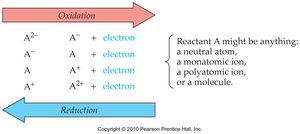
Oxidation–reduction reactions involve the transfer of electrons. Oxidation is the loss of electrons, and reduction is the gain of electrons. These processes always occur together.
Oxidation: Loss of electrons by an atom.
Reduction: Gain of electrons by an atom.
Reducing agent: Causes reduction by losing electrons and undergoing oxidation.
Oxidizing agent: Causes oxidation by gaining electrons and undergoing reduction.
Recognizing Redox Reactions: Oxidation Numbers
Oxidation numbers (or states) are assigned to atoms to track electron transfer. By comparing oxidation numbers before and after a reaction, one can determine if an atom has been oxidized or reduced.
Oxidation number: Indicates whether an atom is neutral, electron-rich, or electron-poor.
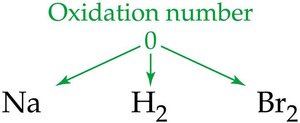
Atoms in their elemental state have an oxidation number of zero.
Monatomic ions have oxidation numbers equal to their charge.
In molecular compounds, atoms usually have the same oxidation number as if they were monatomic ions.
For compounds with more than one nonmetal, the more electronegative element gets its preferred negative oxidation number.
The sum of oxidation numbers in a neutral molecule is zero; for a polyatomic ion, it equals the ion's charge.
Summary of Key Rules for Oxidation Numbers
Rule 1: Free elements have an oxidation number of zero.
Rule 2: Monatomic ions have oxidation numbers equal to their charge.
Rule 3: Atoms in molecular compounds usually have the same oxidation number as their monatomic ion form.
Rule 4: Oxygen is usually -2, hydrogen is usually +1.
The sum of oxidation numbers for a neutral molecule is zero; for a polyatomic ion, it equals the ion's charge.
Chapter Summary
Chemical equations must be balanced to reflect the conservation of mass.
Coefficients are used to balance equations; formulas themselves cannot be changed.
Precipitation reactions form insoluble solids.
Acid–base reactions yield water and a salt.
Redox reactions involve electron transfer; oxidation is loss, reduction is gain.
Oxidation numbers help track electron transfer and identify oxidation/reduction.
