 Back
Compounds—How Elements Combine (Chapter 3 Study Notes)
Study Guide - Smart Notes
 Tailored notes based on your materials, expanded with key definitions, examples, and context.
Compounds—How Elements Combine
3.1 Electron Arrangements and the Octet Rule
Understanding how electrons are arranged in atoms is fundamental to predicting how elements combine to form compounds. The arrangement of electrons in energy levels (shells) determines the chemical properties and reactivity of elements.
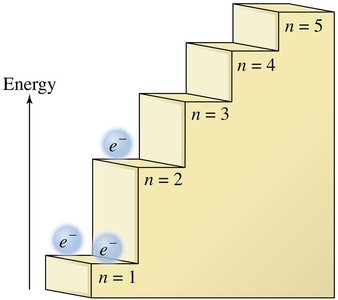
Electron Energy Levels: Electrons occupy specific energy levels around the nucleus, filling the lowest energy levels first.
Maximum Electrons per Level: The maximum number of electrons in a given energy level is calculated by , where n is the energy level number.
Valence Electrons: The electrons in the outermost energy level (valence shell) are called valence electrons. These are responsible for chemical bonding.
Periodic Table Organization: Groups (columns) indicate the number of valence electrons for main-group elements; periods (rows) indicate the highest occupied energy level.
The Octet Rule: Atoms tend to gain, lose, or share electrons to achieve eight electrons in their valence shell, a stable configuration similar to noble gases. Hydrogen and helium are exceptions, following the duet rule (two electrons).
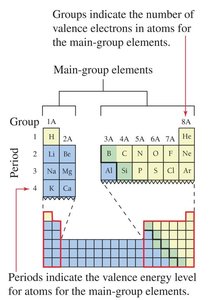
Example: Boron (B) and aluminum (Al) both have three valence electrons and are found in Group 3A.
Table: Electron Arrangements for Selected Elements
Element | Group Number | Total Electrons | n=1 | n=2 | n=3 | n=4 |
|---|---|---|---|---|---|---|
H | 1A | 1 | 1 | |||
He | 8A | 2 | 2 | |||
Li | 1A | 3 | 2 | 1 | ||
Be | 2A | 4 | 2 | 2 | ||
B | 3A | 5 | 2 | 3 | ||
C | 4A | 6 | 2 | 4 | ||
N | 5A | 7 | 2 | 5 | ||
O | 6A | 8 | 2 | 6 | ||
F | 7A | 9 | 2 | 7 | ||
Ne | 8A | 10 | 2 | 8 | ||
Na | 1A | 11 | 2 | 8 | 1 | |
Mg | 2A | 12 | 2 | 8 | 2 | |
Al | 3A | 13 | 2 | 8 | 3 | |
Si | 4A | 14 | 2 | 8 | 4 | |
P | 5A | 15 | 2 | 8 | 5 | |
S | 6A | 16 | 2 | 8 | 6 | |
Cl | 7A | 17 | 2 | 8 | 7 | |
Ar | 8A | 18 | 2 | 8 | 8 | |
K | 1A | 19 | 2 | 8 | 8 | 1 |
Ca | 2A | 20 | 2 | 8 | 8 | 2 |
3.2 In Search of an Octet, Part 1: Ion Formation
Atoms can achieve a stable octet by gaining or losing electrons, resulting in the formation of ions. Ions are charged particles that play a crucial role in the formation of ionic compounds.
Anions: Atoms that gain electrons become negatively charged anions.
Cations: Atoms that lose electrons become positively charged cations.
Isoelectronic: Ions with the same number of electrons as the nearest noble gas are called isoelectronic with that noble gas.
Trends: Groups 1A, 2A, and 3A form cations with charges equal to their group number; Groups 5A, 6A, and 7A form anions with charges equal to 8 minus their group number.
Polyatomic Ions: Groups of nonmetals that form ions with an overall charge (e.g., SO42−, NO3−).
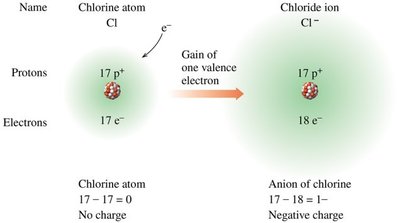
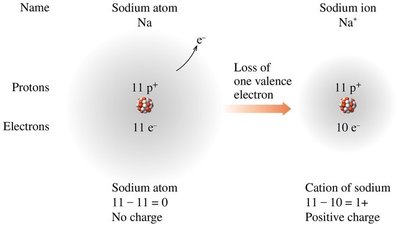
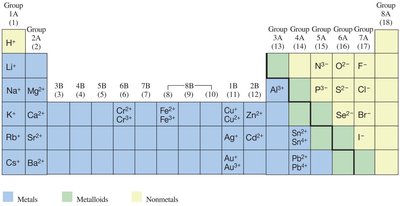
Table: Common Polyatomic Ions and Their Uses
Ion | Name | Formula | Common Uses |
|---|---|---|---|
Hydroxide | OH− | Antacids | |
Hydronium | H3O+ | Acidity (pH) | |
Ammonium | NH4+ | Indicator of organ malfunction | |
Nitrate | NO3− | Preservative | |
Carbonate | CO32− | Antacids, depression treatment | |
Sulfate | SO42− | Reduces inflammation | |
Phosphate | PO43− | Energy transfer in body |
Table: Biologically Important Ions
Ion | Function | Sources |
|---|---|---|
Na+ | Regulates fluids outside cells | Table salt, seafood |
K+ | Maintains ion concentration in cells | Dairy, bananas |
Ca2+ | Muscle contraction, bones/teeth | Dairy, leafy vegetables |
Cl− | Fluid balance in cells | Table salt, seafood |
Naming Ions: Metal ions are named by adding "ion" (e.g., sodium ion). Transition metals with multiple charges use Roman numerals (e.g., iron(II) ion). Nonmetal ions end in -ide (e.g., fluoride). Polyatomic ions often end in -ate or -ite.
3.3 Ionic Compounds—Electron Give and Take
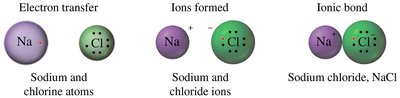
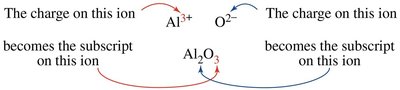
Ionic compounds are formed when metals transfer electrons to nonmetals, resulting in the attraction between oppositely charged ions (ionic bonds). The chemical formula of an ionic compound reflects the ratio of ions needed to achieve electrical neutrality.
Ionic Bond: The electrostatic attraction between cations and anions.
Formula Writing: The total positive and negative charges must balance to zero. Subscripts indicate the number of each ion in the compound.
Naming: Combine the names of the cation and anion (e.g., sodium chloride). For transition metals, use Roman numerals to indicate charge (e.g., copper(II) oxide).
3.4 In Search of an Octet, Part 2: Covalent Bond Formation
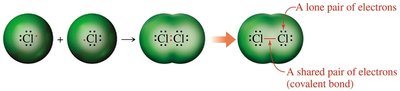
Nonmetals achieve octets by sharing valence electrons, forming covalent bonds. The resulting compounds are called covalent (or molecular) compounds, and the smallest unit is a molecule.
Covalent Bond: A shared pair of electrons between two nonmetal atoms.
Electron-Dot Symbols: Lewis structures use dots to represent valence electrons and lines to represent shared pairs (bonds).
Bonding Capacity: The number of covalent bonds an atom forms equals the number of electrons needed to complete its octet.
Examples: Nitrogen forms three bonds, oxygen forms two, fluorine forms one, and carbon forms four (single, double, or triple bonds).

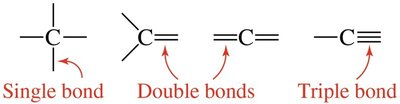
Molecular Formulas: Show the actual number of each atom in a molecule (e.g., glucose is C6H12O6). Unlike ionic compounds, these formulas do not reduce to the lowest ratio.
Lewis Structures: Visual representations of molecules showing how atoms are bonded and how valence electrons are arranged.
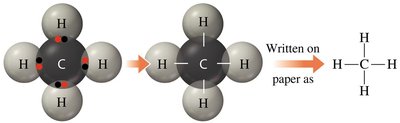
Naming Covalent Compounds: Name the first element, then the second with the ending -ide, and use Greek prefixes to indicate the number of each atom (e.g., carbon dioxide, CO2).
Prefixes: mono- (1), di- (2), tri- (3), tetra- (4), penta- (5), hexa- (6), hepta- (7).
Distinguishing Compounds: Determine if a compound is ionic (metal + nonmetal) or covalent (all nonmetals) before naming.
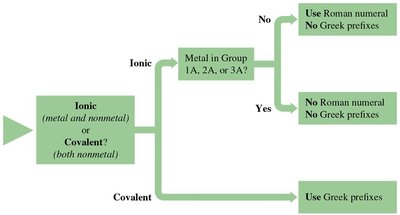
Summary Table: Greek Prefixes for Covalent Compounds
Prefix | Number |
|---|---|
mono- | 1 |
di- | 2 |
tri- | 3 |
tetra- | 4 |
penta- | 5 |
hexa- | 6 |
hepta- | 7 |
Key Equations and Concepts
Maximum electrons per energy level:
Octet Rule: Atoms gain, lose, or share electrons to achieve eight valence electrons.
Charge of main-group ions: For cations (Groups 1A–3A): For anions (Groups 5A–7A):
Additional info: These notes cover the foundational concepts of electron arrangements, ion formation, ionic and covalent bonding, and the rules for naming and writing formulas for compounds, as outlined in a typical GOB Chemistry curriculum.
